It is perhaps a strange question to ask, with the dust not even settled, the riders still breathless, chafed and full of lactic acid from scaling Alpe d’Huez, but how will the 2015 Tour de France be remembered? With Chris Froome in yellow, Team Sky – and, by current extension, British cycling – are firmly back on their perch. Considering the quality of the field, studded with Grand Tour champions, that is some feat.
Poor Froomedog. Ostensibly one of the least offensive, most humble sportsmen of modern times, what is his reward? He has had urine thrown in his face and had another spectator spit on him on Saturday. He has been remorselessly attacked day-in, day-out by this generation’s three most durable stage-racers and then, after being given some flowers and a stuffed toy, the world’s media. It is hard to prove yourself as a charismatic, exciting rider – which you could make a case for – when you’re wiping yourself down from bodily fluids and everyone is interested only in your power data.
But while the dramatic, penultimate stage to Alpe d’Huez and Nairo Quintana’s desperate last bid will live long in the memory, the 102nd Tour de France has been about more than the battle of the Fab Four (Froome, Quintana, Alberto Contador and Vincenzo Nibali). For me – and, as the author of a book about the Rwandan cycling team, I might be biased – one story has stood out: the ridiculous overachievement of the MTN-Qhubeka squad. The first properly African team to ride the Tour de France is competing in the event because of a wild card.
Now, wildcards in the Tour tend to have about as much impact as wildcards at Wimbledon. At best, they get their face on television for a few hours and pocket a bit of prize money.
But MTN-Qhubeka have proved different. Before Friday’s stage, they were placed second in the team classification, behind Quintana and Alejandro Valverde’s Movistar and ahead of Team Sky. (Their riders had a long afternoon on La Toussuire and slipped to fifth.) To give that some context: the Murdochs hand Dave Brailsford a budget of around £21m each year; MTN-Qhubeka makes do with less than a third of that.
In the early days of the US Postal Service team, Lance Armstrong dubbed them the “Bad News Bears” – after the 1976 film about a ramshackle baseball team led by an alcoholic Walter Matthau – with their “mismatch of bikes, cars, clothing, equipment”. MTN-Qhubeka, though, are a much closer incarnation of the Bad New Bears. Their squad is made up, for the most part, of rejects and nearly men from other teams (sorry, Edvald Boasson Hagen and Tyler Farrar, but them’s the facts) with a couple of riders from Eritrea (aka “Africa’s North Korea”). And for most of the Tour, this mob was, by one calculation, outperforming the most high-tech outfit ever assembled in the history of cycling.
I am not going to overstate the significance of the team classification competition. It does not even have a fraction of the lustre of Formula One’s constructors’ championship. According to legend, Henri Desgrange, the founder of the Tour de France, disagreed with the very concept of teams in his race; they detracted from the ultimate individual endeavour.
The sole perk it bestows is that riders of the best team wear black-on-yellow back numbers (instead of white ones) and they can also wear yellow helmets, if they like. The only person ever to publicly declare his desire to win the team classification was Armstrong again, back in 2010, when his comeback was dramatically hitting the skids.
But MTN-Qhubeka has backed up its overall consistency with some spectacular individual performances. Team principal Douglas Ryder has aggressively insisted to his riders that they need to be represented in the breakaway every single day. And, to a large extent, they have been.
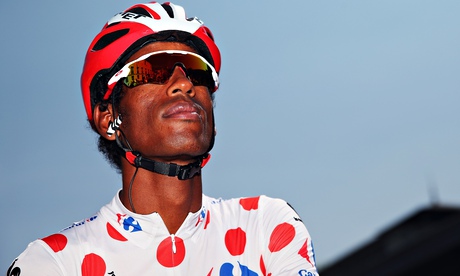
Daniel Teklehaimanot, one of the Eritreans, buried himself on stage six to lead the mountains classification, becoming the first African to wear the polka-dot jersey. Even this achievement was eclipsed on stage 14 – what Ryder calls “the Mandela Day stage”, on the anniversary of the South African president’s birthday – when the 34-year-old British journeyman Steve Cummings, a Bad News Bear if ever there was one, took off on the airport runway at Mende and won the biggest victory of his career.
It is inevitable to wonder about the longer-term significance of MTN-Qhubeka’s efforts. That their riders are unfancied – and no legitimate threat – means the team has a freedom that it would not have if it were more successful. But what has been really impressive is its indefatigable spirit. Three-week cycling races are attritional but MTN-Qhubeka are representing a continent and seem to be inspired by that every day.
For Ryder, though, African riders are here to stay. “I believe we could see a podium finish in the next three to five years,” he said. He even regards Merhawi Kudus, the 21-year-old Eritrean who is the youngest competitor in this year’s event, as a possible future winner. “He has the potential to be one of the best stage-race riders in the world.”
Chris Froome, perhaps relieved for once not to be discussing urine or spit or wattage-per-kilo, agreed. “I believe riders from East Africa are potentially the best in the world,” he said. “I don’t think it’s too long before we start to see some real talent coming out of east Africa.”
Perhaps, in years to come, it will be this subplot that really marked out the 102nd Tour de France.
Land of Second Chances by Tim Lewis (Yellow Jersey Press) is out now