KUMAMOTO -- Wednesday's eruption of Mt. Aso in Kumamoto Prefecture sent stunned visitors fleeing and stoked fears among local businesses still reeling from the novel coronavirus pandemic.
Experts are warning people to stay away from the volcano, which roared as black volcanic smoke billowed out and volcanic rocks were sent flying from the Nakadake peak.
A 52-year-old visitor from Suma Ward, Kobe, witnessed the eruption from a spot about three kilometers from the crater.
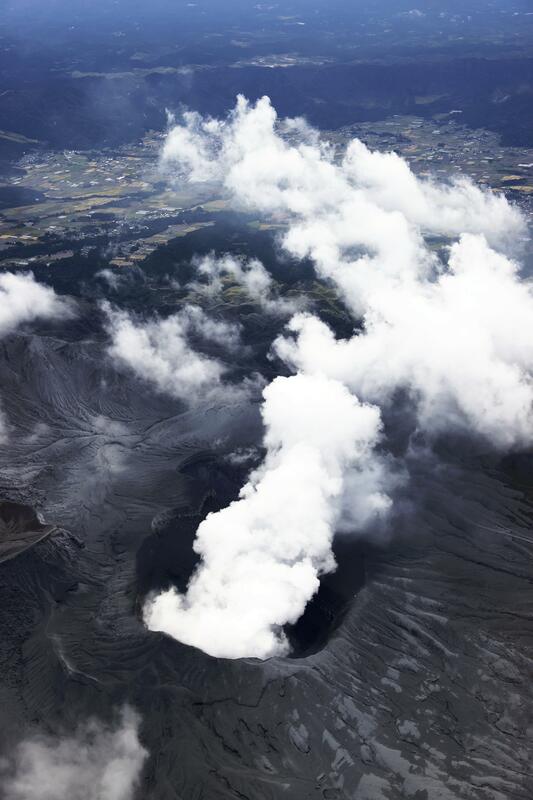
"I heard a loud rumble, and I saw plumes of black smoke rising into the air. It was scary," said the man, who was traveling through the area by motorcycle.
He said he could see what appeared to be lightning in the clouds of volcanic smoke, which soon turned the sky dark. He rode his bike away from the area when he saw other people fleeing.
Thirty-nine-year-old Tsuyoshi Nomura from Matsusaka, Mie Prefecture, was also on a long-distance motorcycle trip at the time of the eruption. He said he did a U-turn when he saw huge plumes of black smoke suddenly belching out of the volcano. "I'm glad the volcanic ash didn't come in this direction," a visibly relieved Nomura said.
About 30 tourists temporarily took shelter inside the Aso Volcano Museum, which is a few kilometers from the crater. "I was astonished to see great columns of smoke billowing into the air," said a 71-year-old employee at the museum.
Following the eruption, the Japan Meteorological Agency raised its volcanic alert for Mt. Aso from Level 2, meaning people should stay away from the crater, to Level 3, meaning people should stay away from the mountain.
The move, which comes just as visitors had started returning due to the recent decline in coronavirus cases, has raised concerns in the local tourism industry.
The proprietor of the New Kusasenri tourist facility in Aso, about three kilometers from the crater, said he told between 10 and 20 tourists to leave the mountain and then evacuated with his staff.
Sales were around 10% of pre-pandemic levels, but there were hopes that a cafe that opened at the facility in September would help to boost business. "The facility hasn't been damaged so we can still operate, but I'm worried that rumors and misinformation might hurt our business," he said.
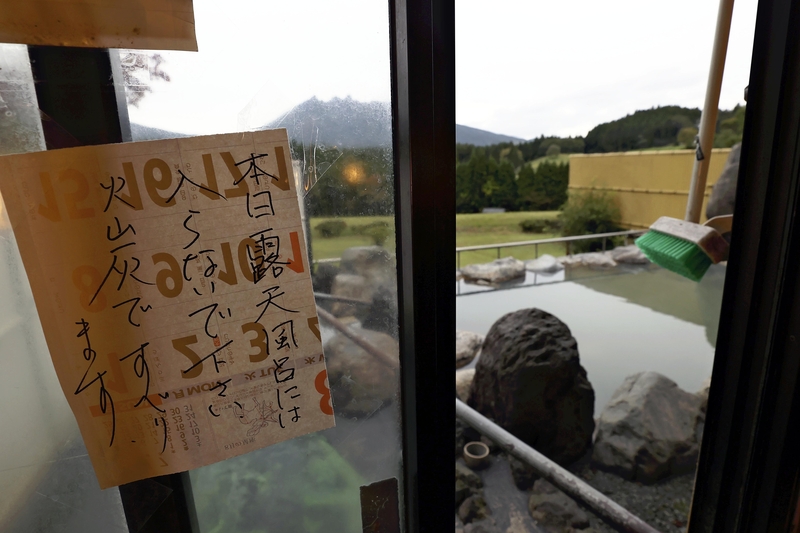
Volcanic ash fell in the outdoor baths at the Tsukimawari hot spring facility in the town of Takamori, Kumamoto Prefecture, about six kilometers from the crater. The facility stayed open but closed the outdoor baths.
It was temporarily forced to close following the powerful earthquakes that battered the prefecture in 2016, and visitor numbers also plunged after the outbreak of the pandemic.
"This feels like a triple whammy of setbacks," said the facility's 68-year-old manager.
SUBHEAD: Predictions difficult
Mt. Aso, which sent volcanic smoke about 3.5 kilometers up into the air in Wednesday's eruption, is one of Japan's most active volcanoes -- along with Sakurajima in Kagoshima Prefecture.
An eruption in October 2016 sent volcanic smoke about 11 kilometers into the air, and eruptions in May 2019 and February 2020 sent smoke billowing about two kilometers high.
University of Tokyo Prof. Emeritus Toshitsugu Fujii, a former chairman of the agency's Volcanic Eruption Prediction Liaison Council, said people should not go near the volcano.
"This eruption doesn't seem remarkably large compared with previous eruptions, but the volcano did erupt about one week ago and further eruptions are possible. There are fears pyroclastic flows could increase in scale, so I urge people to stay away from the volcano," Fujii said.
According to Takahiro Yamamoto, deputy director of the Research Institute of Earthquake and Volcano Geology at the National Institute of Advanced Industrial Science and Technology, eruptions accompanied by pyroclastic flows -- like the latest eruption -- sometimes occur.
Three people died in one such eruption on Mt. Aso in 1979.
"Although this eruption wasn't large, [such eruptions] are difficult to predict so they can be considered the most frightening type from a disaster prevention perspective," Yamamoto said. "They can occur just when a volcano is becoming increasingly active."
Prof. Takahiro Okura at Kyoto University's Aso Volcanological Laboratory, which is in Kumamoto Prefecture and monitors Mt. Aso, said: "This eruption is of a similar scale to one in September 2015, which deposited ash as far away as Fukuoka Prefecture. The volcano emitted up to 100,000 tons of volcano ash, according to estimates."
Read more from The Japan News at https://japannews.yomiuri.co.jp/