The Cabinet's Friday decision to dispatch Maritime Self-Defense Forces personnel to the Middle East was the result of careful consideration to satisfy two different requirements -- making contributions to the security of sea lanes in the region, as requested by the United States, and maintaining friendly relations with Iran, with which Japan has distinctive diplomatic relations.
Not part of U.S.-led initiative
"The selection of areas where the MSDF engage in operations must be made in coordination with past and future diplomatic efforts," Defense Minister Taro Kono said at a press conference after the Cabinet approval, acknowledging in effect that the Strait of Hormuz and the Persian Gulf were excluded from the scope of the MSDF's information-gathering activities out of consideration for Iran, which opposed the activities of foreign vessels in these areas.
The MSDF's not participating in Operation Sentinel, which is based on the U.S.-led marine security initiative, is also meant to not provoke Iran, which has strongly criticized the plan.
Thanks to these efforts, Iran has expressed understanding of the dispatch of MSDF personnel to the Middle East.
Information sharing
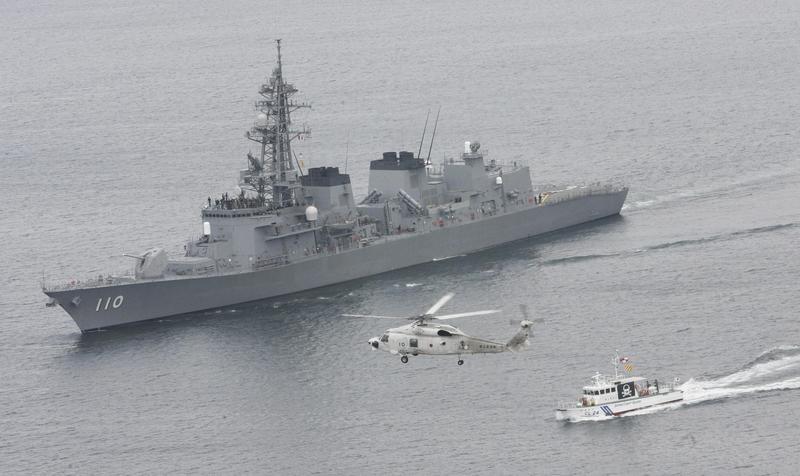
The government will send the MSDF's Takanami destroyer to the Middle East. Using radars and surveillance helicopters, the Takanami will gather information on the situation of the area as well as the type, location and course of vessels cruising in it. Two P-3C patrol planes currently engaged in an anti-piracy mission, will also take part in information-gathering operations. The P-3C planes will conduct patrolling and surveillance activities from the air about 20 times a month.
The government plans to share information obtained through these activities with the United States, Britain, Australia and other countries participating in Operation Sentinel. Japan will contribute to the operation through information sharing and engagement in patrolling and surveillance activities in some areas.
Kono said that information related to the Persian Gulf can also be exchanged with relevant countries. The government plans to obtain information from the United States and other countries, and use the information to ensure the security of Japan-related vessels.
Contingencies
If necessity arises, the MSDF operation will be switched to maritime patrol activities. In such a contingency, activities in the Strait of Hormuz will not be ruled out. "We cannot abandon Japan-related vessels," a source close to the government said.
In principle, the MSDF will use weapons only to protect Japanese-registered ships in maritime patrol activities.
According to the government, about 3,900 Japan-related vessels, including about 2,600 tankers, sail through the Strait of Hormuz annually. About 20 percent of all tankers sailing through the strait are Japan-registered.
The MSDF will not take any measures with force against vessels attacking Japan-related foreign-flagged vessels. It will only approach or warn them, and ask the United States and other countries to take appropriate measures when necessary.
The MSDF will use weapons in accordance with Article 95 of the Self-Defense Forces Law in case an MSDF destroyer is collided with or attacked.
Since responsibility for such attacks is hard to determine, the MSDF will take measures different from those taken in anti-piracy operations, in which all ships are subject to protection.
Read more from The Japan News at https://japannews.yomiuri.co.jp/