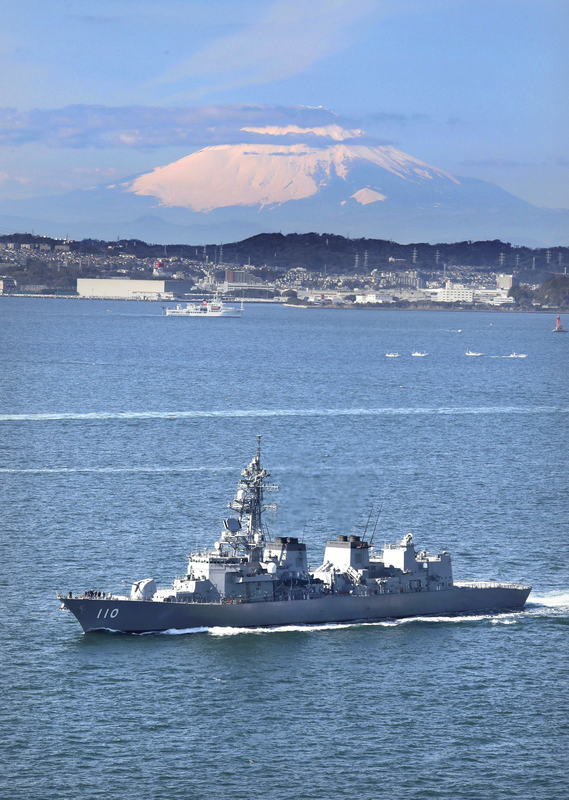
The dispatch of a Maritime Self-Defense Force destroyer to the Middle East was based on the "survey and research" provision stipulated in the Defense Ministry Establishment Law. It was the first time this provision was used for an extended dispatch and it was difficult to draw up a code of conduct for units to prepare for unexpected contingencies. Cooperation with the United States will be key to the SDF's activities in the Middle East.
'Japan's lifeline'
"The sea that you travel to is a main artery that supports the lives of the Japanese people, waters that can be called a lifeline," Prime Minister Shinzo Abe said at a ceremony Sunday to mark the departure of the destroyer Takanami. Inspecting parts of the ship such as the bulletproof glass windows of the bridge of the destroyer, Abe underscored the significance of sending SDF personnel to the Middle East.
Japan depends on the Middle East for 88% of its crude oil imports. About 3,900 Japanese-affiliated ships pass through the Strait of Hormuz annually, including about 2,600 tankers. Through the gateway to the Red Sea, the Bab el-Mandeb Strait off Yemen, about 1,800 Japanese-affiliated vessels pass. Abe has emphasized that the safe passage of these ships is vital.
After arriving in the Middle East, the Takanami will conduct activities in waters suitable for monitoring sea-lanes where a large number of Japan-related vessels sail. Using radar and the destroyer's helicopters, the MSDF will continuously collect information on the situation in the sea-lanes and surrounding waters, as well as on the presence of unusual events such as the approach of unidentified vessels.
Use of weapons
The dispatch of MSDF units is based on Article 4 of the Defense Ministry Establishment Law, which stipulates the "conducting of survey and research necessary for performing affairs under its jurisdiction." In principle, the use of weapons by the SDF is not permitted. When the SDF is attacked, the SDF must defend itself under Article 95 of the Self-Defense Forces Law, but in the event of an unforeseen situation, the conduct will switch to maritime policing actions.
SDF units act in accordance with the code of conduct for units stipulated under domestic and international laws, including the Self-Defense Forces Law. The code of conduct stipulates in detail the scope of SDF activities and the types of weapons to be used. This time, when performing maritime policing actions, weapons will only be used to protect Japanese-registered ships.
A senior MSDF source said, "The code of conduct for the unit became more complicated than anti-piracy operations."
Hormuz excluded
The survey and research provision also applies to surveillance in waters near Japan and to intelligence gathering on smuggling by North Korea in international waters. This is the first time that a Cabinet decision has been made, although it can be implemented by order of the defense minister. This is in consideration of the Liberal Democratic Party's ruling coalition partner Komeito, which calls for thorough civilian control.
"There is a limit to observing a vast sea area with one destroyer and two patrol planes," a senior Defense Ministry source said. Its information-gathering capability is limited, and the Strait of Hormuz, a main artery for crude oil transportation, is excluded from its operations.
"Does it make sense to gather information that doesn't go to the most important places?" a former Defense Minister said.
Cooperation with the United States, which has one of the best surveillance capabilities in the Middle East, is indispensable. In consideration of friendly relations with Iran, Japan has decided not to participate in the U.S.-led Operation Sentinel. However, Japan hopes to share with the U.S. the information gained from the destroyer's dispatch to complement efforts to gather information in the Middle East.
Read more from The Japan News at https://japannews.yomiuri.co.jp/