Afternoon summary
- MPs have voted in favour of the government’s plans for ‘English votes for English laws’, which will create new stages in the legislative process where the Speaker declares a Bill, or clause within a Bill, is English or English and Welsh only. All MPs will continue to speak and vote on the existing legislative stages but only relevant MPs will be allowed to vote at the new phases. The new system was voted through by 312 to 270, a majority 42, after a four hour debate in which SNP MPs complained that the measures would give them second class status in Westminster. The changes, which will be in place for a year before review, seek to address what is known as the West Lothian question, which refers to the anomaly where Scottish MPs in Westminster can vote on matters such as health or education in England, but English MPs cannot do likewise on issues devolved to the Scottish Parliament.
- An early warning system for benefit claimants facing sanctions is to be trialled in response to claims that an excessively punitive and bureaucratic system is driving some claimants deeper into poverty. The work and pensions secretary, Iain Duncan Smith, has announced that claimants will be given a “yellow card” 14 days before their benefits are reduced. The warning allows them time to give a good reason for failing to meet the commitments they must make in return for getting benefits. Under current rules, sanctions are applied immediately.
- A report on sugar’s ruinous health effects that was controversially delayed by Jeremy Hunt has urged ministers to impose a sugar tax. It also pushes for a crackdown on the marketing of unhealthy products to children and two-for-one deals in supermarkets in an effort to tackle childhood obesity. The report, compiled by Public Health England (PHE), the government’s advisory group, sets out a range of tough policies that it says need to be implemented to reduce the consumption of sugary foods and drinks that are fuelling the obesity crisis and costing the NHS £5.1bn a year.
- This morning commons speaker John Bercow ordered a Foreign Office minister to respond to an urgent question about the imprisonment of the human-rights lawyer Zhang Kai. MPs from all sides demanded to know whether Cameron had raised specific human-rights issues during the state visit of President Xi Jinping. In a sign of the concern on Conservative benches, it was Fiona Bruce, a Tory MP and the chairwoman of the party’s human-rights commission, who tabled an urgent question warning ministers not to be silent on human rights in China, which brought the Foreign Office minister Hugo Swire to the house.
That’s all from me for today. Andrew Sparrow will be back anchoring the politics live blog on Monday. Thanks for all your comments.
Labour’s Chris Bryant asks the Speaker whether he will be making a statement on Monday about the new procedures. John Bercow says that it is “not immediately obvious to me that it is so urgent as to require a statement on Monday”. He says it may be what the speaker’s office calls UIMM – “urgent in mind of member”.
The SNP’s Pete Wishart asks the Speaker whether there will be written guidance to MPs on the new EVEL rules. He says there are number of bills coming up in the near future to which the new rules will apply. Bercow says he will provide guidance where necessary.
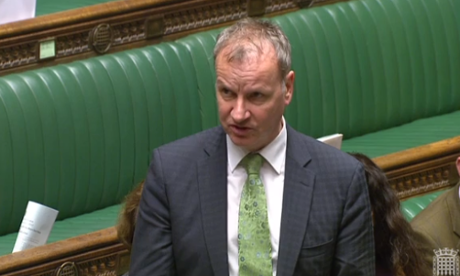
Chris Grayling says that the clerks in the House of Commons have been doing “extensive work” to prepare for the possibility of the motion passing.
MPs vote for EVEL plans
MPs vote 312 to 270 in favour of EVEL plans.
History made today. For first time ever parliament restricts rights of Scottish MPs to represent their electors. Tories win 312 to 270 #EVEL
— Tommy Sheppard MP (@TommySheppard) October 22, 2015
312 Yes, 270 No #EVEL So much for being an equal partner in a family of nations. Some nations are more equal than other it would seem....
— Richard Arkless MP (@ArklessRichard) October 22, 2015
#EVEL will out: 312 votes to 270 Just have to figure out what that means. Ah a handy graphic... pic.twitter.com/lPgh8JbRJ5
— #SunNation (@SunNation) October 22, 2015
Updated
A Labour amendment suggesting English MPs be given the chance to debate and suggest revisions, rather than block legislation entirely, has been rejected by MPs by 312 votes to 269.
MPs are now voting on the main motion.
MPs are now voting on a series of amendments to the EVEL plans and the motion as a whole. It may take a while to get a clear result. In the meantime, here’s the Guardian’s Politics Weekly podcast to keep you busy.
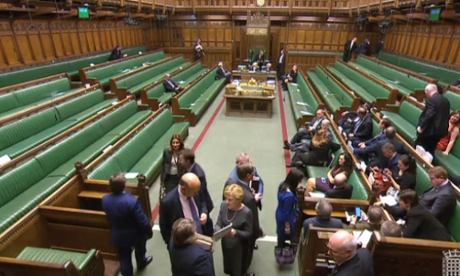
Kate Devlin, Westminster correspondent at The Herald, says Tory rebels may have been pulled back into line –
Labour sources say they believe Tories will win #evel vote after a number of Tory rebels suggest they will back the government
— Kate Devlin (@_katedevlin) October 22, 2015
The shadow leader of the house of commons tweets –
EVEL debate has been profoundly bitter. I fear this will put a worm of grievance in people's heart. It's a charter for breaking the Union.
— Chris Bryant MP (@RhonddaBryant) October 22, 2015
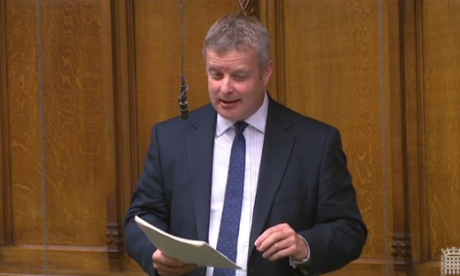
Chris Davies, Conservative MP for Brecon, says: “what is fair about this bill?” He says that he is a Welsh MP in a constituency bordering England and has constituents whose children who go to school across the border. His wife goes across the border to work in Hereford hospital and treats his constituency on a daily basis, he says.
Davies says he will have to tell his constituents: “This does affect you, but sorry the house says it does not relate to us, so there’s nothing I can do.”
Labour MP Wes Streeting interjects to correct Davies that the proposals are not contained in ‘a bill’ and that if it were MPs would be able to go through it and work out the complexities.
Davies says he cannot fault the principle of the proposals, but that he is being asked to vote to “turn down” his voice and the voices of his constituents in Westminster. He urges his colleagues “not to vote on this for political reasons, but because it’s the right thing to do. I believe that this bill is a start, but it is by no means the end of this debate.”
I’m not sure if that means he’s voting for or against.
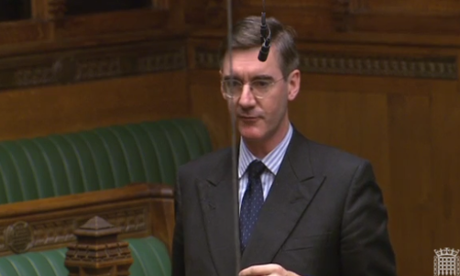
Conservative MP Jacob Rees-Mogg says that the “price of the union” for England is asymmetrical devolution and that “by virtue of being over 80% of the population and the richest part of the union” England cannot be afforded the same level of devolution as it would “overwhelm” the other parts of the UK. He says he therefore appreciates the proposals because of their “modesty”.
Updated
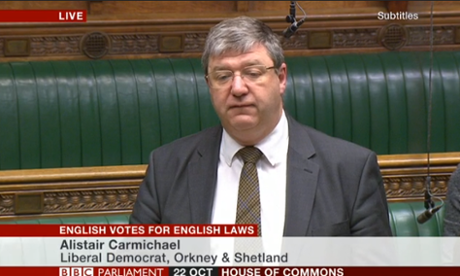
Back to the debate currently going on in the commons – Alistair Carmichael, a Liberal Democrat MP, says that the government would do well to listen to Conservative peers in the Lords, some of whom expressed doubts about the EVEL plans yesterday.
He quotes Lord Forsyth of Drumlean, who said:
I really do think that constitutional change should carry consensus. If we proceed on the basis that we think it would be a good wheeze to make a constitutional change or that it might advantage one party or another, then other parties will do the same when they are in power. As a result, people will lose faith in the integrity of the institution and it will be greatly damaged.
He says its the first time he’s quoted Lord Forsyth with approval, but “these are clearly extraordinary times”.
Updated
Danny Alexander in running for China bank role
Bloomberg is reporting that former Liberal Democrat chief secretary to the Treasury, Danny Alexander, is in the running join China’s Asian Infrastructure Investment Bank. According to “two people familiar with the appointment process”, the government is considering putting Alexander forward for one of a small number of non-Asian seats on the development bank’s board. Alexander, who is 43, was rewarded for his time working in the coalition with a knighthood in the dissolution honours list.

Updated
Lunchtime summary
- MPs have been debating the government’s ‘English vote for English laws’ plans in the commons. Shadow leader of the house of commons, Chris Bryant, has said that Conservative MPs will “rue the day” if they vote for the measures because they constitute “a charter for breaking up the union, not for keeping it together”. MPs will start voting on the proposals at around 4pm.
- Commons speaker John Bercow ordered a Foreign Office minister to respond to an urgent question about the imprisonment of the human-rights lawyer Zhang Kai. MPs from all sides demanded to know whether Cameron had raised specific human-rights issues during the state visit of President Xi Jinping. In a sign of the concern on Conservative benches, it was Fiona Bruce, a Tory MP and the chairwoman of the party’s human-rights commission, who tabled an urgent question warning ministers not to be silent on human rights in China, which brought the Foreign Office minister Hugo Swire to the house.
- Meanwhile, George Osborne has been appearing in front of the treasury select committee to give evidence on the Bank of England bill. Osborne told MPs on the committee that he is “comfortable” with his cuts to tax credits, despite pressure from some of his own Conservative colleagues to soften the impact on the lowest paid. “This is fundamentally a judgment call, and I’m comfortable with the judgment call that I have made, and that the House of Commons has supported this week,” he said. Osborne also welcomed the intervention of Bank of England governor Mark Carney in the debate about Britain’s future in the European Union, saying it was “a very welcome addition” to the national debate.
- Theresa May has publicly criticised claims made by Britain’s most senior police officer that a rise in knife crime is linked to falls in stop and search, branding them as a “kneejerk reaction” and “false”. In a combative speech this morning, May criticised the race record of the police in England and Wales, saying they are too white, with not one of the 43 forces looking like the communities they serve.
Updated
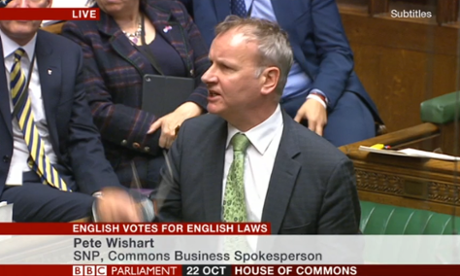
Tempers in the chamber are getting a bit frayed. Labour MP Graham Allen intervenes in Wishart’s speech to say: “The honourable gentleman is posing as a second class member of parliament but he is getting a first class allocation of time.”
Pete Wishart responds:
Can I say ever so gently to the honourable gentleman, this is being done to us... and it’s taken a hour and a half and six speeches before it comes to a Scottish member of parliament, so we will take our time and I won’t be rushing for the honourable gentleman.
Labour MP David Hanson says that Campbell-Bannerman, Asquith, Lloyd George, Brown, Callaghan, Gladstone and Churchill, all served as prime minister of the United Kingdom while representing a constituency in Scotland or Wales. Could this ever happen again?, he asks.
The SNP’s Pete Wishart says:
I don’t. I have to say quite candidly to the honourable gentlemen. It would be absurd for a Scottish member of parliament to be a secretary of state for health and education when he would be debarred from full voting entitlements when it comes to getting legislation through the house... I don’t think there’ll ever be a Scottish prime minister.
Father of the House Sir Gerald Kaufman describes #evel debate as "one of the nastiest, most unpleasant debates I have attended in 45 yrs"
— Kate Devlin (@_katedevlin) October 22, 2015
Tory Bernard Jenkin says "in danger of putting Speaker in impossible position" on #evel and "we are inviting" poss judicial review
— Tim Reid (@TimReidBBC) October 22, 2015
SNP MP Pete Wishart says the govt's Evel plans are "meagre, threadbare, inept and stupid"
— Chris Mason (@ChrisMasonBBC) October 22, 2015
Chris Grayling intervenes to say that the top up fees bill in 2004 would not have been passed if it wasn’t for Scottish MPs. Bryant insists it wouldn’t. He says it passed very easily at earlier stages and that the EVEL proposals don’t cover second and third reading, so wouldn’t have made any difference to the outcome.
Bryant says that this isn’t a move towards devolution, it simply retains power here in Westminster. There should be line-by-line consideration of relevant legislation by an England only committee, he says. “There should be a voice, so not a veto,” says Bryant.
This is the biggest constitutional change for quite some time... and it is being introduced without a constitutional convention...
It’s a bureaucratic nightmare and I think the honourable members will regret it... it’s as if the prime minister has decided to fashion a new grievance for Scotland and god knows they’ve never needed a new grievance, because he wanted to antagonise them...
Conservative and Unionist members will, in the end, rue the day if they vote for these measures because this is a charter for breaking up the union, not for keeping it together.
Updated
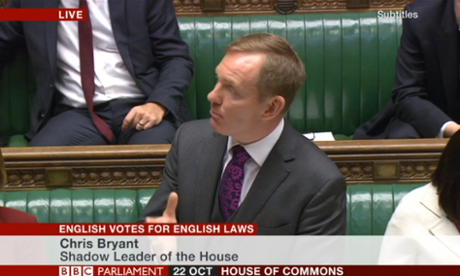
The measures will not deliver the government’s aim, says Bryant. He points to this research from the house of commons library, which we mentioned earlier.
Bryant says that the higher education bill in 2004 would not have been effected by these measures. Some MPs have claimed in debates that that bill (which introduced £3,000 tuition fees) would not have passed its second reading if it wasn’t for Scottish Labour MPs voting for it.
“That vote would not have been changed by these proposals, would it? He need only nod,” he says to Grayling. Grayling shakes his head and says “it would have”. “No because it was at second reading and second reading isn’t covered, a point he’s made several times. He doesn’t understand his own provisions that he’s bringing forward this afternoon.”
Updated
Bryant says that Grayling chose not to go into any detail on what exactly his proposals entail because they are so incredibly complicated.
This is a dangerous road to go down because it will set a worm of grievance into the hearts of many.
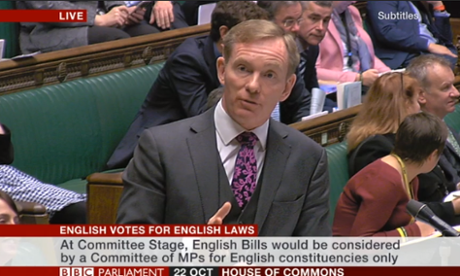
He says that the measures will politicise the speaker and will open up his judgement to being questioned in a court of law.
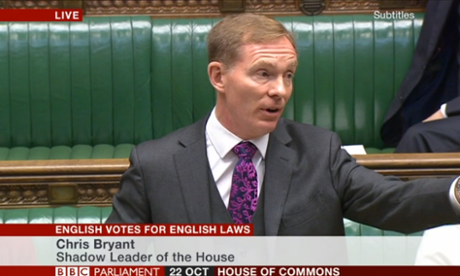
Chris Bryant:
Because our constitution is unwritten we shouldn’t enter into major constitutional change unadvisedly or lightly, but – in the words of the prayer book – discretely, advisedly and soberly. That means the government of the day should, where it possibly can, proceed on a cross-party basis and, where it cannot do so, and especially where one party alone holds a view, it should proceed with extreme caution.
Updated
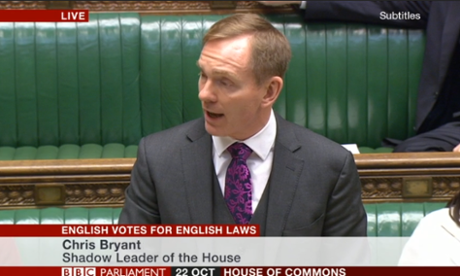
Shadow leader of the house of commons, Chris Bryant, says that he passionately supports the union, but also supports devolution to Scotland, Wales and Northern Ireland.
I believe that England should have a clear and distinctive voice in this parliament. For that matter, I also believe that power, responsibility and finance should be devolved further within England because we are, and have been for far too long, a very centralised state.
All MPs are equal...I believe that overturning that equality of all members that has withstood an 800 year test is a big step to take.
Updated
The public is on our side on this issue, says Grayling. He says that the fact that the Conservatives are in government demonstrates that they are more in touch with public opinion than the opposition. Chris Grayling concludes:
We are going to hear much this afternoon about how this will create a different class of MPs...the truth is Madam Deputy Speaker, is that this is actually nonsense. Despite all the rhetoric our proposals do none of that. They bring fairness to our devolution settlement and it’s fairness that will secure the future of our Union.
Grayling: "I am entirely comfortable as a unionist in presenting these to this house, no matter what some on the other side might say" #EVEL
— Libby Brooks (@libby_brooks) October 22, 2015
Conservative MP John Redwood says English Labour MPs should be ashamed of their party’s position. Grayling says Labour’s opposition baffles him as it gives English MPs the same rights as MPs from other countries in the UK.
John Redwood on #evel "England has waited 18 years for some justice"
— Kate Devlin (@_katedevlin) October 22, 2015
Angus MacNeil MP says that, seeing as he wants English votes for English laws, could the Scottish get Scottish votes for Scottish laws. Grayling replies that Scotland, Wales and Northern Ireland all have devolved governments, so why shouldn’t England have more controls over its own matters.
Updated
Conservative MP Edward Leigh says he is grateful to Grayling for listening so carefully to the views of MPs. “He’s actually a model minister in that respect.”
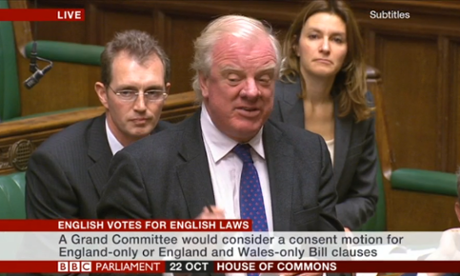
Grayling says Scots & Welsh MPs wd still be able to be English Health Sec (despite, at times, not being able to vote on own policies.)
— Kate Devlin (@_katedevlin) October 22, 2015
Grayling says #evel could affect 3 or 4 bills in the next few months; snp claim that could mean housing bill within the next week
— Tim Reid (@TimReidBBC) October 22, 2015
Grayling: #evel is "process of development" and if there is issue of financial implications for Scotland/Wales then "we will return to it"
— Tim Reid (@TimReidBBC) October 22, 2015
Conservative MP Mark Spencer asks Chris Grayling if the nickname for the proposals should be changed. For some reason he doesn’t think ‘EVEL’ has helped the government’s cause. He suggests that ‘Laws Only Votable in England’ might be a good replacement – so, LOVE. Chris Grayling says that he was not responsible for the name and so can’t do anything about it.
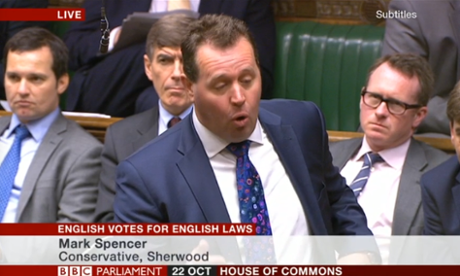
Grayling says that it is untenable to say that devolution for Scotland, Wales and Northern Ireland is a good thing, but it’s not appropriate to England.
Updated
MPs debate plans for 'English votes for English laws'
Chris Grayling, leader of the house of commons, says he is a staunch unionist and he thinks the whole of the UK is stronger than the sum of its parts.
He says he will always cheer for the nations of the United Kingdom in sports.
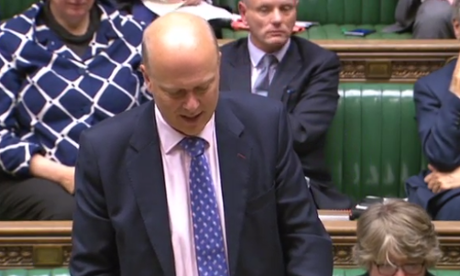
Somebody shouts at Grayling to “sit down” and gets a telling off from the deputy speaker. Kevin Brennan MP is then forced to apologise for saying “shut up”.
Tempers fraying in #evel debate almost immediately. Labour MP Kevin Brennan forced to apologise for telling Grayling to "shut up".
— Kate Devlin (@_katedevlin) October 22, 2015
Updated
TheGreatBaldo and Tenthred, who have been commenting below the line, have drawn my attention to this House of Commons library research on the number of bills that will actually be affected by the EVEL plans. Between June 2001 and March 2015, the outcome of 0.7% of votes would have been different if the votes of Scottish MPs not been counted.
Six of 19 governments since 1945 have had a sufficient number of MPs in England to form a UK majority consisting of English MPs only. Of these six governments two were Labour administrations, three Conservative and one the current Coalition...
Of approximately 3,800 divisions to occur between 26 June 2001 and 26 March 2015, 25 (0.7%) would have concluded differently had the votes of Scottish MPs not been counted.
In the 2010-15 Parliament, the lobby in which the majority of English MPs have voted coincided with that of the majority of UK MPs for 99% of divisions. The majority of Scottish MPs has coincided with the majority of UK MPs for 26% of divisions; that of Welsh MPs for 28% of divisions.
Labour MP Jonathan Reynolds describes the nuclear energy deal the UK has done with the Chinese as ridiculous. Swire responds that he does not regard £30bn of Chinese investment into the UK as ridiculous.
Liberal Democrat MP Tom Brake asks Swire about comments by Sir Simon McDonald, permanent secretary at the Foreign Office, that “human rights are no longer a priority for the UK government”. Swire responds that human rights was being brought into the mainstream work of the Foreign and Commonwealth Office because they think it informs everything they do on a day to day basis.
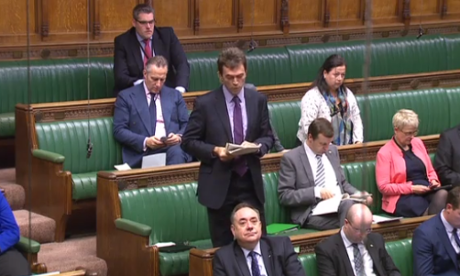
Hugo Swire says that in advance of the Chinese state visit he met with a number of human rights pressure groups.
In response to a question from Conservative MP Peter Bone, Swire says that the UK can show China that there is nothing to fear from freedom of expression. We take our freedoms for granted and should do everything we can to export them abroad, he says.
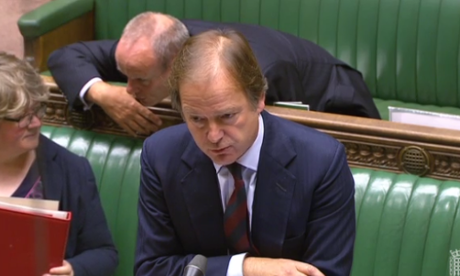
Swire says that Chinese dissident artist Ai Weiwei is wrong to say that the UK government is sacrificing long-term values for short term gains.
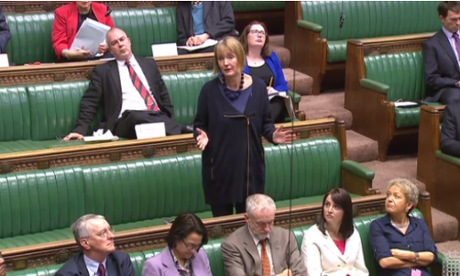
Labour’s former acting leader Harriet Harman says this debate is very important and she’s sure it will be watched in China. She criticises the government’s attack on the Human Rights Act and the use of the term “Labour’s Human Rights Act”.
Frankly, you cannot stand up for human rights abroad if you regard them as a nuisance at home.
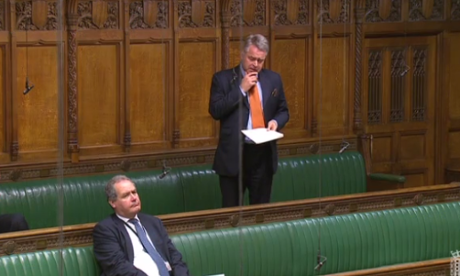
Tory minister Tim Loughton asks about Tibet and the reports that “Chinese state sponsored cheer leaders” were given ‘I love China’ t-shirts and pushed to the front of the crowd, in front of protesters, during the procession along the Mall on Tuesday.
Labour MP Catherine West asks whether UK ministers have had any opportunity to raise issues of freedom of religion in China with the Chinese president. She asks specifically about Zhejiang province and the case of the persecution of christians there.
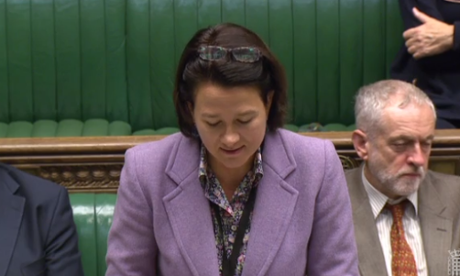
Swire says that the situation in Zhejiang has been raised before in parliament and is worrying.
Conservative MP Edward Leigh says that the persecution of christians in China is the sort of thing that happened in the UK in the 16th century and that the UK must not be afraid of raising these issues with the Chinese because they are trying to develop economic relations.
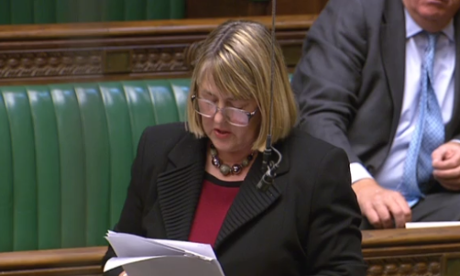
Fiona Bruce is responding to Swire’s answer by listing a string of cases of Chinese citizens being prosecuted for speaking out against the Chinese state. Bruce is the chair of the Conservative Party Human Rights Commission. She quotes Martin Luther King:
In the end we will remember not the words of our enemies, but the silence of our friends.
MPs debate China's human rights record
Fiona Bruce MP is asking her urgent question about the case of lawyer Zhang Kai.
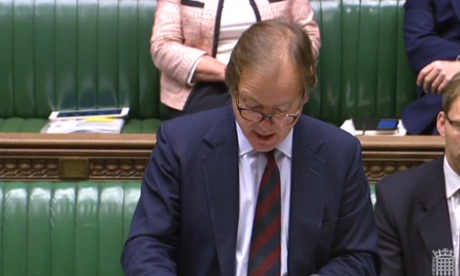
Hugo Swire, minister of state for the Foreign and Commonwealth Office, is answering saying that the UK government is in the middle of a “hugely positive” state visit from China’s President Xi. The strong relationship which the government is building allows the UK to discuss all issues, he says. The government is concerned about the case of Zhang Kai and that his whereabouts are unknown, he says.
Updated
Chris Grayling, leader of the House of Commons, has written for ConservativeHome about the EVEL question:
Issues like health and education have long since been the province of the assemblies and parliaments in Cardiff, Belfast and Edinburgh. We are now moving to a new stage of devolution, with responsibilities also passing for parts of our taxation system as well. Local decision making is at the heart of our strategy in this Parliament.
But England has to be a part of this as well. It cannot be in any of our interests to see English people becoming cynical about the Union. That is why it has been so important to secure what most reasonable people would think to be a fair settlement across the United Kingdom...
It’s simply a question of fairness, of creating fairer Parliaments and Assemblies. We need to give the English a stronger voice on English matters.

Bercow grants urgent question on China
The House of Commons Speaker John Bercow has granted an urgent question on China’s human rights record to Conservative MP Fiona Bruce.
Bercow has been stirring trouble for Cameron during the visit of Chinese president Xi Jinping, making a series of references to human rights and democracy on Tuesday during Xi’s visite to parliament.
A Foreign Office minister will respond to Bruce’s question, which will focus on reports that human rights lawyer Zhang Kai faces a severe prison sentence and a possible death penalty for defending civil liberties.
Bercow's overly firm handshake from yesterday is still making me laugh https://t.co/yRnFQcKg55
— Jess Brammar (@jessbrammar) October 21, 2015
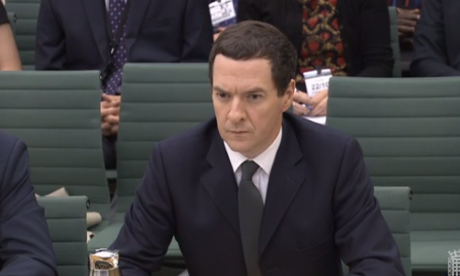
George Osborne has just started giving evidence to the Treasury select committee on the Bank of England Bill. You can get live updates on our business live blog here. You can also watch the meeting here.
Updated
The Fabian Society’s general secretary Andrew Harrop has written a blog post about what EVEL will mean for the Labour party, pointing to the organisation’s Mountain to Climb report, which set out what it will take for Labour to win in 2020.
To win a majority in England under EVEL, an anti-Conservative alliance would need to gain 71 seats. For Labour to win these seats alone, without any gains by the Liberal Democrats, it would require a swing in the key English Lab/Con marginals of 7.5 percentage points. The task would be easier if the Lib Dems and Labour were each able to make gains in England, in seats where they face the Conservatives. If both parties achieved a swing of around 6.5 points this would be sufficient for them to achieve a combined majority in England (Labour would gain around 55 seats; and the Lib Dems 16). This suggests that it is strongly in Labour’s interests for the Lib Dems to stage a recovery in those parts of England where Labour is not competitive, such as the South West.
Looking at these numbers, it is clear that the task of eliminating the Conservative majority could be relatively achievable, even after the boundary changes; while the task of winning a UK Labour majority will be very difficult. This means there is a good chance that no party will win a UK majority in 2020: Labour will need to give careful thought to the many possible scenarios arising from a future hung parliament. EVEL hugely complicates the picture, because it creates the possibility of an anti-Conservative alliance being able to secure a UK majority but not an English majority.
Updated
Today’s Guardian editorial focuses on the EVEL question. Here’s an extract –
The main item on the agenda for the House of Commons on Thursday may seem drily procedural, Westminster-bubble stuff. But the motion “to approve standing orders relating to English votes for English laws”, to be moved by the leader of the Commons, Chris Grayling, plays with constitutional fire. Within the thickets of subclauses and the jungle of parliamentary drafting of these new standing orders lurks a potentially explosive question. Is the Commons becoming the parliament of a state whose constituent nations are now inexorably and antagonistically moving apart from one another?
For a few English voters, English votes for English laws is not a dry phrase. For most Scots, not just nationalists, it certainly isn’t one. David Cameron’s promotion of Evel on the morning after Scotland’s vote to stay in the UK was an incendiary and irresponsible act. In many Scots’ eyes, it instantly undermined the credibility of pro-UK political parties and promises – with consequences that continue to this day. Tory and press fear campaigns against the SNP in the general election added to this further. The standing orders on which MPs will vote on Thursday are not in fact particularly objectionable in themselves. However, in the context of post-referendum distrust they can all too easily be represented, as they are being, as a destructive and hostile partisan act.
Oh dear ...
The good news for @timfarron is he has a whole page piece in @TheSun. The bad news is they've got his name wrong: pic.twitter.com/1rC4cwt2NF
— Chris Mason (@ChrisMasonBBC) October 22, 2015
The Herald has an interesting quote from Scotland secretary David Mundell on the ‘EVEL’ plans. He admits that the current proposals wouldn’t technically prevent Scottish MPs from voting down England-only legislation at the final stage.
Ultimately, Scottish MPs will potentially have the final say as to what the arrangements are for fox-hunting in England, Sunday shopping in England, for the arrangement of the northern powerhouse in England, because all MPs will continue to have all the votes that they currently have.
Updated
MPs will debate the government’s English votes for English laws plans at around 11.30.
The plans to be debated today are a watered down version of the proposals that were presented to parliament in July. The government decided to dilute its plans – including allowing for more time to debate them – after Tory whips warned Downing Street it faced defeat because rebel Conservatives had joined forces with the Democratic Unionist party (DUP).
The debate was delayed until now because there were no more free days to debate before parliament rose for the summer recess on 21 July.
The ‘EVEL’ plans would introduce a new parliamentary stage for laws that only affect England or England and Wales. English and Welsh MPs would have a chance to scrutinise proposed legislation alone first and all MPs would then continue to debate and vote on the legislation at second reading, third reading and report stage.
The SNP’s Pete Wishart has just been on the BBC’s Today programme with Chris Grayling, leader of the House of Commons.
Wishart repeated the argument that the plans would render Scottish MPs “second class in the unitary parliament”, politicise the office of the speaker of the House of Commons and increase the work load of parliament. He also complained that the plans were being “rushed through” in the form of a standing order.
Chris Grayling responded to the criticism that the new plans would politicise the commons speaker – who would have to decide whether legislation effects England only – saying he didn’t think such a judgement call would be “complicated at all”. Grayling said John Bercow would be given recommendations by the civil servants who had drafted the bill as to which parts of the United Kingdom they affected.
Wishart said:
Why not do it yourself? Get an English parliament. Then we can come together in a UK parliament in a federal system and consider all the big issues. What is being proposed is to turn the unitary parliament of the UK into a quasi-English parliament and that’s surely unacceptable.
I’m covering for Andrew this week, bringing you breaking political news as it happens, as well as bringing you the best reaction, comment and analysis from the web.
If you want to follow me or contact me on Twitter, I’m on @fperraudin
Updated