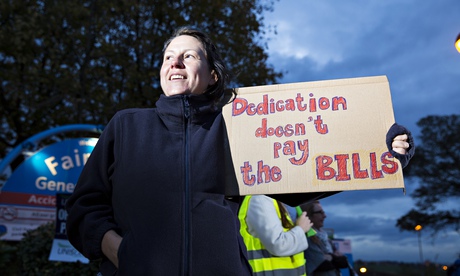
Proposals for a dedicated credit union to help low-paid NHS staff avoid falling into the clutches of costly payday lenders are to be debated by MPs.
Gareth Thomas, Labour MP for Harrow West, is bringing forward a 10 minute rule bill that proposes the setting up of a credit union open to all NHS staff and other care workers. He said such a move would help employees avoid becoming victims of payday loan companies, high-cost bank overdrafts and other expensive forms of credit.
Thomas, whose bill will be debated in the House of Commons on Wednesday, said he was aware of a number of cases of NHS and care staff who had got into financial difficulty and taken out payday loans, but then found themselves in an even worse situation.
Credit unions are co-operatives owned and controlled by their members that have traditionally specialised in loans and savings for the less well-off, but are now targeting people of all incomes with revamped products. Some, such as London Mutual Credit Union, also offer far cheaper versions of payday loans.
There is already an NHS credit union based in Glasgow, which was set up in 1998 and caters for NHS employees and their family members in Scotland and the north of England. However, Thomas said there was a need for one that all NHS staff could join, and his call has been backed by Unison.
“We need to help low-paid NHS and other staff who are looking after our most vulnerable neighbours avoid falling into the clutches of the payday loan companies or using high-cost bank overdrafts and credit cards,” he said.
He said examples of nurses and other care staff who had struggled included:
• Sarah, a 44-year-old community nurse with a six-year-old daughter. In 2010, Sarah’s husband left her. Until then, Sarah’s income of £25,000 a year covered her rent (£825 per month), food and nursery fees, while her husband paid the council tax and fuel bills. When he left, Sarah had to try to find several hundred pounds a month to make ends meet. She immediately struggled to pay her bills and got into arrears with her council tax, electricity and gas. She then found herself getting deeper and deeper into debt and decided to take out a payday loan because she couldn’t afford to pay her daughter’s nursery fees. She found this loan impossible to pay back and subsequently ended up with five loans with different companies, totalling around £6,000. Citizens Advice told her how to apply for a debt relief order, but she decided not to go ahead as she is hopeful that this situation is temporary. In the meantime she has consolidated her debts and is slowly paying back her creditors.
• Jenny, a 40-year-old who got into debt when she decided to work part-time for a spell before returning to full-time work in November 2013. One of her problems is that she is incurring £90 of bank charges each month, even though she has an authorised overdraft. Her bank charges £3 a day for any account overdrawn by more than £3,000 even when the overdraft is authorised, and Jenny is finding it hard to manage. She has been using credit cards to pay for food.