“It’s like it’s taking place on the moon,” said Labour MP Vernon Coaker, exasperated at some of what he was hearing during the inquiry into delivering fair pay being held by the Parliamentary Business, Energy & Industrial Strategy Committee.
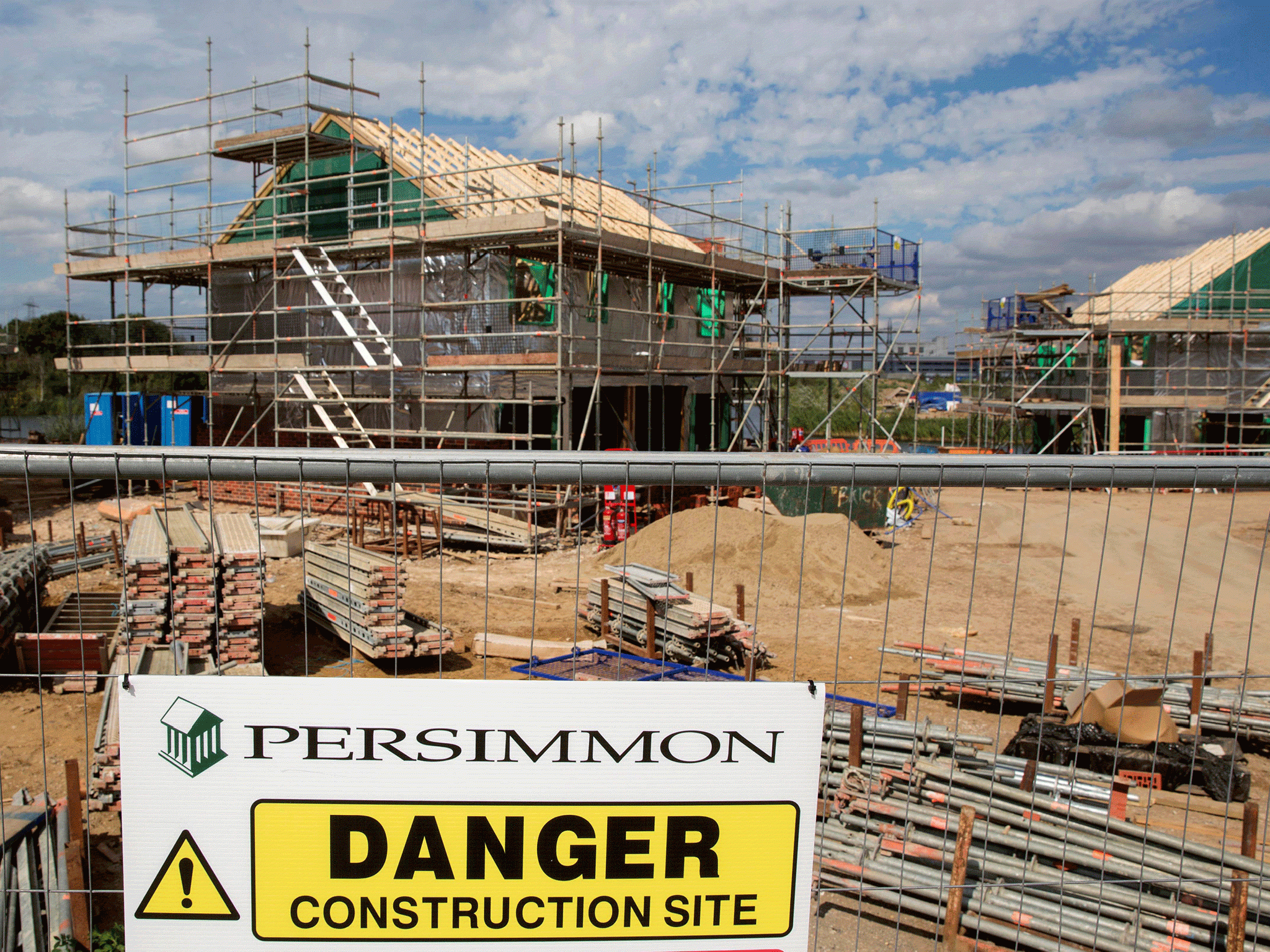
Of course, the most noteworthy part of its deliberations concerns the excessive pay pocketed by the chief executives of Britain’s great companies, a scandal that has recently exploded as a result of the £600m in bonuses Persimmon Homes is paying to a group of just over 100 executives. The CEO alone was due more than £100m until he agreed to take a bit less.
But even after that, and an unspecified charitable donation, Jeff Fairburn's package was still, well, like something from the moon.
Marion Sears, who was installed as chair of its remuneration committee to deal with the fall out after her predecessor resigned, managed to take some of the heat out of that issue by admitting it to be a “debacle”.
But there was plenty for MPs to get cross about all the same. Mr Coaker’s frustration was entirely understandable in the face of the windy talk about pay structures, the role of voting advisers, corporate committees and non executive directors, he was hearing from the fearfully clever, influential and successful people who appeared before him and his colleagues.
They often appeared to struggle with simple questions and their inability to give straight answers rather suggested that some of them are getting paid too much.
That doesn't apply, however, to one Charles Cotton, who boasts the rather grandiose title of senior performance and reward advisor at the Chartered Institute of Personnel & Development.
One of those rather quietly spoken people whose truths sometimes get missed because of that, he got right to the heart of the matter.
Asked more than once whether executive pay is too high, he put it simply: “Yes.”
Forget the talk about structures, and incentives, and global markets for CEOs, and the need to attract and retain top talent, and all the other tired excuses the corporate lobby turns to when it tries to defend the indefensible, some of which were used by Ms Sears, and especially Clare Chapman, who sits on the board of engineer Weir Group and retailer Kingfisher, as well as, ironically, the Low Pay Commission.
Mr Cotton felt no need to fly up to Mr Coaker’s moon. He just said yes. He also quietly explained another truth that those in the remuneration industry, the non executive directors and consultants who sit on and advise pay committees, like to ignore: Booming executive pay hasn’t resulted in better corporate performance, better productivity, or better economic performance more generally.
When it comes to the subject of productivity it may be actively damaging it.
Mr Cotton pointed to evidence that it demotivates staff. Well, yes. Consider the situation at BT, where boss Gavin Patterson admitted the company was under performing and said he needed to sack thousands of people to correct that but still took a bonus and a pay rise for himself. How could that be anything other than demotivating to a hard working member of staff?
That sort of thing is, as another witness opined, also very damaging to the reputation of companies and business generally.
And yet still a tide self justification pours forth from corporate Britain.
Shareholders do have a mandatory vote on pay policy every three years now, and the Investment Association runs a corporate naughty step serving to highlight the really bad cases in which typically somnolent institutional shareholders have been moved to vote against boards in numbers. There have been one or two other reforms too.
But listening to Ms Sears and Ms Chapman, and some of the other witnesses, it is very clear that corporate Britain still just doesn’t get it.
It needs to wake up because we’re getting to the stage where lawmakers might have to force its understanding of the problem.