Summary
-
MPs have backed the government’s recall bill but demanded substantial changes during its second reading debate this afternoon. With Labour backing the bill, it will get its second reading tonight with little or no oppostion. But some MPs did express reservations about the principle during the debate, and others demanded sweeping changes to allow voters, not parliament or the courts, to take the decision that would trigger a recall election. Zac Goldsmith, the Conservative backbencher leading the campaign to amend the bill, told MPs:
I think this shabby pretence at reform needs to be profoundly amended and with the help of a very considerable number of colleagues I hope to do so at the committee stage. And the goal will simply be to put voters in charge but with enough checks and balances to prevent any possibility of abuse. We will attempt to remove the government’s trigger and replace it with a system that allows voters to initiate this process.
He was backed by Douglas Carswell, the new Ukip MP. Carswell said the bill as drafted would have the “precise opposite effect to that intended”.
It is a proposal supposed to make MPs more accountable to voters, but actually leaves the trigger firmly in the hand of Westminster grandees. A measure designed to make MPs answer outward to the electorate ends up actually strengthening the power of whips. It is MPs and whips who will sit in judgment of errant MPs, not voters as this bill is drafted. This is an implausible bill from an implausible front bench with an implausible record on political reform.
The deputy prime minister has spoken of his concerns that real recall might leave MPs subject to partisan pressure, to sectional interests. By leaving it to Westminster insiders to decide who gets to face a by-election, MPs are going to be vulnerable to precisely ... that they most need protection from - the party whips.
- David Cameron has demonstrated his commitment to curbing immigration by giving a peerage to Sir Andrew Green, chair of the MigrationWatch UK thinktank. Government sources have said that Cameron was partly recognising Green’s achievement in raising concerns about immigration when that was politically unpopular. But there have been objections to the appointment from critics who have questioned the quality of MigrationWatch’s research.
-
Nigel Farage, the Ukip leader, has defended Ukip’s decision to form a pact in the European parliament with an MEP from the far-right, Polish Congress of the New Right (KNP) party. He told the World at One:
I have found nothing in this guy’s background to suggest he is a political extremist at all. He has joined our group to save us. All of us in the European Parliament have to make compromises to make sure that our voice is heard. I want us to have our voice, I want us to have a group, but I will not do it at any price. If it came to a decision that do we cast Ukip into the outer darkness of a non-attached group here or do a deal with a known prominent extremist in Europe, I would not do that deal.
But the Board of Deputies of British Jews has described the move as “beyond belief”. (See 3.49pm.)
- The Office for National Statistics has revealed that the state of Britain’s finances deteriorated unexpectedly in September, pushing the deficit 10% higher in the first half of the year and leaving the chancellor further off course in his deficit-reduction plans. Borrowing last month totalled £11.8bn, £1.6bn higher than September 2013 and more than £1bn higher than City economists had forecast, as government spending increased more than the value of its tax receipts.
- The chair of the Government’s historic child abuse inquiry has insisted she does not have a “close association” with Lord Brittan amid calls for her to quit over their social links. As the Press Association reports, Fiona Woolf said the former cabinet minister - who has flatly denied failing to act on a dossier of abuse allegations in the 1980s - was just “one of thousands” of people she knew in London. The corporate lawyer has entertained Lord and Lady Brittan at dinner parties on three occasions since 2008, and dined at their house twice. She also met the peer’s wife for coffee, sat on a prize-giving panel with her, and sponsored her 50 for a fun-run. But the Lord Mayor of London insisted there was nothing in the encounters to stop her chairing the wide-ranging probe ordered by Theresa May. She said she had “gone the extra distance” to declare every possible issue in order to reassure victims.
- Statistics showing cross-border journeys of patients between Wales and England are “incredibly misleading”, Welsh Government officials have insisted. As the Press Association reports, according to figures published today by the Welsh Conservatives, 31,000 people from Wales travelled to hospitals in England for treatment while 8,000 English people made the reverse journey. But the Tories’ decision to release the statistics to the media as the spat between rival administrations in Cardiff and London intensifies has been met with anger from Welsh ministers. A Welsh government spokesman said: “Every year, thousands of English patients are treated in Wales and thousands of Welsh patients are treated in England.” The figures have been highlighted by the Daily Mail, which this week has been running front page stories attacking Labour’s handling of the NHS in Wales. Yesterday the Welsh government issued this statement accusing the Mail of getting its facts wrong.
-
Lord Freud, the welfare minister, has issued a fresh apology for his comments about some disabled people not being worth the minimum wage. He told peers:
I would like to take this opportunity to repeat briefly the apology I made last week.I want to make a full and unreserved apology for the comments that I made at the Conservative party conference. Of course disabled people should be paid at least the minimum wage just like everybody else and I am profoundly sorry for any offence that I have caused.
Updated
Rochester byelection round-up
Here’s a Rochester and Strood byelection round-up.
-
Two election lawyers have told Channel 4 News’s Michael Crick that the Conservatives could be breaking the law on election spending in the Rochester and Strood byelection. The Conservatives are spending a fortune on the all-postal primary that they are using to choose their candidate. They believe this money does not count as byelection spending. But the laywers have told Crick that an election court could decide otherwise. He has explained all this in an excellent blog. Here’s an excerpt:
The Tories insist that the costs of their primary to choose their candidate need not be included within that spending limit. They’re relying, they say, on guidance from the Electoral Commission, which they say stipulates that spending doesn’t count until a candidate is announced.
Ukip, on the other hand, claim they’ve taken legal advice – from a top QC – that says the Tory primary should count towards election costs.
In law, election spending is broadly linked to each candidate. The crucial point here is the definition of what constitutes a “candidate”. The Conservatives say that the two women in their primary election are not candidates, and that they won’t have a candidate until Thursday. Therefore, they argue, they can’t incur election spending until then ...
However, read on. A few lines later, section 90ZA (5) says that the act’s earlier reference to a candidate: “includes (where the context allows) a reference to a person who becomes a candidate at the election after the expenses are incurred.”
So it seems money spent before the candidate is picked might count as an election expense, and that the spending clock may actually have started ticking when David Cameron wrote to every voter last week asking them to take part in the party’s primary.
The Board of Deputies of British Jews has issued a very strong statement condemning Ukip’s decision to form a group in the European parliament including an MEP from the far-right Polish party, the Congress of the New Right. (See 9.42am.) This is from Jonathan Arkush, board vice president.
The Board is gravely concerned by reports that Ukip may sit in the same parliamentary grouping as a far-right Polish MEP in a bid save its funding. Robert Iwaszkiewicz belongs to an extremist party whose leader has a history of Holocaust denial, racist remarks and misogynistic comments. He belongs to the far-right Polish JKM, led by Janusz Korwin-Mikke who has reportedly called into question the right of women to have the vote.
Furthermore, we entirely reject Ukip’s justification that ‘All groups in the European Parliament have very odd bedfellows (and) The rules to get speaking time and funding are set by the EP, not Ukip’. Extremists and racists should be roundly rejected, not embraced. Even France’s far right Front National rejected the JKM as being too extreme.
For Ukip to choose such a figure as Robert Iwaszkiewicz as a bedfellow, apparently for money, is beyond belief. Nigel Farage now has some very serious questions to answer. He has placed in issue the credibility of Ukip.
Back to David Cameron’s decision to give Sir Andrew Green, the MigrationWatch chair, a peerage.
Peter Oborne, the Telegraph columnist, has welcomed the appointment.
Sir Andrew was for many years either ignored or traduced in the British media. The BBC accused him of running a “far Right” think-tank. According to the Independent, Migration Watch was a “nasty little outfit with a distinctly unpleasant agenda”. Even Boris Johnson, then editor of the Spectator, sent down Deborah Ross to do a hatchet job on Sir Andrew. Ms Ross interviewed Sir Andrew in 2004, just before central European countries joined the EU. “You say that come 1 May, when the central European countries join the EU, 40,000 will make their way to the UK annually,” she mocked, “whereas the government predicts 5,000 to 11,000. How can one have a proper debate based on such unreliable figures?” Sir Andrew was right and Ms Ross owes him an apology.
Migration Watch is an organisation that has had its reports castigated as “sloppy,” “wrong,” and “based on guess-work” by academics at University College London.
The Daily Telegraph and Daily Mail recently had to print corrections to stories based on Migration Watch reports after a ruling by the Press Complaints Commission.
And when David Cameron rehashed Migration Watch’s line on jobs and immigration, earlier this year, the UK Statistics Authority rebuked the PM, flatly contradicting his claims while the Press Complaints Commission said he had ‘significantly misrepresented’ the facts.
And Nigel Farage, the Ukip leader, has issued this statement, according to Huffington Post.
This is recognition from a life spent in public service, first in the Diplomatic Corps, but latterly for his courageous stand with MigrationWatch.
For years, despite the opprobrium and tacks he has doggedly applied statistics and hard evidence to the thorny questions surrounding migration into this country. Without his clear work, the debate in this country would still be typified by attempts to blank out debate. His calm, accurate and methodical approach has changed the whole climate around the debate. The political class and the country at large owes him a debt of gratitude.
Turning away from the recall bill debate, Ryan Coetzee, Nick Clegg’s strategy chief, has been photographed this morning with a document apparently showing the Lib Dems’ top four manifesto priorities.
Ryan Coetzee leaving Lib Dem Political meeting before Cabinet this morning seemed to be showing me there future plans pic.twitter.com/TReplSoKwn
— Political Pictures (@PoliticalPics) October 21, 2014
The four priorities are: balancing the budget, cutting income tax, promoting mental health and improving education.
The Lib Dems have put out this statement:
The fact that the key sentence on this document is ‘only the Liberal Democrats will create opportunity for everyone by building a stronger economy and a fairer society’ shouldn’t surprise anyone. The public will have already heard it many times from us and everyone will be hearing a lot more about it between now and May.
The subjects mentioned – tax, mental health and education – were the key themes of Nick Clegg’s Conference speech. And unlike Ed Miliband, we think tackling the deficit should be a top priority for the next government.
Was it a genuine mistake? Perhaps, but it’s just as likely that it was a deliberate ploy to get the media talking about the Lib Dem manifesto.
Goldsmith says the arguments against recall are arguments against democracy itself.
The mere existence of recall would embolden parliament.
It would not fix democracy. But it would be a good start, he says.
And that’s it. Goldsmith has now finished.
Goldsmith says that, under his plan, if 20% of voters triggered a recall, there would then be a referendum, and 50% of voters would have to vote in favour for an MP to be recalled from parliament.
He says in the US this has not been used often. In California, where recall is most common, only one governor has been recalled in the last 100 years. And there has not been a vexatious recall, he says.
Goldsmith is still speaking. Andrew Bridgen, a Conservative, asks if the names and addresses of people signing the petition would be made public.
Goldsmith says he thinks they would not be made public. But the name of the person initiating the petition would be made public.
Goldsmith says 38,000 people contributed to the version of the bill that he and David Davis have produced. It was crowd-sourced, he says.
This “shabby pretence at reform” needs to be profoundly amended, he says.
His goal would be to put voters in charge, but with enough checks and balances to prevent abuse.
The protection would be in the threshold. It would be high enough to ensure recall only happened in appropriate circumstances.
There would be a three-stage process. First, 5% of people would have to sign a petition for a notice of intent for a recall election.
On average, 3,500 names would be needed.
This should be no source of shame, he says. He suspects that at some point all politicians would undergo this.
But, for a recall election to take place, 20% of voters would have to sign a petition. That would be 14,000 people. And they would have to go to the town hall to sign in person. It would not be an online gimmick, he says.
And those 14,000 would have to sign the petition within a two-month period.
Labour’s Frank Dobson asks Goldsmith if he is in favour of recall or against. He seems to be saying in practice people would not take part.
Goldsmith says, under his proposal, the threshold would be too high to make it possible for the process to be abused by vexatious complainants.
Charles Walker, a Conservative, says he thinks the 5% initial trigger is too low. It would be easy to collect those signatures in Sainsburys, he says.
Goldsmith says, if MPs want 10% instead, he could go along with that. It’s a detail issue, not a principle issue.
Goldsmith is still speaking. John Redwood, a Conservative, says Goldsmith envisages a ban on recall elections six months from an election. What would happen if a future parliament abolished the Fixed-term Parliaments Act?
Goldsmith says the six-month limit applies after a general election, not before it.
He says, although he favours recall, this bill is a “travesty”. It would “set democracy back”.
Nick Clegg is proposing allowing a panel of voters to decide whether or not to have a recall election, he says.
But we already have such a panel, he says. It is called the constituency.
One problem with the bill is that it would allow only 10% of constituents to trigger a recall ballot, he says.
Goldsmith is still speaking. Labour’s Kevan Jones says recall would empower wealthy groups and individuals, like Goldsmith himself.
Goldsmith says those spending issues can be addressed easily.
Jones says it is not so much a matter of spending limits during campaigns. Wealthy groups can undermine an MP before an election starts.
Goldsmith says the petition stage he is proposing would be regulated.
Jones says in the US wealthy groups undermine politicians ahead of a recall ballot.
Goldsmith says in the US there are not limits on spending, or on advertising. In the UK there are restrictions. And, in the US, use of recall is limited anyway, he says.
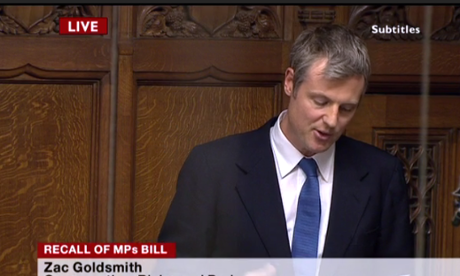
Zac Goldsmith's speech
Zac Goldsmith, the Conservative pro-recall MP, says at the time of the expenses scandal, recall was the only proposal that won the support of voters.
Change is not just necessary, he says. It is inevitable, like the Great Reform Act and women getting the vote.
Today people know far more about what their MPs are doing than they did when the voting system was last changed, when the voting age was reduced to 18.
He says he will introduce a version next week that would allow voters to decide whether to trigger a recall election.
He is not arguing that recall is the only solution to the problem facing politics, he says.
Conor Burns, a Conservative, says Goldsmith is talking down politics, and ignoring the element of honour involved.
Goldsmith says allowing recall would be an honourable thing.
Recall mechanisms are common in other parts of the world, he says.
Updated
Twigg says most MPs are in favour of the principle of recall.
But the bill needs to be “strengthened considerably”, he says.
Labour will work hard to strengthen it, he says.
Twigg says it would not make sense for a minister to face recall for taking a decision unpopular in the constituency, but good for the country as a whole.
David Davis, the Conservative, intervenes. He says the public are wiser than that. When he triggered his byelection over his opposition to 42-day pre-trial detention, 72% of voters supported that idea, he says. Yet he won the byelection with 75% of the vote.
Chris Walker, a Conservative, asks Twigg to define a “genuine member of the public”. Earlier Twigg said he wanted genuine members of the public on the standards committee.
Twigg says he meant genuine members of the public, not members of “the great and the good”.
Twigg says he is concerned that an MP like Terry Fields, who was jailed for not paying the poll tax, could be caught by the bill.
Zac Goldsmith intervenes. He agrees. Fields could have lost his job as a result of just 10% of his constituents backing a recall election. That is one of the flaws in the bill, he says.
Twigg agrees, although he thinks that Fields would have been re-elected in the recall byelection.
Updated
Twigg says the time threshold required to trigger recall, a 21-day suspension, is too high. It would not capture some of the worst cases of misconduct, he says.
He also says there may be a case for extending the number of lay members on the standards committee.
Sylvia Hermon, the independent Northern Ireland MP, asks Twigg if Labour welcomes the fact the bill applies to Sinn Fein MPs, who have not taken their seats.
Twigg says Labour does support this aspect.
Twigg says Labour supports recall. In its manifesto, it said recall should be available for financial misconduct.
But MPs are not delegates. There must be a balance between allowing recall for misconduct, and holding people to account for their views. Recall is not appropriate for that, he says. That’s a role for general elections.
But Twigg says introducing recall only when an MP is suspended for 21 days or more is two lax. Only two MPs in recent years would have been affected by this, he says. The MPs caught in the cash-for-questions affair in the 1990s would not have been affected, he says.
Greg Clark intervenes. He says six MPs would have been caught by the provisions in recent years; Chris Huhne and Eric Illsley because of their jail sentences; and four other MPs, including Teresa Gorman, Denis MacShane and Patrick Mercer, because of their being suspended for more than 21 days.
Zac Goldsmith, a Conservative, asks if Labour will allow its MPs a free vote on his amendments making it easier for the public to trigger a recall election. Conservative MPs are getting a free vote.
Twigg says whipping arrangements are not a matter for him.
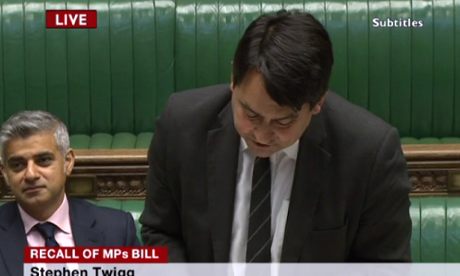
Twigg says it is a shame the government has taken more than four years to produce a bill.
David Cameron and Nick Clegg both originally said they were committed to recall. But both seem unhappy with this bill. Clegg said yesterday he would like to go further. And Cameron said at PMQs last week that these provisions were the minimum acceptable.
Richard Drax, a Conservative, says what is needed is honour in politics, not necessarily legislation.
Twigg says that’s a good point.
He says recall is a good mechanism for dealing with misconduct. But he does not think it is a good means of dealing with concerns about how an MP votes.
Stephen Twigg's speech
Stephen Twigg, the shadow political and constitutional reform minister, is responding now for Labour.
He says in 2009 the relationship between politics and the people reached a nadir. We cannot overestimate how much damage was done, he says. The public were left furious with the system, and with MPs involved, he says.
Clark says Britain has gained more than it has lost from the preference for “evolutionary, rather than revolutionary change”.
And that’s it.
Stewart Jackson, a Conservative, says an MP, Garry Allingham, was expelled from the Commons in the 1940s for writing disobliging things about his colleagues. That shows MPs can be expelled even if they do not break the law.
Andrew Lansley, the former leader of the Commons, says the Commons as a whole should hear from the lay members of the standards committee if they disagree with the committee’s findings.
Clark says the committee is looking at this issue.
Clark corrects something he said earlier. The bill would apply to Sinn Fein MPs, he says.
Clark says some changes have been made since the draft bill.
The recall proceedings would open automatically if an MP were suspended for 21 days or more.
This time threshold is open to debate, he says.
He says the standards committee is currently reviewing its own work.
Duncan Hames, a Lib Dem, says the fact that the standards committee can effectively trigger an investigation is what concerns members of the public.
Clark says the committee is reviewing the way it works partly because of public concern about this.
Frank Field, the Labour MP, says he was under recall from “the Trots” for 10 years, he says (referring to leftwing activists trying to deselect him). It was the electorate that saved him, he says.
Clark is now setting out the detailed provisions of the bill. (See 12.57am.)
He says the bill would not apply to Sinn Fein MPs, because they have not taken their seats.
David Davis, a Conservative, asks what would happen if an MP were arrested and jailed after attending a demonstration.
Clark says it would be up to the MP’s constituents. The constituents would have to decide whether to hold a byelection, and then whether or not to re-elect the MP.
Clark says no where in the world is there a direct equivalent to what is being proposed here.
So it is right to proceed with care, he says.
Richard Drax, a Conservative, says he has been in the Commons long enough to know that legislation that starts off with good intentions often gets added to. He urges Clark to proceed with “caution”.
Charles Walker, a Conservative, says that he would find it easier to take the government seriously if it had not passed legislation (the Fixed-term Parliaments Act) making it impossible for MPs to recall the government.
Clark says, like Walker, he would have preferred the Conservatives to have been governing with a majority.
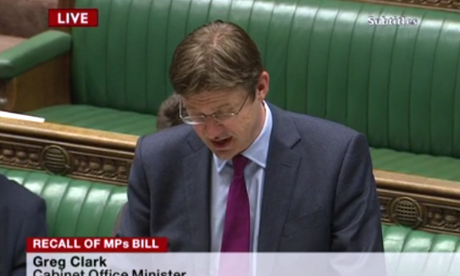
David Heath, a Lib Dem, says there is a distinction between misconduct, and advocating an unpopular policy. But does Clark understand the concerns of members of the public who think that it needs to be easier for the public to trigger a recall election.
Clark says he will consider this issue in committee. The government will take “very seriously” the views of MPs on this, he says.
Labour’s David Winnick asks Clark if Sydney Silverman, who campaigned against the death penalty, would have been in danger from this bill.
Clark says voters can get rid of MPs at a general election.
Stewart Jackson, a Conservative, says Edmund Burke said MPs were representatives, not delegates. They were there to exercise their independent judgment, Jackson says. But Burke was thrown out by the voters.
Clark agrees. He quotes Burke back at Jackson.
Charles Walker, a Conservative, asks Clark to name MPs who would be affected by the provisions in this bill.
Clark says it would have affected Chris Huhne and Eric Illsley.
But he concedes they both chose to resign.
Frank Field, the Labour MP, asks what would stop poweful lobbies using recall to take out MPs they dislike.
Clark says all the parties proposed recall in the manifestos.
Bob Neill, a Conservative, says he supports the bill. But he is concerned about MPs being victimised for taking up unpopular causes.
Clark says it would be “infinitely regrettable” if MPs lost their seat for taking up an unpopular cause.
Greg Clark's speech
Greg Clark, the Cabinet Office minister, is opening the debate.
He says all three main parties proposed a recall bill at the election.
MPs debate the recall bill
MPs are about to start debating the recall bill.
Before we start, here’s some background reading.
-
A 34-page House of Commons library note with a briefing on the bill (pdf). Here’s an extract, explaining what the bill does.
The Bill provides that a recall petition will be triggered if a Member is sentenced to a prison term or suspended from the House for at least 21 sitting days (28 calendar days, if not specified in terms of sitting days). If either occurs, then the Speaker gives notice to a petition officer, who in turn gives notice to parliamentary electors in the constituency. A petition is open for signing for eight weeks. If at the end of that period at least 10 per cent of eligible electors have signed the petition, the seat is declared vacant and a by-election follows. The Member who was recalled can stand in the by-election. The Bill introduces rules on the conduct of the recall petition, including campaign spending limits for those supporting and opposing recalling the Member.
There are already both statutory sanctions preventing individuals sentenced to over 12 months in prison from standing for election or sitting as MPs; and disciplinary processes within the House of Commons for Members who breach the Code of Conduct, which could lead to suspension or expulsion from the House. These sanctions are not changed by the Recall of MPs Bill. Members sentenced to over a year in prison will continue to automatically lose their seat; and breaches of the Code of Conduct will continue to be investigated by the Parliamentary Commissioner for Standards and, if necessary, sanctions recommended by the Committee on Standards will continue to be voted on by the House. However, the behaviour of the Committee and the House may change if their recommendations and decisions could trigger a recall petition.
We are not convinced that the proposals will increase public confidence in politics. Indeed, we fear that the restricted form of recall proposed could even reduce confidence by creating expectations that are not fulfilled. Under the Government’s proposals, constituents themselves would not be able to initiate a recall petition. The circumstances that the Government proposes would trigger a recall petition—if an MP received a custodial sentence of 12 months or less, or if the House of Commons resolved that there should be a recall petition following a case of “serious wrongdoing”—are so narrow that recall petitions would seldom, if ever, take place. Moreover, time has shown that the existing democratic and legal processes worked in removing the MPs who were shown to have been guilty of serious wrongdoing during the expenses scandal.
In addition, we do not believe that there is a gap in the existing disciplinary procedures of the House of Commons which needs to be filled by the introduction of recall. The new House of Commons Committee on Standards, which will include lay members, already has the sanctions it needs to deal with MPs who are guilty of misconduct, including recommending the ultimate sanction of expulsion in cases of serious wrongdoing. The Committee must actively consider this option, and if it does make this recommendation, the House must be prepared to act. Given that the House has confirmed the recommendations of the Standards and Privileges Committee in the past, we are confident that it will continue to do so.
We recommend that the Government abandon its plans to introduce a power of recall and use the parliamentary time this would free up to better effect.
Twitter reaction to Sir Andrew Green's peerage
Here’s some Twitter comment on Sir Andrew Green’s peerage.
From Lady Royall, Labour’s leader in the Lords
Yet another Peer created, Sir Andrew Green of Migration Watch. More desperation in face of UKIP? Why wasn't this announced with last list?
— Janet Royall (@LabourRoyall) October 21, 2014
From Ian Birrell, the journalist and former speechwriter o
I am shocked & dismayed by Downing Street giving MigrationWatch's Andrew Green a peerage. Pathetic response to Ukip http://t.co/1UlUOrHYdD
— Ian Birrell (@ianbirrell) October 21, 2014
From the Times columnist David Aaronovitch
What mechanism is there for objecting to Sir Andrew Green becoming an unelected legislator?
— David Aaronovitch (@DAaronovitch) October 21, 2014
From John Philpott
@Kevin_Maguire To be consistent Andrew Green should turn peerage down, on the grounds that House of Lords is overcrowded
— John Philpott (@JobsEconomist) October 21, 2014
From the Telegraph’s James Kirkup
Sir Andrew Green of Migration Watch UK has been given a peerage. Surely justice demands @jdportes is now sent to the Lords too?
— James Kirkup (@jameskirkup) October 21, 2014
From the Times columnist Tim Montgomerie
Delighted Sir Andrew Green of @migrationwatch has been enobled. He's faced a lot of hate for championing popular concern about immigration.
— Tim Montgomerie (@montie) October 21, 2014
From the Telegraph’s Tim Stanley
I'm not saying Cameron's desperate but if Ukip wins Rochester, don't be surprised if David Icke gets a peerage.
— Tim Stanley (@timothy_stanley) October 21, 2014
Updated
Nigel Farage has welcomed David Cameron’s decision to give Sir Andrew Green a peerage.
Congratulations to Sir Andrew Green, recognition for a life spent in public service latterly with @migrationwatch https://t.co/uR2m24wPEj
— Nigel Farage (@Nigel_Farage) October 21, 2014
Government insiders won’t go as far as saying that Sir Andrew Green’s peerage is a sop to the Ukip vote, but they will say that he is going to the Lords partly in recognition of his willingness to raise public concerns about immigration at a time when that was politically unpopular. This is from a senior source.
It’s a combination of two things. Sir Andrew Green had a very distinguished diplomatic career. But he has also made an important contribution to the immigration debate. In 2004 and onwards the government did not accept concerns about rising immigration numbers and Andrew Green’s MigrationWatch did a lot of work analysing the figures. People may disagree with their perspective, but they contributed to the debate. Labour now concede that they tried to shut down that debate, and that that was a mistake.
MigrationWatch UK welcomes Sir Andrew Green's peerage
MigrationWatch UK has put out this statement about Sir Andrew Green’s appointment.
We were delighted at Migration Watch to learn of our Chairman Sir Andrew Green’s elevation to the Lords. It is a non-party appointment and he intends to sit on the cross-benches.
After a long and distinguished public service career, Sir Andrew co-founded Migration Watch UK together with Prof David Coleman in 2001, since when he has been chairman. His appointment is a clear endorsement, at the highest level, of the work that Migration Watch has been doing. In the early years there was widespread reluctance to discuss the issue at all but Migration Watch has worked steadily to improve public understanding of the impact of the very high levels of net migration of the past 15 years. Under Sir Andrew’s guiding hand Migration Watch has undeniably become a leading voice in a very necessary debate.
Asked to comment, Sir Andrew said that Migration Watch UK was very much a team effort so he was very grateful for the commitment and hard work of his colleagues, many of them volunteers, that had made this possible.
Earlier I said that, when Tony Blair set up the House of Lords Appointments Commission but reserved the right to send a small number of distinguished public figures to the Lords himself, he originally intended to use this just to ennoble people like the former cabinet secretary. (See 11.28am.) He never used it to give a peerage to someone like Sir Andrew Green.
But Number 10 point out that David Cameron quietly changed the rules in the summer, allowing him to use this loophole to ennoble people “with a proven track record of public service”, not just retiring public servants.
Here’s the written ministerial statement announcing the new criteria.
The House of Lords Appointments Commission is responsible for recommending non-party political appointments to the House of Lords. In line with the practice of the previous Administration, I continue to nominate direct to Her Majesty the Queen a limited number of candidates for crossbench peerages, based on their public service. I am extending the criteria for these recommendations to ensure they can properly encompass a range of individuals with a proven track record of public service, not solely public servants on retirement. The nominations will continue to be vetted by the House of Lords Appointments Commission. The number of appointments covered under this arrangement will remain unchanged at a maximum of ten in any one Parliament.
Updated
Cameron gives MigrationWatch's chair a peerage
David Cameron really is going to extraordinary lengths to appease the Ukip vote.
Sir Andrew Green, the head of MigrationWatch UK, has been made a peer, Number 10 has announced today.
He is one of four people appointed to the House of Lords by Cameron for their contribution to public life. The others are Sir Jonathan Evans, the former head of MI5, Sir Robert Rogers, clerk of the Commons, and Professor Alison Wolf, an education expert who carried out a review of vocational education for the government.
All four will sit in the Lords as crossbenchers.
Some people are appointed to the peers as working peers. And some are nominated by the House of Lords Appointments Commission, an independent body that chooses crossbenchers.
But, as Number 10 says in its news release, the prime minister reserves the right to nominate some crossbenchers himself.
The Prime Minister nominates direct to Her Majesty The Queen a limited number of candidates for Cross Bench peerages, based on their public service. The number of appointments covered under this arrangement is a maximum of 10 in any one Parliament.
Tony Blair reserved the right to nominate a select few people to the House of Lords when he set up the House of Lords Appointments Commission. His intention was to ensure that some very distinguished public servants, like former cabinet secretaries, former archbishops of Canterbury and former Metropolitan police commissioners, could continue to go to the Lords.
But for Cameron to use this power to ennoble Green, a controversial campaigner accused by some of talking up the threat posed by immigration, is remarkable.
A Downing Street spokesman said Green was being sent to the House of Lords partly because of his record in the Foreign Office, where he was a diplomat for 35 years and served as ambassador to Syria and Saudia Arabia, and partly because of his work with MigrationWatch UK.
When I put it to the spokesman that this was a naked attempt to buy off the Ukip vote, he suggested that I speak to one of the political advisers instead.
I’ll take that as a yes.
Updated
Kings College London has made a good hire. It has taken on David “two brains” Willetts, the Conservative former higher education minister, as a visiting professor.
Here’s an extract from its news release.
Rt Hon David Willetts MP, former Minister for Universities and Science, has been appointed as a Visiting Professor at King¹s College London.
He will work with the Policy Institute at King¹s, which is led by Professor Jonathan Grant and based in the Faculty of Social Sciences and Public Policy, but have a College-wide remit. He will be engaged in a range of activities, including teaching, and will undertake research for his forthcoming book on higher education.
Mr Willetts will initially teach on a range of undergraduate and postgraduate courses in the Department of Political Economy across the fields of political theory, political economy and comparative public policy, and also contribute to master¹s programmes in the Department of Social Science, Health and Medicine.
Ed Miliband has paid tribute to Gough Whitlam, the former Australian prime minister who has died at the age of 98. In a statement Miliband said:
I am sad to hear of the death of Gough Whitlam, a truly great Labour leader and a great Australian. His achievements in three short years as Australian prime minister remain inspirational: in setting up universal healthcare, creating free higher education and recognising Aboriginal land rights, he changed his country forever. Gough remains an inspiration to social democrats around the world.
There is full coverage of the tribute to Whitlam here, at theguardian.com/australia.
It’s a good morning for written ministerial statements. We’ve just had another, from Theresa May, the home secretary, naming all the members of the panel that will conduct the inquiry into historic child abuse allegations (pdf).
Sharon Evans, Ivor Frank, Dame Moira Gibb, Professor Jenny Pearce OBE, Dru Sharpling CBE and Professor Terence Stephenson, will join Graham Wilmer MBE and Barbara Hearn OBE as panel members for the Independent Panel Inquiry into Child Sexual Abuse. Ben Emmerson QC is Counsel to the Inquiry, and Professor Alexis Jay OBE will serve as an expert adviser.
I am confident that this panel, under the chairmanship of Fiona Woolf CBE, will carry out a robust and thorough inquiry, and will challenge individuals and institutions without fear or favour, in order to consider this important issue, to learn the relevant lessons, and to prevent it happening again.
British military drones to fly surveillance missions over Syria
British military surveillance drones will be flying over Syria, Michael Fallon, the defence secretary, has told MPs.
He made the announcement in a written ministerial statement (pdf).
Further to the update I provided to the House on 16 October on UK operations against [Islamic State], I can confirm that Reaper remotely-piloted aircraft are due to begin operations very shortly.
As well as their operations over Iraq, both Reapers and Rivet Joint surveillance aircraft will be authorised to fly surveillance missions over Syria to gather intelligence as part of our efforts to protect our national security from the terrorist threat emanating from there. Reapers are not authorised to use weapons in Syria; that would require further permission.
The legal basis for this authorisation is as set out to Parliament in the debate on 26 September.
I will continue to provide updates to the House on our military activity.

Updated
Theresa Villiers, the Northern Ireland secretary, has announced that allegations about the cover-up of abuse inquiries relating to the Kincora boys’ home in east Belfast will not be covered by the new overarching inquiry being set up into the handling of historic abuse inquiries in the UK.
A number of people have proposed that the independent inquiry panel into institutional failures (“the inquiry panel”) in respect of child sexual abuse to be chaired by Fiona Woolf CBE set up by my Rt Hon Friend the Home Secretary, is the most appropriate vehicle to establish the facts concerning Kincora. The remaining appointments to the panel and its terms of reference are being announced today.
There is already in place, however, the Northern Ireland Historical Institutional Abuse Inquiry (“the Inquiry”) appointed by the Northern Ireland Executive and chaired by Sir Anthony Hart. I believe that this Inquiry is the better forum for the allegations concerning Kincora to be investigated, and we should not seek to take them out of its remit.
In the written ministerial statement Villiers acknowledges that the Northern Ireland inquiry does not have the power to compel the UK government to give evidence. But she says this can be addressed.
I have discussed these issues with ministerial colleagues and can confirm that there will be the fullest possible degree of co-operation by all of HM Government and its agencies to determine the facts. All Government Departments and agencies, who receive a request for information or documents from the Inquiry will co-operate to the utmost of their ability in determining what material they hold that might be relevant to it, on matters for which they have responsibility in accordance with the terms of reference of the Inquiry.
There are allegations that a senior Orangeman and a number of loyalist extremists are raped children at Kincora. It has also been claimed that the security forces – both MI5 and RUC Special Branch – knew about abuse in Kincora, but failed to act against those responsible because many of the alleged abusers were state agents.
Villiers’ announcement will disappoint organisations like Amnesty International, which said earlier this year that Kincora should be covered by the overarching UK inquiry.
Labour has said the revelation that Ukip has formed an alliance in the European parliament with a far-right Polish party shows that it does not share the values of “decent” British people.
This is from Michael Dugher, the shadow Cabinet Office minister.
As we approach Remembrance in the UK, we rightly honour all those people in Britain who stood up to Hitler and fought against the Nazis and fascism in Europe. Yet here are Ukip forming an alliance with a far-right party in Europe that denies the fact that millions were murdered in the Holocaust, in order to keep receiving hundreds of thousands of pounds from the European Parliament. This shows once again that Ukip do not share the values of decent working people in Britain.
And here’s the Guardian story about the new Ukip pact. And here’s how it starts.
Ukip has struck a deal with a Polish MEP whose far-right party leader casually uses racial slurs and questions the Holocaust following fears that its grouping in Europe would lose millions of pounds in taxpayers’ funds.
Nigel Farage’s Europe of Freedom and Direct Democracy group recruited an MEP from the Congress of the New Right with the blessing of its controversial leader Janusz Korwin-Mikke, according to reports from Poland. The Polish MEP Robert Iwaszkiewicz is to join the EFDD’s ranks as an individual, which will restore the group, a Ukip spokesman said ...
Korwin-Mikke, whose party has two remaining MEPs and received 7.5% support in Poland during May’s European parliamentary elections, is one of the most outspoken figures within the far-right groupings of parliament.
In July, he declared in English that the minimum wage should be “destroyed” and said that “four million niggers” lost their jobs in the US as a result of President John F Kennedy signing a bill on the minimum wage in 1961. He went on to claim that 20 million young Europeans were being treated as “negroes” as a result of the minimum wage. He refused to apologise and was fined 10 days of allowances for his comments.
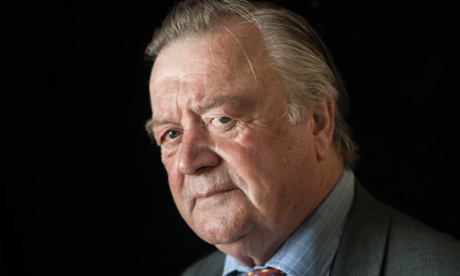
Clarke tells Cameron not to pander to 'ignorance and bigotry' over Europe.
Kenneth Clarke, the pro-European Conservative former minister, used an interview on the Today programme this morning to warn David Cameron not to pander to “ignorance and bigotry” in an attempt to counter Ukip. He told the programme:
We have to demonstrate that we are a strong, sensible party that does sensible things on immigration because there isn’t a politician that isn’t in favour of controlling immigration.
But what we mustn’t do is start competing with ignorance and bigotry and what we mustn’t do is start doing damage to our economy by imposing restrictions on people we need to come here.
There is a section of the population that used to support the BNP and so on that is just bigoted and anti-foreigners and there are popular politicians who just arouse prejudice.
But most people - particularly young people - understand that we are in a global economy. You get used to people who don’t speak your language and you meet people at work who are foreign.
Northern Ireland assembly votes to make paying for sex illegal
Last night the Northern Ireland assembly voted to making paying for sex illegal.
Here’s the Press Association story. And here’s how it starts.
Paying for sex is to be banned in Northern Ireland after members at the Stormont assembly members backed the move in a landmark late-night vote.
The proposal to outlaw purchasing sex is among a number of clauses contained in a bill aimed at amending Northern Ireland’s laws on trafficking and prostitution.
Paid-for consensual sex is currently legal in Northern Ireland though activities such as kerb crawling, brothel keeping and pimping are against the law. The proposed ban is similar to the model operating in Sweden.
CARE, a Christian charity, has welcomed the move. This is from Dan Boucher, its director of parliamentary affairs.
According to the national referral mechanism more than half those trafficked to Northern Ireland are trafficked for the purpose of sexual exploitation. Criminalising paying for sex provides the most effective means of addressing that demand head on and has been very successful in Sweden, Norway and Iceland. Northern Ireland now joins these countries in embracing an approach to prostitution law reform that has been particularly successful at challenging sex trafficking and wider sexual exploitation. This development is of seminal significance.
There are few pieces of legislation before the Commons at the moment that arouse more passion than the recall bill. For some MPs, giving members of the public the right to trigger a byelection in the middle of a parliament because a sitting MP is guilty of misconduct is a key democratic demand. The Conservative Zac Goldsmith is passionate about this, and complaining that the government’s bill does not go far enough, while Douglas Carswell revealed in a Guardian interview yesterday that David Cameron’s reluctance on honour his promises on this was one of the factors that made him defect to Ukip. Yet other MPs are alarmed at the consequences of what his being proposed. Here’s Labour’s Frank Dobson in an article for Comment is free today.
A recall law would leave principled MPs vulnerable. We need a system that rewards rather than punishes such commitment.
My own constituency provides a good example. No, not me. My predecessor Lena Jeger campaigned for many years for changes which were then unpopular. She was a sponsor of the private member’s bill that became the 1967 Abortion Act. Her constituents were predominantly Roman Catholic. If there had been a recall law then, it would have been very easy for opponents of abortion law reform to muster the required number of petitioners to “punish” her.
Similar campaigns could have been mounted against MPs who advocated equal pay and equal rights for women, who sought to outlaw racial discrimination, argued for the abolition of capital punishment, promoted gay rights or, depending on the constituency, voted for or against the hunting ban. Recall of MPs could have deterred many from sticking their necks out.
The debate starts at about 12.40pm. I’ll be covering the opening in full, and some of the highlights after that.
Here’s the agenda for the day.
9.45am: Nick Hardwick, the chief inspector of prisons, publishes his annual report.
10.30am: Rona Fairhead, chair of the BBC Trust, and Sajid Javid, the culture secretary, give evidence to the Commons culture committee about the future of the BBC. My media colleagues will be covering that on a separate live blog.
12.40pm: Greg Clark, the Cabinet Office minister, opens the recall bill debate. Stephen Twigg will be responding for Labour.
2.45pm: Fiona Woolf, chair of the new inquiry into historical child abuse cases, gives evidence to the Commons home affairs committee.
As usual, I will be also covering all the breaking political news from Westminster, as well as bringing you the most interesting political comment and analysis from the web and from Twitter. I will post a summary at lunchtime, and another at the end of the day.
If you want to follow me on Twitter, I’m on @AndrewSparrow.
Updated