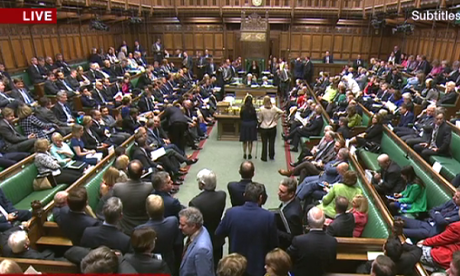
Afternoon summary
That’s all from us for today.
Thanks for the comments.
My colleague Dave Hill followed the London mayoral race particularly closely. In the light of Sadiq Khan’s victory, it is worth reading this blog he wrote last month explaining why he thought, after listening closely to what all six candidates had to say, he thought Khan would be best for London.
Here’s an extract.
All six have come up with good ideas, yet none has really stood out or managed to fully describe how they would re-shape Greater London with the constrained powers and resources City Hall enjoys. Khan, though, edges it for me thanks to a blend of principle and practicality that could evolve into a winning programme for constructive change in a city that sometimes seems to be booming out of control.
On the bedrock issue of housing he has played to the crowd over “poor doors”, private developers and foreign buyers, as have other candidates. Like it or not (and I don’t), the failure of successive national governments to invest as they should have has meant that these boo-fodder have helped boroughs get more “affordable” housing built than they might have otherwise, as some Labour boroughs and Ken Livingstone, a backer of Khan, could attest. Like his rivals, Khan has pledged to press private developers to improve their contributions to affordable homes and other benefits derived from planning deals, such as schools and street improvements. Good. But pressing is one thing, getting might be something else.
Such is the predicament the next mayor will inherit. Purism will be a luxury, pragmatism a necessity. But Khan marks himself out, notably from bookies’ favourite Jowell, in his approach to building on public land, where the potential for increasing amounts of affordable housing is greatest. He is properly cautious about Transport for London (TfL) partnering with commercial property giants and has declared himself against the demolition of council-owned estates, even when the goal is to eventually increase the number of affordable homes available, whether on the same site or nearby.
Dave has also written an article for Common is Free today explaining why he thinks Khan can beat Zac Goldsmith.

Updated
Scope, the disability charity, has welcomed the result of today’s vote on the assisted dying bill. Mark Atkinson, its chief executive, said:
Disabled people will be extremely relieved about the convincing nature of today’s vote. Keeping the current law means giving crucial protection to the lives of disabled and other vulnerable people, who could feel they are a burden to society. Today MPs and the Prime Minister have sent a strong message on this vital issue. Let’s now focus, as a society, on supporting people to live fulfilling lives.
The British Humanist Society says today’s vote means the assisted dying issue will end up back in the courts. This is from Pavan Dhaliwal, its director of public affairs.
Eighty per cent of the public support a change in the law to legalise assisted dying, but it is clear that parliament still has some way to go before it reflects this fact. In the meantime, countless individuals are needlessly suffering, or facing the prospect of travelling to Switzerland or having their loved ones illegally end their lives.
Last year, the supreme court ruled that while it is willing to consider whether the lack of a right to die breaches the European convention on human rights, it thought that parliament should first have the opportunity to legislate on the matter. Today parliament has declined to do so, and so the fight on assisted dying must now return to the courts. We will continue to campaign in favour of assisted dying for the terminally ill and incurably suffering, as this is one of the most pressing ethical issues of our day.
My colleague Rowena Mason has filed a story about the result. Here’s how it starts.
MPs have overwhelmingly rejected a bill that would have allowed doctors to help terminally ill people end their lives.
In the first House of Commons vote on assisted dying for 20 years, MPs voted 330 to 118 to reject the bill.
Under the proposals, a terminally ill person would have been able to request assistance with ending their life if they have been diagnosed by a doctor as having less than six months to live.
Passions ran high from the beginning of the parliamentary debate. Sir Crispin Blunt, a Tory former minister whose parents and father-in-law died of cancer, made the case for people to be given a choice how to end their lives, saying he was somewhat “appalled that the Catholic and faith lobby seek to limit personal autonomy”.
And here is some more reaction from MPs to the result.
From Greg Hands, the chief secretary to the Treasury
Glad to have voted just now against the Assisted Dying bill. Have strong concerns about protecting the vulnerable in this area.
— Greg Hands (@GregHands) September 11, 2015
From Bob Blackman, a Conservative
Excellent debate on #assistedsuicide in @HouseofCommons. I voted against the Bill & I am delighted that the Bill was defeated by 330 - 118.
— Bob Blackman (@bobblackmanmp) September 11, 2015
From Labour’s Chris Bryant
I voted against second reading for Assisted Dying Bill as I worry that the vulnerable will be made to feel a burden. It fell by 118 to 330.
— Chris Bryant MP (@RhonddaBryant) September 11, 2015
From the DUP’s Jeffrey Donaldson
Delighted to be present in the Commons with all @duponline MP's to comprehensively defeat the assisted suicide bill. http://t.co/XRA7IHlOjZ
— Jeffrey Donaldson (@J_Donaldson_MP) September 11, 2015
From the SNP’s Richard Arkless
Just voted against assisted dying bill. Bill defeated 330 to 118. Very moving session in the House. No speech was better than @P_Whitford_MP
— Richard Arkless MP (@ArklessRichard) September 11, 2015
From Ukip’s Douglas Carswell
Hurrah! Overwhelming
— Douglas Carswell MP (@DouglasCarswell) September 11, 2015
From Labour’s Lucy Powell
Powerful speeches on both sides of #AssistedDyingBill After much thought, I voted for. Some reservations, but the debate should continue
— Lucy Powell MP (@LucyMPowell) September 11, 2015
From the DUP’s Nigel Dodds
Present in Commons this afternoon to vote against the legalisation of assisted suicide. It has been defeated by 212 votes.
— Nigel Dodds (@NigelDoddsDUP) September 11, 2015
From the Greens’ Caroline Lucas
I voted for the #AssistedDying Bill today. Here’s a short statement explaining why: http://t.co/SdRUK0T1ei More in @brightonargus tomorrow
— Caroline Lucas (@CarolineLucas) September 11, 2015
From Labour’s Ian Wright
The scale of the vote against #AssistedDyingBill in @HouseofCommons - 118 for and 330 against - means it's unlikely to come back for years
— Iain Wright (@IainWrightMP) September 11, 2015
From Stewart Jackson, a Conservative
Delighted that advocates for #AssistedDyingBill have suffered a huge once in generation defeat in @HouseofCommons today
— Stewart Jackson MP (@Stewart4Pboro) September 11, 2015
From Victoria Prentis, a Conservative
The #AssistedDying debate was filled with compassion. I voted against the Bill, which I believe would have put the vulnerable at risk.
— Victoria Prentis MP (@VictoriaPrentis) September 11, 2015
From the SNP’s Corri Wilson
Voted in favour of The Assisted Dying Bill, shame there was not more discussion, was only the start. Results:118 Aye (for) 330 No (against)
— Corri Wilson MP (@CorriWilsonSNP) September 11, 2015
From Labour’s Richard Burden
#AssistedDyingBill defeated in House of Commons by 330 votes to 118. Hugely moving speeches on both sides. My views: http://t.co/gvaoq5qAuV
— Richard Burden MP (@RichardBurdenMP) September 11, 2015
From George Freeman, a health minister
Just voted against the #AssistedDying Bill. Imp debate but what we need is a more formal palliative NHS Care not state sponsored suicide.
— George Freeman (@Freeman_George) September 11, 2015
Here are some MPs tweeting about the result.
From Labour’s Stephen Kinnock
After excellent debate, assisted dying bill was just defeated. I voted for, but have deep respect for all sides of the argument.
— stephen kinnock (@SKinnock) September 11, 2015
From Labour’s Kerry McCarthy
Assisted Dying Bill voted down 330-118, so no further opportunity to debate in committee. Disappointing.
— Kerry McCarthy (@KerryMP) September 11, 2015
From Labour’s Frank Field
Stayed in London to vote against the #assisteddyingbill. Huge rejection. Almost three to one against.
— Frank Field MP (@frankfieldteam) September 11, 2015
From the SNP’s Paul Monaghan
The Assisted Dying Bill has been defeated in the House of Commons. It will not progress further. Sadly many issues remain outstanding. #SNP
— Dr Paul Monaghan MP (@_PaulMonaghan) September 11, 2015
From Peter Heaton-Jones, a Conservative
Disappointed with result on Assisted Dying. I supported because I believe in freedom of choice & thought the bill deserved further scrutiny.
— Peter Heaton-JonesMP (@PeterNorthDevon) September 11, 2015
From David Mackintosh, a Conservative
Pleased the Assisted Dying bill was defeated in House of Commons. We now need to focus on increased support and access to palliative care
— David Mackintosh MP (@davidmackintosh) September 11, 2015
From Labour’s Lilian Greenwood
Sat throughout debate on #assisteddying & still undecided. Voted for the Bill to allow further discussion on such a vitally important issue
— Lilian Greenwood (@LilianGreenwood) September 11, 2015
Here's the press release from @CareNotKilling on massive rejection of #AssistedDying in Britain pic.twitter.com/ywgo57c4yD
— Tim Montgomerie ن (@montie) September 11, 2015
Assisted dying bill defeated by 330 votes to 118 - a majority of 212
- Assisted dying bill defeated by 330 votes to 118 - a majority of 212
Updated
Douglas Carswell, the Ukip MP, thinks the bill will get defeated.
Looking good in lobbies to defeat Assisted Dying Bill. Surprised if not crushing defeat
— Douglas Carswell MP (@DouglasCarswell) September 11, 2015
MPs vote on the assisted dying bill
MPs are now voting on the assisted dying bill.
We have a technical problem earlier. My wifi crashed at the Royal Festival Hall, and my colleagues Matthew Weaver and Nadia Khomami had to help out. But I’m back now.
Though he nominated Jeremy Corbyn for Labour leader, Khan just told World At One he actually voted for Andy Burnham.
I was very clear when I nominated Jeremy all those months ago that I was going to nominate him because it was really important that the views he held - and many people subscribe to those views - were aired. I made clear when I nominated him that I wouldn’t be voting for him.
My first choice when it came to the leadership elections went to Andy Burnham.
What’s important is that, whoever the Labour movement decide to select as our leader tomorrow, we as a party need to get behind him or her.
Updated
Diane Abbott has congratulated Khan on his victory. “All of us in Labour will be backing his campaign to be elected mayor in May 2016,” she said. “I’m pleased that most of my supporters transferred their votes to Sadiq. Labour beat the Tories in London this May. Now with large numbers of new members and supporters we aim to defeat the Tories, to ensure London government changes and works for all.”
Other Labour heavyweights to congratulate Khan include interim party leader Harriet Harman and deputy leadership candidates Stella Creasy and Caroline Flint.
.@SadiqKhan @uklabour's Mayoral candidate will be great #London Mayor. Now Lets get him elected. #TogetherWeKhan @LondonLabour
— Harriet Harman (@HarrietHarman) September 11, 2015
Congratulations to @SadiqKhan for winning labours mayoral nomination in a strong field - now we fight for our city’s future! #labourfamily
— stellacreasy (@stellacreasy) September 11, 2015
Many congrats to @SadiqKhan, @UKLabour's London Mayoral Candidate. Looking forward to hitting the streets to make him our Mayor! #VoteLabour
— Chuka Umunna (@ChukaUmunna) September 11, 2015
So proud of the Mayoral selection campaign of @TessaJowell and the immense contribution of all the other candidates #TeamLabour
— Chuka Umunna (@ChukaUmunna) September 11, 2015
Congratulations @SadiqKhan on his election as @UKLabour's candidate for #London Mayor. Time now to unite & focus on winning back City Hall.
— Dan Jarvis (@DanJarvisMP) September 11, 2015
Congratulations to @SadiqKhan on winning the election to be Labour's candidate for London's Mayor in 2016.
— Caroline Flint (@CarolineFlintMP) September 11, 2015
Analysis
In the event it was not even particularly close. In the final round of voting, Sadiq Khan beat Tessa Jowell by 59% to 41%.
It is a surprise because Jowell, the former culture secretary who oversaw London’s successful 2012 bid for the Olympics, and who is widely liked in the party, was the favourite throughout, according to polls showing the views of Labour supporters in London.
But the Jowell camp started to worry in the early summer when it became clear that enthusiasm for Jeremy Corbyn was leading to a surge in people signing up to take part, either as new members or registered supporters.
Khan is no Corbynite leftwinger, but he was one of the MPs who nominated Corbyn to help get him on the ballot paper and his soft left, Ed Miliband-ite politics are more palatable to the Labour newcomers than Jowell’s.
For some, Tony Blair and the Iraq war will have been a factor too. Khan did not vote for the war, because he was not elected until 2005, and he has been critical of the war, while Jowell famously once said she would throw herself under a bus for the former prime minister.
Today’s result will reinforce the impression that that Labour’s new selectorate is about to deliver a resounding victory for Corbyn tomorrow.
But the read across is not exact, as some London Labourites were voting Jowell and Corbyn. In 2010 London Labour voted for David Miliband as leader, but for Ken Livingstone as mayoral candidate.
And it would be a mistake to assume that leftishness was the only, or even the main, factor behind Khan’s success. With support from the unions, Khan ran a formidably well-organised campaign.
Perhaps just as importantly, with the Tory candidate almost certain to be the millionaire Old Etonian Zac Goldsmith, some Labour members will have felt that a bus driver’s son, bought up on a council estate, would have made a better contrast than a former cabinet minister married to a wealthy lawyer.

Updated
In quick non-Khan related news, David Cameron has been heard saying Yorkshire people “hate each other” while rehearsing for a speech in Leeds.
Wearing a microphone, the prime minister was heard off-camera saying: “We just thought people in Yorkshire hated everyone else, we didn’t realise they hated each other so much.” Watch a video of the incident below.
It’s unclear whether the comments were intended as a joke, and Downing Street is yet to comment.
Updated
Khan’s win means that Jeremy Corbyn will be much more closely associated with the London mayoral contest next year – and it is likely to be a bitter one, in which Goldsmith and Khan will fight it out head on.
There have been two competing strategies inside the Labour party on how to win a mayoral contest in London. One is to win the suburbs. the strategy favoured by Jowell, and other other is to put together a strong left coalition, a strategy favoured by Ken Livingstone.
“It means we are now going to get a Bill de Blasio-style campaign,” one of the candidates said, in a reference to the leftwinger now running New York. It may work, but we are about to find out. If Khan wins, it will be a big boost for Corbyn.”
The result also show that the party membership in London js behind Corbyn’s politics, and contrary to expectation, the turnout in the union-affiliated section was quite high.
Corbyn never endorsed Abbott although she linked her voting record in the Commons to his and had tried to ride on his coat tails.
Khan has said he will not resign his Tooting seat unless he wins the mayoralty.
Here’s a bit more from Khan’s speech - He said:
I love this city. It’s given me and my family huge opportunities. My dad was a bus-driver and my mum sewed clothes to help support our family.
We lived on a council estate in south London, my mum, my dad, my brothers and my sister. City Hall might have been a few stops up the Northern Line, but to a young Londoner like me it seemed a million miles away.
To many young Londoners today, it still feels a million miles away.
I never dreamed that I would be standing here as your candidate for mayor and I’m only here because of the opportunities London gave me and my family - a safe and affordable council home, so my parents could save for a home of their own; a fantastic state school education for me and my brothers and sister; university education based on the grades we had rather than our means.
Khan added that his campaign would be underpinned by the “burning ambition” to ensure all Londoners have similar opportunities in future, to make London the best city in the world to start a business and to be “the greenest mayor we’ve ever had” and freeze transport fares while investing in the network.
As a quick reminder, Khan, 44, entered Parliament in 2005 and took ministerial posts in the communities and transport departments under Gordon Brown. He was appointed to Ed Miliband’s shadow cabinet as shadow justice secretary and shadow lord chancellor in 2010, but quit following May’s general election defeat to pursue the mayoral nomination.
Khan took 58.9% of the vote against Tessa Jowell’s 41.1% in the final round of counting - with 48,152 votes to Jowell’s 33,573.
First to be eliminated in the contest, after receiving the fewest of the 87,954 votes cast, was Harrow MP former international development minister Gareth Thomas, followed by transport campaigner Christian Wolmar, Tottenham MP David Lammy and left-wing former public health minister Diane Abbott.
Khan becomes the first major party candidate for London Mayor to be formally named, though the Liberal Democrats are shortly expected to confirm their nomination of Caroline Pidgeon from a shortlist of one. Sian Berry has been chosen as Green contender, while the Conservatives are due to announce their choice from a shortlist of four - including millionaire MP and environmentalist Zac Goldsmith - by the end of the month.
Full results
Here are the full results. (We didn’t catch the total for Diane Abbott in the second round - we’ll add it later.)
Round 1
Sadiq Khan: 32,926 (37.5%)
Tessa Jowell: 26,121 (29.7%)
Diane Abbott: 14,798 (16.8%)
David Lammy: 8,255 (9.4%)
Christian Wolmar: 4,729 (5.4%)
Gareth Thomas: 1,055 (1.2%) – eliminated
Round 2
Sadiq Khan: 33,141 (37.8%)
Tessa Jowell: 26,406 (30.1%)
Diane Abbott: 14,891 (17%)
David Lammy: 8,392 (9.6%)
Christian Wolmar: 4,927 (5.6%) – eliminated
Round 3
Sadiq Khan: 34,813 (40%)
Tessa Jowell: 27,272 (31.3%)
Diane Abbott:15,878 (18.2%)
David Lammy: 9,147 (10.5%) – eliminated
Round 4
Sadiq Khan: 38,440 (44.7%)
Tessa Jowell: 29,785 (34.6%)
Diane Abbott: 17,849 (20.7%) – eliminated
Round 5
Sadiq Khan: 48,151 (58.9%) – selected
Tessa Jowell: 33,575 (41.1%)
Updated
Khan has confirmed that he will stand down as MP, the New Statesman’s George Eaton reports.
Sadiq Khan confirms that he will stand down as Tooting MP. Early by-election test for Labour in marginal seat.
— George Eaton (@georgeeaton) September 11, 2015
Meanwhile, Ladbrokes has slashed its odds on a Tory mayoral victory, according to the Spectator’s Fraser Nelson.
Ladbrokes has just slashed its odds on Tory mayoral victory. Race far closer now: 8/11 Sadiq Khan, 11/10 Zac Goldsmith
— Fraser Nelson (@FraserNelson) September 11, 2015
Many believe Khan’s win is an indication of Corbyn’s success tomorrow. Either way, it’s reflective of the “transformation” of the Labour party.
From the BBC’s Norman Smith:
London Labour shows it is now firmly on the left. A big boost for Jeremy Corbyn's prospects
— norman smith (@BBCNormanS) September 11, 2015
From the Spectator’s James Forsyth:
Striking thing about London Mayoral result is how easily Khan won, even his campaign thought it would be close. Suggests easy Corbyn win
— James Forsyth (@JGForsyth) September 11, 2015
From the Daily Mirror’s Kevin Maguire:
Sadiq Khan's victory over Tessa Jowell is stunning. The sun set on Blairism in a Royal Festival Hall where Blair made his new dawn speech
— Kevin Maguire (@Kevin_Maguire) September 11, 2015
From Huffington Post’s Paul Waugh:
Never forget @SadiqKhan nominated @Corbyn4Leader for leader (even tho didn't vote for him). And crucially @ken4london backed Sadiq.
— Paul Waugh (@paulwaugh) September 11, 2015
From Sky News’ Faisal Islam:
The Labour Party has been totally transformed: perceived attraction of Jowell candidacy to tory suburbs counted for little
— Faisal Islam (@faisalislam) September 11, 2015
From the Evening Standard’s Joe Murphy
So 2016 looks like @SadiqKhan versus Zac Goldsmith. Can you think of people with more more contrasting personalities, backgrounds, poltiics?
— Joe Murphy (@JoeMurphyLondon) September 11, 2015
From the Telegraph’s James Kirkup:
& if mayoral race becomes about personal history, compare @SadiqKhan 's story to @ZacGoldsmith 's: council estate kid vs inherited fortune.
— James Kirkup (@jameskirkup) September 11, 2015
Meanwhile, others believe Khan’s nomination is a sure fire way of ensuring a Zac Goldsmith win at the ballot next year.
Congratulations @ZacGoldsmith
— Toby Young (@toadmeister) September 11, 2015
Slightly baffled by the "Zac wins!" tweets. London elected Ken Livingstone. Sadiq Khan is hardly to his left.
— Tim Shipman (@ShippersUnbound) September 11, 2015
Updated
Union reaction
Paul Maloney, regional secretary of the GMB union, called it a “convincing win”. He added:
We now want to see all parts of the party uniting to secure a win in the election next year.
Peter Kavanagh, Unite’s London and southeast regional secretary, said:
The selection of Sadiq Khan to be Labour’s mayoral candidate is a vindication of the progressive polices he set out during the campaign.
On housing, transport and employment Sadiq offered a positive vision that will deliver the change Londoners are crying out for and with Sadiq as Labour’s candidate I am sure we will win.
It was clear Khan had won as soon as the first results showed that the votes of Khan and Diane Abbott combined would outnumber those for Tessa Jowell.
The results suggest Jeremy Corbyn is going to sweep to victory in the national leadership ballot on Saturday.
Jowell had hoped her consensual style and reputation for bringing the Olympics to London in 2012 would be enough for her to see off the organisation of Khan and the leftward surge in the party. Khan will be relieved that in the final ballot he did not just win the registered supporters and affiliated supporters sections, but also in the members section, giving him a solid mandate.
Jowell had hoped her personal reputation would render her immune from the leftward surge, as well as her constant message that opinion polls showed she was best placed with the wider electorate to defeat the a Tory candidate such as Zac Goldsmith.
We’ve got the number of people who voted. There were 114, 839 voters eligible, and 87,854 votes cast. That means the turnout was a extremely healthy 76.5%.
Politicians and the commentariat have been reacting to Khan’s win on Twitter. Leading the pack is Jeremy Corbyn, who writes that he’s looking forward to working with the mayoral candidate.
Congratulations @SadiqKhan for becoming London's Labour mayoral candidate-regardless of leadership result I look forward to working with him
— Jeremy Corbyn MP (@jeremycorbyn) September 11, 2015

Jowell trailed in every round of voting. By the time the second preferences of the lower-placed candidates were reallocated, Khan won 59% to 41%.
Updated
Khan is speaking now. He thanks his opponents. “Your ideas and energy will be a vital part of the campaign going forward,” he says.
He also thanks the voters who “took the time to have their say”. He adds: “Members, registered supporters and affiliated supporters. You are the lifeblood of our movement and the supporters I am so confident we will win next May.”
Sadiq Khan wins
Sadiq Khan has won, on the fifth round of voting.
Updated
This is from the New Statesman’s George Eaton.
I'm hearing that Sadiq Khan has won Labour's London mayoral nomination.
— George Eaton (@georgeeaton) September 11, 2015
Updated
The music has gone off. So we must be about to start.
This is from my colleague Dave Hill.
Trying to read body language of #labour #londonmayor candidates' teams. Getting nowhere....
— DaveHill (@DaveHill) September 11, 2015
They teach “body language” at journalism college. It is more useful than French.
This is from Sky’s Faisal Islam.
Looking good for @SadiqKhan at the London labour mayoral candidate selection ... We'll find out shortly
— Faisal Islam (@faisalislam) September 11, 2015
Twitter rumour is giving it to Sadiq Khan.
And this is from the New Statesman’s Stephen Bush, who is normally on the money.
It's Sadiq Khan, I think. Which, given the rest of the electorate, I'm not sure is a shock.
— Stephen Bush (@stephenkb) September 11, 2015
Don't forget too that @SadiqKhan was EdM campaign manager, so knows all about beating the odds in an internal party election
— Paul Waugh (@paulwaugh) September 11, 2015
Labour mayor candidates are all in a private room with one aide each, finding out who's won. We'll find out at 1230.
— Emily Ashton (@elashton) September 11, 2015
Sky’s Adam Boulton has a better pic.
Nice backdrop for @UKLabour London 2016 Mayoral Candidate announcement. Due soon at 1230 pic.twitter.com/NpUHhvLovq
— Adam Boulton (@adamboultonSKY) September 11, 2015
There’s a nice view from the window, but I’m afraid you would not guess from this.
Labour about to announce its candidate for London mayor pic.twitter.com/D7nAscyNZC
— AndrewSparrow (@AndrewSparrow) September 11, 2015
As Patrick Wintour points out in his preview story, the electorate for this contest has not been formally announced, but it is thought to be 21,800 affiliated members, 63,900 full members and 28,600 registered supporters paying £3 to vote. So the London electorate is 21% of the total Labour electorate.
If Sadiq Khan does win the mayoral nomination, people may be tempted to see that as evidence of the Jeremy Corbyn effect. The registered supporters and new members who have been signing up to take part in the contest seem to be more leftwing than longstanding Labour members, and Khan, an Ed Miliband-ite who nominated Jeremy Corbyn to help him get on the ballot for the Labour leadership, is probably more in tune with their politics than Tessa Jowell, one of Britain’s few surviving Blairites.
But, as LabourList’s Conor Pope points out, the converse does not necessarily apply. A Jowell victory won’t necessarily mean that Corbyn is in trouble.
Don't think Labour's London Mayor result will be a great indicator of leadership. In 2010, London voted strongly for Ken and David Miliband.
— Conor Pope (@Conorpope) September 11, 2015
This is from the Sun’s Steve Hawkes.
Sadiq Khan camp increasingly confident of Mayoral victory. Played canny game telling would-be voters their man nominated Jeremy Corbyn
— steve hawkes (@steve_hawkes) September 11, 2015
Labour announcing its candidate for London mayor
I’m at the Royal Festival Hall, where Labour is about to announce its candidate for London mayor.
Tessa Jowell, the former culture minister, was for a long time the favourite. But Sadiq Khan, the former transport minister and former shadow justice secretary, has been mobilising effectively and now it is said to be a toss up as to which of them wins.
There are four other candidates too: David Lammy, Diane Abbott, Gareth Thomas and Christian Wolmar.
I have beefed up some of the earlier posts with direct quotes from the speeches. I have taken them from the Press Association reports. You may need to refresh the page to ensure they appear.
From what I’ve heard so far, I get the impression that opponents of the bill are in the Commons in larger numbers, but I haven’t done a count and that’s only an impression. We’ll find out when the debate ends at 2.30pm.
Nadine Dorries, a Conservative, says she has heard doctors say they would like to be able to kill themselves if they had locked-in syndrome. But this bill would not apply to locked-in syndrome, she says.
As a nurse in the 1980s she remembers holding the hand of a young man diagnosed with Aids. Not HIV, but Aids. He was told he would die. But he is still alive today.
She says a friend was diagnoses with a terminal illness last year. Dorries was with her as she died in her last 14 days. It was peaceful. Now, with palliative care, no one needs to die a painful death.
But the death that people would experience killing themselves under this bill would be painful, she says.
Here is another MP unsure how he will vote. It’s Labour’s Toby Perkins.
Am in Commons for #assisteddying debate, some very strong arguments for and against- rare to be in debate unsure of how I'll vote.
— Toby Perkins (@tobyperkinsmp) September 11, 2015
I posted tweets from two others earlier. (See 10.13am.)
Nigel Evans, a Conservative, uses a point of order to complain that Starmer is taking too long. Eleanor Laing, the deputy speaker, says Starmer is in a unique position to contribute. She is giving him more leeway than other speakers, but hopes he will wrap up soon.
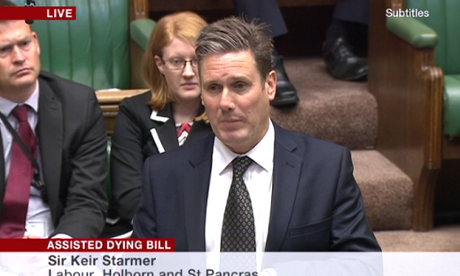
Labour’s Sir Keir Starmer, the former director of public prosecutions, is speaking now. As DPP he drew up guidelines for relatives intended to clarify in what circumstances people would and would not be prosecuted for helping people to kill someone who wanted to die.
There are details of those guidelines here.
He says the first principle was that the criminal law should not be used against loved ones helping people who genuinely wanted to end their life. But the second principle was that there should be very strong safeguards to stop people being subtly pressurised into suicide.
There was a huge response to his consultation, he says. And there was “overwhelming support” for these two principles.
He says the guidelines have applied for five years. As DPP, he oversaw 80 cases covered by them. In 79, he decided there should be no prosecution.
But he says the guidelines said doctors were likely to be prosecuted. He took the view that exempting doctors would be counter to the wishes of parliament. This led to a case that went to the supreme court. And the supreme court said it was up to parliament to clarify the law.
He says the problem with the current law is that amateur assistance from relatives, for someone wanting to commit suicide, is now allowed in practice. But professional assistance from a doctor is not allowed. That is inconsistent, he says.
Fiona Bruce, a Conservative, says, if the bill passes, we will have crossed the rubicon from killing people being illegal to killing people being legal. This is totally unacceptable ethically, she says. MPs must reject it.
The start of this debate was rather dry, but it is now getting much more lively and passionate. The two best speeches so far have come from Crispin Blunt (see 10.40am) and Lyn Brown (see 10.45am). That is because they have been been talking about the experience of real people with whom they were emotionally involved.
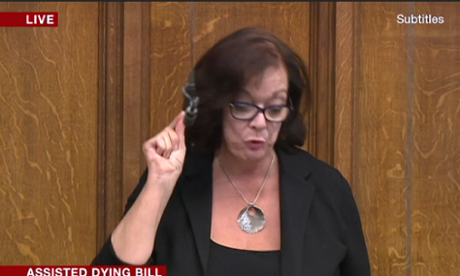
Labour’s Lyn Brown says her mum died of cancer. If this legislation had been on the statute book, it would have place a huge burden on her. She would have worried about whether she should have killed herself.
But her mum had a loving family around her. What would happen to her constituents who did not have family around them saying they should stay alive.
Brown acknowledges that safeguards have been inserted into the bill. But the bill could turn into a slippery slope. In Holland, where similar legislation was introduced 13 years ago, it is now routine for old people how are lonely or bereaved to seek to end their lives.
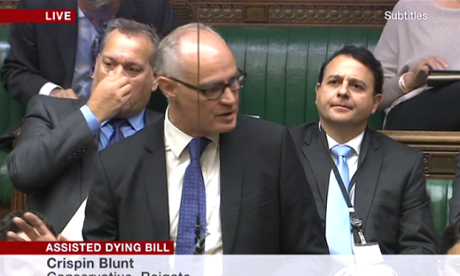
Crispin Blunt, a Conservative, says some people see suffering as a grace-filled opportunity. But count me out, he says. The concept of a good death is not one that would have shocked Seneca.
He says he watched his two parents and his father-in-law die of cancer. He said his father-in-law had said in advance that he would like his life support turned off. But in the end he did not have control over his own death. That was truly appalling, he says.
He says in Oregon hardly anyone exercises the right to choose assisted dying. But people like having the choice, he says.
This is an issue of freedom, he says. For years, the logo of the Conservative party was the torch of freedom. So he is surprised that religious colleagues want to limit his freedom, and the freedom of the majority of people in the country who support the bill.
He says if opponents believe there should be more safeguards in the bill, they should insert them at committee stage.
The SNP MP Tommy Sheppard says religious MPs are out in force in the chamber today.
Opponents of assisted dying start by reference to God and sanctity of life. The more spiritually certain MPs here in great numbers.
— Tommy Sheppard MP (@TommySheppard) September 11, 2015
Labour’s Jim Fitzpatrick is speaking now.
He was a fireman before becoming an MP, he says.
In my time I worked with asbestos as did [Conservative minister Mike Penning] Because of its heat-resistant properties the fire service used it for all manner of things. For example, we used to wear asbestos helmets and gloves. I don’t know how many people here have seen the terminal stages of asbestos or mesothelioma. Not only is it not pretty, it’s damned ugly and if that’s what lies in store for me, I want to control my own exit.
The bill would introduce more safeguards than apply at the moment, he says.
People should not have to travel to Switzerland if they want to end their life, he says.
Updated
Caroline Spelman, the Conservative MP and former environment secretary, is speaking now. She is introducing religion into the debate.
Caroline Spelman MP, in opposition to bill, says life is is a gift from God with all the pain and suffering that it entails. #assisteddying
— John McDermott (@johnpmcdermott) September 11, 2015
Why is it that so many people say ‘I don’t want to be a burden’? In societies which revere the elderly there’s less fear among old people that they impose a strain on everyone else. One of my constituents put it like this: ‘We are born into dependency, we rely on the goodwill of others even when we’re in our prime, and dependency is a necessary feature of our senior years’.
Respect for life is a question that the Bill challenges. This bill would also be a major shift in the fundamental principle, changing the relationship between the doctor and their patient. It would not just legitimise suicide but promote the participation of others and even if we consider assisted dying to be acceptable in some circumstances, in my view, the law should not be changed.
Updated
Rob Marris’s speech - Verdict: Rob Marris’s opening speech was sober, measured and rational. The BBC’s Mark D’Arcy was impressed.
Whatever u think of Marris Bill he's performing v calmly in hi pressure debate #AssistedDying
— Mark D'Arcy (@DArcyTiP) September 11, 2015
And the Conservative MEP Daniel Hannan thinks the debate has got off to a very good start.
Wherever you stand on #AssistedDying, you must admire the quality of the Commons debate this morning. I wish MPs were unwhipped more often.
— Daniel Hannan (@DanHannanMEP) September 11, 2015
Marris had a very good grasp of detail, and he managed to see off all the interventions with facts and arguments that were effective. But perhaps it was all just a little too dry. He never tried to make an emotional case for assisted dying and it felt like a defensive speech, not one that was likely to sway those sitting on the fence.
Updated
Marris quotes from the Mental Capacity Act. He and many other MPs backed it, he says. It says that a person should not be treated as unable to make a decision just because they make an unwise one.
He says his bill would provide more protection for the living, and more choice.
He says he does not know if he would choose to kill himself if he had a terminal illness.
I don’t know if I had a terminal illness with a prognosis of less than six months if I would. But I and many other people would find it comforting to know that the choice is available - to have the option of choosing a dignified and peaceful death at a time and place, and in a manner of my own choosing, at my own hand. I think there’s been a trend in our society, which I support, in many cases that if the exercise of a choice does not harm others in a free society we should allow that choice.
And that’s it. He has finished.
Updated
Marris says California is accepted to agree to assisted dying legislation.
He refers to Oregon, where assisted dying laws are in place, and quotes from a medic saying that there is no evidence that the legislation has led to people being coerced into killing themselves.
Here are two Conservatives undecided on the bill.
Second reading of the Assisted Dying Bill today. Strong arguments on both sides. I will listen to the debate before deciding how to vote.
— Will Quince (@willquince) September 11, 2015
I am open minded on the Assisted Dying Bill. I am listening to the arguments. @politicshome
— Bernard Jenkin (@bernardjenkin) September 11, 2015
Craig Tracey, a Conservative, is not impressed by how Marris is doing.
Rob Marris not winning his own argument on Assisted Dying.
— Craig Tracey MP (@craig4nwarks) September 11, 2015
Tracey is minded to vote against, according to a tweet he posted yesterday.
@MaryGavigan2 I will be at the debate and listen to the arguments, but my default position is to vote against it
— Craig Tracey MP (@craig4nwarks) September 10, 2015
Sir Edward Leigh, a Conservative, asks Marris about the case of Barbara Wagner, a patient in Oregon who was told the state would not pay for medical treatment, but that it would fund assisted suicide.
Marris knows the case. He says a mistake was made. Wagner should not have been told that assisted dying was an alternative for her.
Marris says he accepts that a majority of people in the medical professions are opposed to his bill. But a substantial minority is in favour.
He wants good palliative care in this country. But terminally ill people who want to die should not be “held hostage” while palliative care improves, he says.
Updated
Marris is setting out the safeguards that would apply in the bill. They are set out in detail on page 23 of this briefing note (pdf).
Labour’s Siobhain McDonagh says she knows that, for some campaigners, this is just a start; they would like a much more liberal assisted dying bill.
Marris says, if that is the case, they would have to come back to parliament and try to change the law again.
Marris says the bill would only apply to people terminally ill, and expected to die within six months.
A Labour MP, Helen Jones, says doctors can never know for sure how long a person will live.
Your bill is founded on the belief it is possible to predict the time of death up to six month accurately. In fact, most doctors will tell you that is impossible - certainly impossible to predict beyond a week or two. Is that not the case?
Marris replies:
Professionals often give advice on a balance of probabilities. That is the same for medical professionals. In fact, on the gross statistics when errors in prognosis occur for the terminally ill it usually an overestimate of life expectancy.
Updated
Rob Marris's opening speech
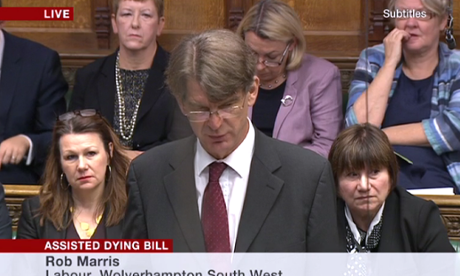
Rob Marris, the Labour MP who has sponsored the bill, is opening the debate.
He says the current law does not meet the needs of the terminally ill, of their relatives, and, in some cases, of the medical profession.
I hope today we can see parliament at is best, with an open debate and a free vote on a matter of conscience. The current law does not meet the needs of the terminally ill, does not meet the needs of their loved ones. And in some way it does not meet the needs of the medical profession.
We have amateur suicides going on. We have what would be technically illegal assistance going on. We have those who have the means going off to Dignitas in Switzerland. The Supreme Court in the Tony Nicklinson case recognised there was a problem which needs to be addressed by parliament. It is time parliament grasped this issue.
He says polling shows that there is widespread support for this bill.
We all know as politicians not to rely too much on opinion polls - however, opinion polling by Dignity in Dying of 10,000 people, carried out independently by Populus, suggested extremely strong support for the kind of measure I am proposing to the House today.
Asked why so many disability groups are opposed to the bill, he says disability is not an illness. The bill does not apply to them.
He says he understands the motives of those opposed to the bill.
On the way into work this morning he was standing by someone on the tube with a t-shirt saying: “Understand difference.” That applies today. People have different ethical views.
The Lib Dem MP John Pugh asks why the bill was called the assisted dying bill, not the assisted suicide bill.
Marris says it’s simple; the bill was called the assisted dying bill in the Lords.
Updated
Natascha Engel, the deputy speaker, says that 85 MPs have asked to speak in the debate. That is unprecedented, she says. She asks MPs to keep interventions to a minimum. It is not customary to impose a time limit on speeches in debates on private members’ bills. But she asks MPs to restrict their speeches to five minutes. And she says she may impose a limit as the debate goes on.
The motion to sit in private has been defeated by 239 votes to one.
MPs in favour of assisted dying
And here are some MPs in favour.
Labour
Off to listen to the debate on assisted dying today. This is why -on balance - I will vote for the Bill. http://t.co/Tzcn5wDrck
— Hilary Benn (@hilarybennmp) September 11, 2015
Early train down to London to speak in favour of assisted dying bill. I believe everyone has the right to a dignified death @dignityindying
— Sarah Champion MP (@SarahChampionMP) September 11, 2015
MPs opposing assisted dying
Here are some MPs opposing the bill.
Conservative
In Commons today for Assisted Dying debate. I shall be voting against in line with my pledge in last May's election hustings
— Charlie Elphicke (@CharlieElphicke) September 11, 2015
@AndrewSparrow To oppose
— Charlie Elphicke (@CharlieElphicke) September 11, 2015
Today I'm in the House of Commons for the Assisted Dying bill. Read here why I'm voting against http://t.co/CU05Z5vrMA
— David Mackintosh MP (@davidmackintosh) September 11, 2015
Why I am voting against moves towards Assisted Dying today in Parliament: This was a short spee... http://t.co/QdpEPt3mm7
— Robert Halfon (@halfon4harlowMP) September 11, 2015
Assisted Dying Bill today. Powerful arguments on both sides but I believe suicide is a tragedy, not a treatment. I will be voting against.
— James Cartlidge MP (@jc4southsuffolk) September 11, 2015
My article in @ConHome on the assisted dying debate tomorrow http://t.co/crTzXPHVrW
— Maria Caulfield MP (@mariacaulfield) September 10, 2015
Instead of seeking to hasten death Parliament should be focusing on improving the quality of End of Life Care http://t.co/F0eYTfXWKV
— Sarah Wollaston MP (@sarahwollaston) September 11, 2015
My view on the Assisted Dying Bill being debated today..http://t.co/rZM5u9FRit
— David Burrowes (@davidburrowesmp) September 11, 2015
Labour
Having listened to senior medical experts that I trust & reflected on the arguments I have decided to oppose the Assisted Dying Bill
— Barry Sheerman (@BarrySheerman) September 11, 2015
I will be voting against the Assisted Dying Bill. Please read my blog on my website to understand why, like the vast majority of clinicians.
— Rachael Maskell MP (@RachaelMaskell) September 11, 2015
Sensitive & emotive issue with sincerely held views on all sides, but I'll be voting against Assisted Dying Bill. Hoping to speak in debate.
— Conor McGinn MP (@ConorMcGinn) September 11, 2015
In Assisted Dying debate. Impassioned speeches on both sides. I am voting No. My decision is based on many years experience working in SEN
— Pat Glass (@PatGlassMP) September 11, 2015
Updated
According to the Tory MP Craig Tracey, more than 80 MPs want to speak in the debate.
Sitting in on today's debate in Parliament on Assisted Dying. Over 80 people have put in to speak so should be an lively debate
— Craig Tracey MP (@craig4nwarks) September 11, 2015
I did not see which MP moved the “House sit in private” motion, but Jacob Rees-Mogg and David Nuttall, two Conservatives, are both tellers for the ayes, which means they are backing the time-wasting tactic.
The Commons debate is starting. But before it could get underway an MP moved a motion that the House sit in private. MPs have to vote on that, which is what they are doing now. It is a routine time-wasting tactic almost always introduced at the start of a controversial private member’s debate.
I'm case you can't read the signs, red is yes, blue is no to #AssistedDying at the Westminster protest pic.twitter.com/h0NzMFLnhK
— Tom Barton (@tombarton) September 11, 2015
There are protesters for and against the bill outside parliament today.
WE WANT CHOICE #AssistedDying pic.twitter.com/eRhIx9Iuqu
— Dignity in Dying (@dignityindying) September 11, 2015
Opponents have brought a puppet with syringe! Very strange, as it's nothing to do with what's actually in the Bill pic.twitter.com/8NW3XkFxCd
— Dignity in Dying (@dignityindying) September 11, 2015
Assisted dying - A reading list
Ethically and legally, assisted dying is a particularly complex issue. Here is some background reading that will help anyone interested in exploring it in depth.
The best place to start is the 48-page House of Commons library briefing paper on the bill (pdf). As it explains, the issue has come to parliament partly because the courts have decided that it is for parliament, not judges, to settle what the law should be on this matter.
There have been several legal cases regarding the offence of assisted suicide, particularly in the context of disabled or terminally ill people who are unable to end their lives without assistance from family or friends. Of particular relevance is the case of Debbie Purdy, who in July 2009 obtained a House of Lords ruling ordering the Director of Public Prosecutions (DPP) to formulate an offence-specific policy setting out the public interest factors the Crown Prosecution Service will consider when deciding whether to prosecute assisted suicide offences. The DPP’s policy was published in February 2010 following a public consultation.
In June 2014 the Supreme Court revisited the issue of assisted suicide in the cases of Tony Nicklinson, Paul Lamb and AM, who were seeking a declaration that the current law on assisted suicide was incompatible with their right to a private life under Article 8 of the European Convention on Human Rights. The Supreme Court decided against making such a declaration by a majority of seven to two. It took the view that Parliament was the most appropriate forum for considering changes to the law on this particular issue. Following the Supreme Court decision, in July 2015, the European Court of Human rights dismissed applications from Jane Nicklinson and Paul Lamb.
Dignity in Dying is probably the most prominent pressure group in favour of the assisted dying bill. It used to be the Voluntary Euthanasia Society.
Here is some of its briefing material.
A 12-page note defending the bill (pdf)
A two-page note highlighting polls showing public support for the bill
A two-page note highlighting what it says are the 15 safeguards in the bill (pdf)
Care Not Killing is an alliance of groups opposed to assisted dying.
Here is some of its material.
A four-page briefing highlighting arguments against the bill (pdf)
A four-page briefing on what has happened in Oregon, where similar legislation is in force (pdf).
And Not Dead Yet UK is a network of disabled people opposed to assisted dying. It sets out its thinking here. Here’s an excerpt.
We believe that legalising assisted suicide will inevitably lead to increasingly adverse judgements about the quality of life of disabled people. This will undoubtedly begin to affect the many disabled people who cannot speak for themselves and who have not requested death. Research in the Netherlands has shown that legalising assisted suicide has led to nearly a quarter of overall intentional killings of patients happening without request. This research has also shown that intentional killings, by either withdrawal of treatment without the patient’s permission or by deliberate over-doses of symptom control, have increased. Nowhere is there evidence to show that legalising assisted suicide has deterred medical practitioners from intentional killings, or that the number of these killings has declined.
Rob Marris’s bill is very similar to an assisted dying bill introduced by Lord Falconer, the former Labour lord chancellor, in the House of Lords in the last parliament. On the Today programme Falconer said the law needed to be changed.
The courts have said repeatedly that the law is a mess and it needs to be dealt with and addressed by Parliament and it is a very good thing, this early in Parliament, that such a debate is taking place.
Asked about claims that introducing the law, which is similar to legislation in Oregon in the US, would lead to 1,500 deaths a year, Falconer replied:
That’s the percentage of people who die in Oregon, if you applied that percentage to the people who die in Britain, I think that is the right figure. But it is very difficult to predict. I don’t know if that figure would be right or wrong in Britain.
Rob Marris has defended his assisted dying bill in a post on his blog. Here is an excerpt, in which he takes on some of the arguments made by the bill’s critics.
As a politician, of course I have no problem with people criticising me for proposals I make. I do object to people criticising me for proposals which I have never made.
In particular, I do object to the comment ‘promote death in order to encourage life’, when I am not promoting death.
What I am promoting is choice, a choice that the authors would for their own deeply held faith reasons, deny all terminally ill adults of sound mind.
It is disappointing that these opponents of the bill continue to misrepresent that which I propose.
In the case of the open letter, that misrepresentation starts as soon as the first line. The authors say that my bill ‘proposes to allow doctors to prescribe and administer drugs to prematurely end life’.
It does not. It would only be the patient, and no-one else, who administers such drugs.
This is not a minor quibble. It is a major difference, as the open letter authors well know. They want people to think that I am proposing euthanasia; hence their repeated use of the word in their letter. To allow doctors to administer fatal drugs is indeed euthanasia, but I am not proposing that.
They say that ‘an assisted suicide is not a more dignified end to life than one which has taken its natural course’. In some circumstances, I do believe that assisted dying is more dignified. It allows a terminally ill adult of sound mind to end their own life, in their own home, surrounded by their loved ones, escaping from intolerable pain – whereas at the moment some such patients are killing themselves in most undignified circumstances; and others are dying in pain they do no longer wish to experience.
On protection, the authors again suggest that my bill would allow someone to ‘take away’ a patient’s life. As those authors know full well, the bill does not propose that.
The authors are quite right that ‘hard cases make bad law’. That is precisely the problem we have now. In the absence of clear law from Parliament, the Director of Public Prosecutions is freelancing on which cases of assisted death get prosecuted and what don’t.
Debates in the House of Commons are often dull and predictable, but today’s proceedings will be neither. MPs are considering the assisted dying bill, a private member’s measure proposed by the Labour MP Rob Marris. It would allow terminally ill people to get medical help to end their lives. It will be the first time MPs have voted on the issue since 1997, and, with MPs allowed a free vote, it is not at all clear what the result will be.
But, as my colleague Rowena Mason reports, even if the bill gets a second reading, that does not guarantee it will become law. David Cameron is opposed.
David Cameron does not favour any move to legalise assisted dying, Downing Street has said.
MPs are due to debate the ethically fraught issue in the House of Commons for the first time in around 20 years on Friday, after Labour’s Rob Marris laid a private members bill that would give terminally ill patients the right to die.
It is not clear whether Cameron will vote on the second reading of the bill but his official spokeswoman said: “The PM’s views are clear on this issue. He is not convinced further steps need to be taken and he is not in favour of an approach that would take us closer to euthanasia.”
His opposition to the idea is significant, as private members bills rarely make it on to the statute book without a degree of government backing to give it time for debate in parliament. However, it would be difficult for Downing Street to ignore the will of MPs if there was a strong vote in favour.
I will be covering the opening of the debate in full, as well as the the final stages and the result.
But in the middle of the day I will be covering the announcement of the winner of the contest to choose Labour’s candidate for London mayor in detail.
Here is the agenda for the day.
9.30am: MPs start debating the assisted dying bill.
10.30am: David Cameron gives a speech on the economy.
12pm: Labour announces the winner of the contest to be the party’s candidate for London mayor.
2.30pm: MPs are due to vote on the assisted dying bill.
If you want to follow me or contact me on Twitter, I’m on@AndrewSparrow