By any standards, it is an extraordinarily long and ambitious arts project. “A few people have pointed out that I might be dead before we finish,” said conductor Ian Page, contemplating the 27-year exploration of Mozart’s life and work that he is planning.
Page and his company, Classical Opera, are to embark on the Mozart 250 project, marking the anniversary of the composer’s visit to London during which, aged eight, he wrote his first symphony. The idea is to follow Mozart’s life and work year by year until his death in 1791, to be marked in 2041.
Over the years, all of Mozart’s major works will be performed by the company: all his operas, oratorios and concert arias; most of his symphonies and concertos; and many of his chamber and instrumental compositions. They will be performed 250 years after their composition or premiere – a reaction, Page admitted, against the predictable default of celebrating a composer on only their death or birth anniversary.
He hopes the project will allow people to see Mozart’s highs and lows: when he was doing well and when he was struggling, when he was working on dance music to make money, rather than on the operas he really wanted to write.
The idea of Mozart 250 is to give audiences a deeper understanding of one of the most naturally talented artists of all time. Page said: “The more we work with music from that period, the more we engage with audiences, the more fascinated I become by telling stories through concerts rather than it just being a series of pieces that we’d like to play for you..”
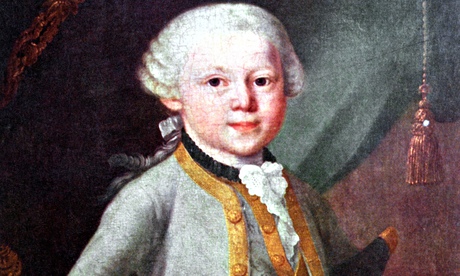
Events in 2015 will see the project exploring a chapter of Mozart’s life that few people know. Mozart’s proud and possibly overbearing father brought his son to London to show him off. They lived off Charing Cross Road and in Frith Street in Soho before doctors advised an ill Mozart Sr to get out of the smog and consider some peace and quiet. They moved to the then rural charms of Chelsea and the young Mozart was banned from playing his noisy instruments. So he wrote music. Mozart’s Symphony No 1 will be one of the highlights of 2015, a piece of music that would be remarkable for anyone but is dumbfounding for an eight-year-old.
Page said the original score was fascinating: the title page looks like it was written by a child, full of crossings out, whereas the music is near-perfect. “I think it is every bit as good as what contemporary adult composers were doing – it is an individual voice already. It is a bit like Shakespeare: there are better and worse plays but all of them have things which nobody else would have thought of, and Mozart has that.”
There will be many firsts, including the only production in modern times of an opera Mozart would have seen – and was influenced by – at the King’s theatre, Haymarket – Adriano in Siria by JC Bach, son of Johann Sebastian. Mozart later wrote of JC Bach: “I love him with all my heart, and have the highest regard for him.”
Page, who set up Classical Opera in 1997 to celebrate all things Mozart, stressed that Mozart 250 would not take up all of the company’s time. “Otherwise we wouldn’t do Figaro for 20 years,” he added. He said some years would be busier than others. For instance, 2017 will be significant because Mozart started writing his operas at 11, so the intermezzo Apollo et Hyacinthus will be performed, as well as Die Schuldigkeit des ersten Gebots – which roughly translates to The Supremacy of the First Commandment. “It’s bit like a mystery play but it’s quite comic,” said Page. “It’s quite fun.”
The hope is that people taking their first steps into classical music will be enthused by Mozart, as well as the composer’s fans. “I would be depressed if we didn’t get people who want to learn about Mozart,” said Page. “There are so many more people out there who think they might quite like opera in particular and classical music in general, but are either too scared or too intimidated or just a bit fearful.”
He hopes Mozart 250 will lead people to a lifelong pleasure and interest. Page said it was important that people felt they could dip in and out but he hoped some would stay for the long haul. The project will begin on 22 January with 1765 – a retrospective at Wigmore Hall in London in which Mozart’s musical childhood will be put in context with music performed by composers such as Gluck, Haydn and JC Bach as well as the first symphony and concert arias from a very young Mozart.
On 20-22 February an immersive weekend of events, talks and concerts at Milton Court, London, is planned to explore more fully Mozart’s childhood stay in London.
Another idea is to put Mozart family letters on Classical Opera’s website, also in real time.
There will be many things happening in the next 27 years, said Page, but one idea in particular has been rejected: a concert of music by Mozart’s rival, Salieri. “Very few have heard any of his music,” said Page. “But actually, when push comes to shove, I don’t think any of it is good enough to justify doing. It would be a wasted exercise.” Mozart would perhaps have been delighted.
From prodigy to operatic pop star
1756 Wolfgang Amadeus Mozart (or Johannes Chrysostomus Wolfgangus Theophilus Mozart as he was baptised) is born in Salzburg, the youngest of seven children. He showed astounding musical talent from an early childhood.
1764 Mozart arrives in London. During this time he writes his first symphony.
1767 Aged 11 he composes his first operas, Apollo et Hyacinthus and Die Schuldigkeit des ersten Gebots.
1768 He writes his first full comic opera – the three act La Finta Semplice which translates as ‘The make-believe idiot’. There were many who assumed it must have been written by his father. Mozart spent the autumn writing his first complete Mass.
1770 Mozart’s six-hour long Mithridates, King of Pontus is performed.
1781 A key year. Idomeneo is his first mature opera and a huge hit. The following year, another success in the shape of The Abduction from the Seraglio which, when Mozart was alive, was one of his most performed works - it was the one which really established his reputation in German-speaking lands.
1786 The Marriage of Figaro is first performed in Vienna’s Burgtheater.
1787 Don Giovanni “the opera of all operas” is performed. Mozart finished just before his deadline and the story goes that the ink was still wet on the scores as the opera was premiered in Prague.
1790 Cosi fan Tutte, his final comic opera, is performed. Its run is halted by the death of the emperor Joseph II.
1791 The Magic Flute, probably his most performed opera, was an instant hit. Mozart’s final staged work was commissioned for the crowning of Leopold II as king of Bohemia. He fell ill while he was in Prague for its premiere and died on 5 December that year, aged just 35. The cause of death is still unknown.