It's still early morning at Kings Place near London's St Pancras, but Lucy Reynolds is already animated by her passion for research – specifically, the importance of research into the use of the moving image by artists.
Reynolds created the MRes moving image programme at Central Saint Martins, in association with LUX, in response to the importance of artist films on the curatorial agenda of galleries such as the Tate.
"If you go to the Tate, or any other gallery, you'll see projections. You wouldn't have seen that 20 years ago. Think about the Turner Prize – two of the four nominated works (by CSM graduate Laure Prouvost and Tino Seghal) were in moving image. So there is an awful lot of practice happening," she says.
"But there is hardly any discourse around it; our MRes pathway aims to address that."
This is just one example of innovative film studies courses emerging from University of the Arts London. At London College of Communication, graduates of the MA in documentary film are producing provocative, challenging films, such as Sahra Mosawi's Beyond the Burqa, which looks at women living in among the Taliban in Afghanistan.
And at London College of Fashion, the MA in fashion and film looks at how fashion film has become a competitor with catwalk shows as a showcase for collections, giving graduates the foundation to go on to diverse careers. Together, these postgraduate courses represent the changing face of film studies in Britain.
A creative approach to research
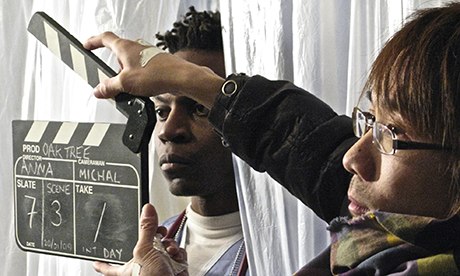
Students on the MRes Art: moving image course look at theory and practice in contemporary moving image, along with screenings, seminars and readings and gallery visits. The programme doesn't only attract film-makers; it also draws in students with a background in art, criticism and curation, who are looking for new ways to think about moving image. Students in the MRes programme graduate with a deeper understanding not only of the history and theories of moving image, but also how research might be integrated into practice.
"Research processes more familiar to academic contexts are finding increasing currency in artists' moving image practices." Reynolds points to directors such as John Akomfrah and CSM lecturer Uriel Orlow, who use research to dramatic effect. Akomfrah, co-founder of the influential Black Film Collective and a recent honorary doctor at University of the Arts London, is known for using archival footage to create moving, thoughtful documentaries such as Martin Luther King: Days of Hope and The Stuart Hall Project.
The course comes at a time when documentary and fine art film are increasingly influencing each other. "Artists' documentaries are an important strand," says Reynolds, whose own curatorial work has toured galleries across the UK, including Tate Britain, and who has published widely on the history of British cinema. "Over the past 15 years, artists are using conventions we're used to seeing in documentary."
Joshua Oppenheimer, who completed a PhD at Central Saint Martins, achieved acclaim with a film noir documentary, The Act of Killing, which blurs the line between fact and fiction.
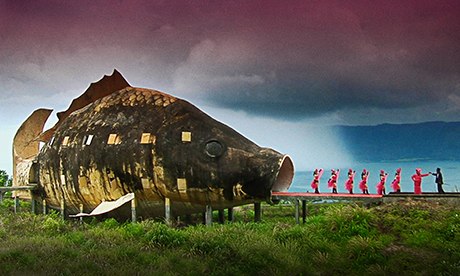
In the documentary, which was executive produced by film-maker Werner Herzog, the principle character Anwar Congo describes numbing himself with alcohol and drugs to erase his memory of the thousands of lives he took. Then he stands up and dances. Congo was one of the death squad leaders who killed more than a million Indonesians following a military coup in 1965. He re-enacts his crimes for a work the Los Angeles Times said "could well change how you view the documentary form".
Oppenheimer comes from a new generation of film-makers who are using fine art traditions to push documentary form. The hunger for scholarships has led to the new Moving Image Research Art Journal (MIRAJ), which bills itself as the first peer-reviewed publication about artists' film and video. It is a collaboration between Intellect Books and University of the Arts London, and contributors include Reynolds (who is features editor) and Pratap Rughani, course leader of MA documentary film at London College of Communication.
Then there are organisations such as LUX, an online resource for film-makers in the UK that partners with the Central Saint Martins course and has worked with everyone from Tate to Frieze to MOMA. LUX collaborates with moving image artists such as Turner Prize-winner Elizabeth Price, Luke Fowler and Mark Leckey, and works with Central Saint Martin's on installations and touring shows – all of which help connect tomorrow's leaders on film theory with new networks.
Avant documentary
At London College of Communication, these new networks are a vital part of its MA in documentary film.
"There was a gap between many academic courses and securing contracts in film and media," says course leader Pratap Rughani, whose background includes training new directors for BBC TV.
Student work has appeared everywhere from the BBC to the Barbican, where Rughani organised an exhibition of 18 films in 2011.
During the one-year programme, students learn everything from pitching ideas to directing and completing a short film. It comes at a time when documentaries are found not only on TV but in galleries and at international film festivals.
"This is a fantastically rich time for the relationship between fine art practice and documentary," says Rughani.
"Ten years ago, who would have predicted that gallery work would be so informed by the use of documentary approaches?"
Consider the emerging director Leila Hussain, who completed the MA course at London College of Communication. Her lyrical short film, Halfway at Sea, documents life at Beachy Head, one of the sunniest spots in Britain that happens to have the second-highest rate of suicides in the world. Hussain's film is nominated for best student documentary at the 2013 Grierson Awards, which honour excellence in British documentary film.
Halfway at Sea combines voice-overs of locals remembering the area, time-lapse shots, archival footage and even shipping forecasts to tell the story of the community.
"It was important for me to play with the documentary form," Hussain says, "because I was studying it so closely. During my MA I was watching so many documentaries and experimental films, as well as reading about them. It makes you want to test the boundaries for yourself."
Hussain started the MA with no film experience. It was a way, she says, to learn practical techniques for film-making, while also learning film theory. "I was lucky enough to get a scholarship, and so it was an offer too good to refuse," she says.
It was also an opportunity to learn from fellow students, many of whom didn't come from a film-making background: "Being at the university means you are likely to meet some talented people, and there were so many opportunities for collaboration – which is a fundamental part of film-making." (She worked with MA sound design students Tim Bamber and Lotte Rose Kjær Skau on Halfway to Sea.)
These strands, from the intellectual adventure of research into moving image to the nuts and bolts of creating a documentary, create what is perhaps one of the broadest, most comprehensive film studies offerings at postgraduate level in the UK. Whether it's a documentary that blends drama with documentary (as in Oppenheimer's film) or the thought leadership of those investigating the history and future of artists' films, the moving image is entering a new phase of diverse and dynamic expansion.
When asked about what he tells young film-makers, like those graduating from Central Saint Martins or London College of Communication, Oppenheimer is very clear and direct: "You need profound curiosity, and to be able to analyse what you're doing so you don't settle for an easy answer. Second, you need the courage to imagine and do things you've never seen in a film. And this might sound peculiar, but it's important to imitate. We stand on top of the research of others."
More information
For course descriptions by college, level and subject, and for the application process, videos and online galleries across the university, visit the UAL website. Scholarship information is also available online.
Content on this page is produced and controlled by University of the Arts London.