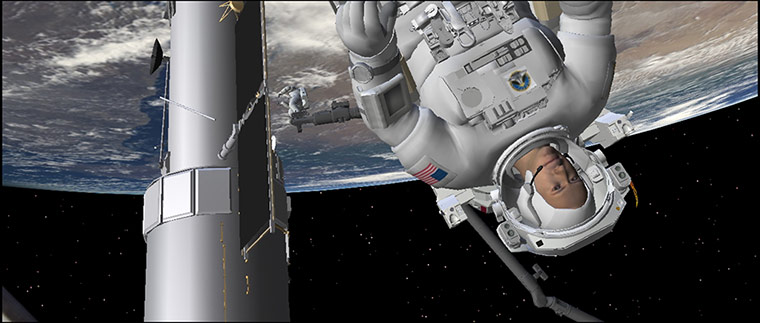
Making The “Previz”
Before filming began, Framestore created a 'previz': an animated version of Gravity on which to 'build' the film. Though primitive-looking compared with the finished film, it was very sophisticated, and required Cuarón’s close involvement. As Rob Duncan puts it: 'Most movies are only made once, Gravity was made twice.' The image is taken from the 'prelight' stage, in which the film lighting was simulated Photograph: Framestore
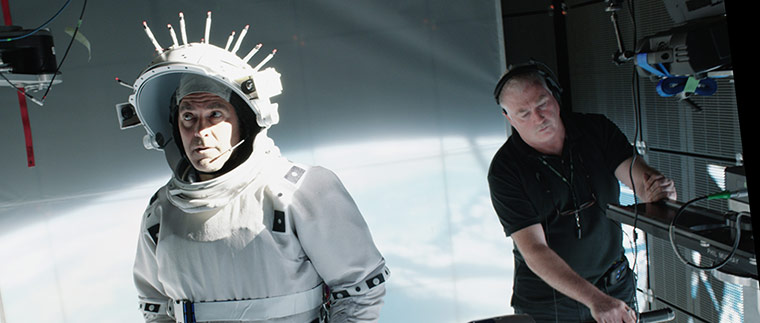
To capture George Clooney for the same shot, he was dressed in a spacesuit similar to the CG costume he would be seen wearing, with a helmet that cast the correct shadow over his face. On top of the helmet LED-topped sticks allowed the team to track the location and angle of his head so the CG helmet could be correctly positioned on top. Behind him, the Earth is represented across a wall of the giant LED lightbox, creating the exact intensity, colour and direction of the light in space Photograph: Framestore
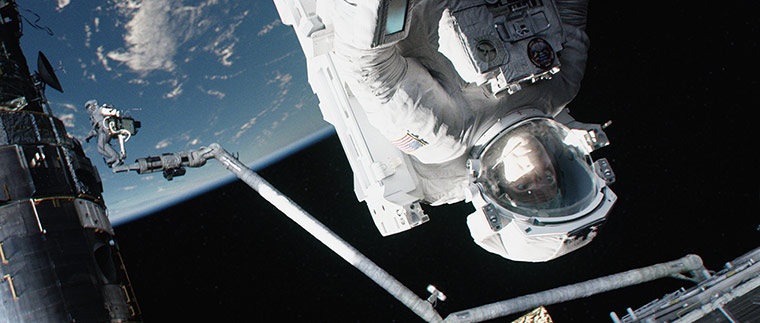
In the final image, Clooney’s face has been 'pasted' into the CG environment, and is the only feature that remains from the live shoot. The image of the Earth’s surface has taken the place of the LED earth, and the highly detailed CG elements – Sandra Bullock’s character repairing the Hubble space telescope while strapped to a robotic arm – have also been worked in Photograph: Framestore
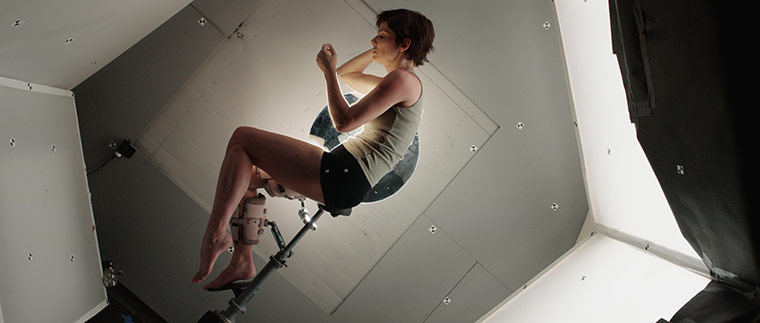
Synchronised Robots
A scene where Sandra Bullock is seen spinning in an airlock was created using three robots, by technicians who called it the 'washing machine shot'. One robot moved the camera, another moved a spotlight behind the porthole, and another moved the porthole. As the camera rotated, the porthole and spotlight stayed in perfect alignment. Bullock was strapped to a cycle seat, while around her LED lights simulate sunlight bouncing off the walls Photograph: Framestore
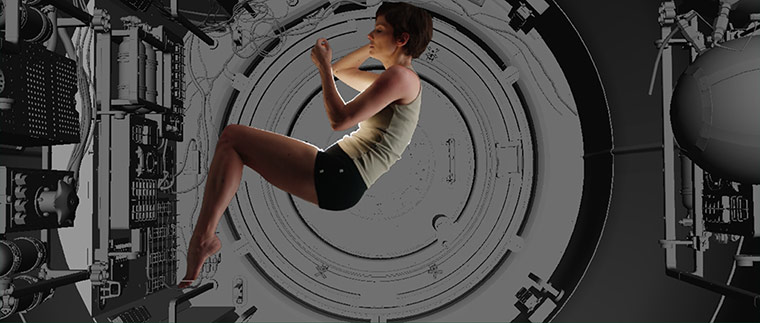
Bullock’s outline has been 'traced out' using a process known as rotoscoping, with her right leg removed. Around her is added the model of the airlock’s interior where her character Dr Stone has entered and removed her spacesuit, but because the suits themselves were made in CG, Bullock had to mime the sequence Photograph: Framestore
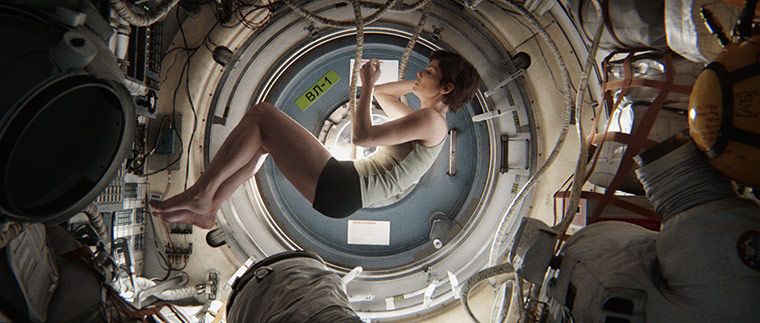
In the finished scene, Bullock gently revolves in zero gravity. Her right leg has been replaced with a CG stand-in, but her physical performance still has to look like weightlessness. The digital set-dressing, with the meticulous clutter of this interior, was approached with as much rigour as on a live set, and entirely overseen by Cuarón. 'The builds team worked towards a very fine level of detail,' Stuart Penn recalls, 'down to every nut and bolt'
Photograph: Framestore
Green-screen City
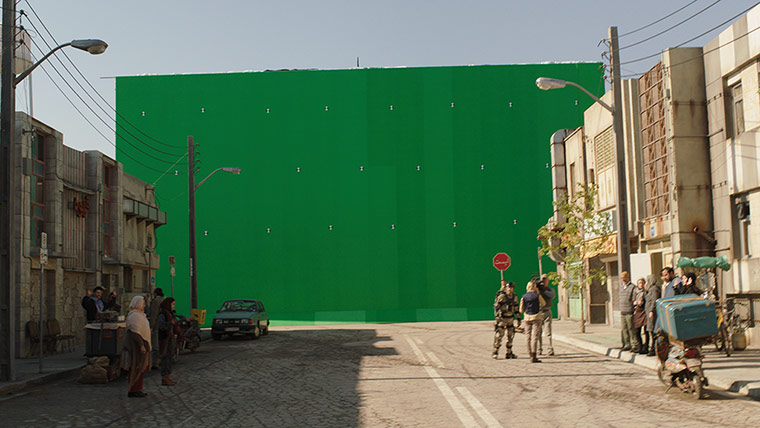
This scene is from the prologue section of the new RoboCop film, in which a cohort of sinister-looking robots parade down a street in suburban Tehran, forbiddingly scrutinising the population. 'We weren’t going to film in Tehran, for obvious reasons,' says Rob Duncan, so a 100-metre set-piece of a street was erected on a backlot in Toronto, terminating at each end in an enormous green-screen. After careful rehearsal, this shot was filmed, with actors miming their reactions to the robots, and the cameraman, having memorised his choreography, moving in response to the imaginary parade Photograph: Framestore
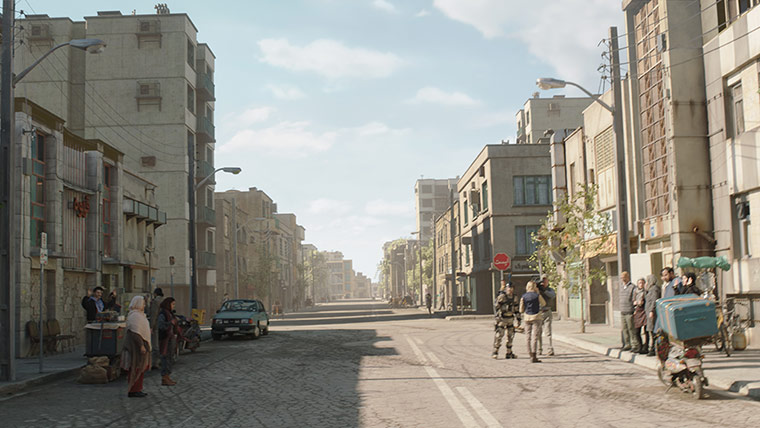
Every inch of the street-set was mapped with a laser, and the data that was collected formed into a 3D image of the scene, on which the digital elements could be built. This image had to be carefully aligned with the footage of the street, so that none of the CG additions sat awkwardly in their surroundings. In place of the green-screen, the street was extended in depth into the distance with buildings matching the filmed set, and some of the existing buildings were extended upwards Photograph: Framestore
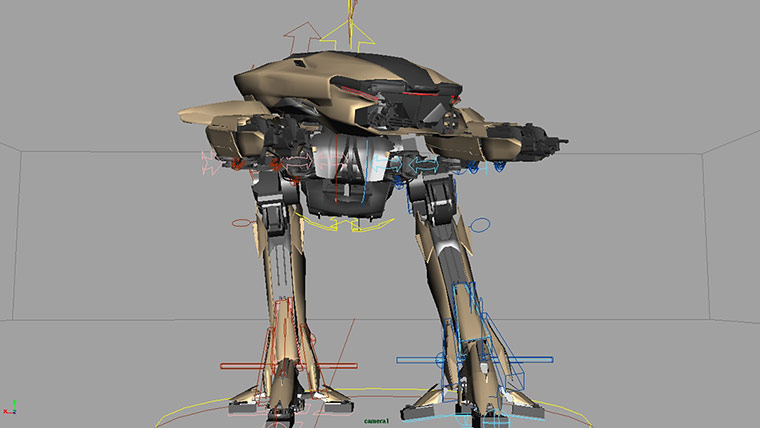
The 'ED-209', a well-loved villain robot from the original RoboCop films, was given an update for the 2014 remake, and the animation team sought a careful balance for its style of movement; it had to be seen as dynamic and mobile, without becoming 'too dainty' and losing some of its fear-factor. Every tiny aspect of the robot was discussed by the team and repeatedly adapted, from the visibility of its wiring to the flexibility of its toes. The colour of the robot shown in this image was eventually changed to create a greater visual distinction from the buildings and street that surrounded the robots Photograph: Framestore
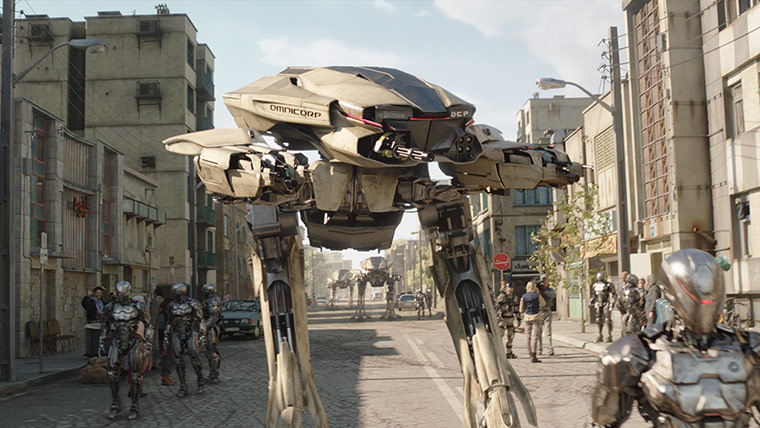
In the final shot, the robots march down the street interacting with people lined up along the sides of the road. 'The robots have to know where the ground is,' says Duncan. 'If they don’t, their feet will slip and slide, and then you’re in big trouble.' The chassis and bodies of the ED-209 robots were then also individually decorated with dirt effects, dents and other small imperfections to make them all appear individual and avoid them seeming too smooth or artificial Photograph: Framestore