Millions of Americans will gather around the dinner table on Thursday to mark a national holiday that originates from a 1621 autumn feast in Plymouth. But the first American Thanksgiving actually took place 2,400 miles away, in what is now Texas, in April 1598. And no one ate turkey.
At least, that’s what they tell you in El Paso.
The small suburb of San Elizario on the banks of the Rio Grande has held a First Thanksgiving Celebration for the past 26 years. The celebration commemorates the Mexico-born Spanish colonist Juan de Oñate’s expedition, which safely arrived at the river after an arduous journey across the Chihuahuan desert on 30 April 1598. Oñate’s party also performed what local historians believe is the first play written in what is today’s United States.
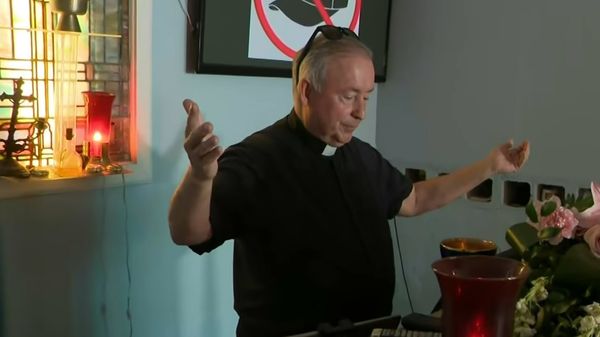
Michael Lewis, a seminarian who is a former vice-president of the El Paso Mission Trail Association, said that all of the elements of a quintessential American Thanksgiving feast – “a meal, some sort of religious component, giving thanks to God for what we’re receiving” – were all there in 1598.
“All three of those elements were present on the banks of the Rio Grande in present-day Texas more than two decades before the Pilgrims landed at Plymouth Rock,” Lewis said. “And the Indians were present of course.”
Lewis said the annual San Elizario event, which includes re-enactments, music and food, is about providing a counterpoint to an anglocentric view of American history. “I think it’s just making more people aware that our nation’s history is a larger tapestry that includes many colours,” he said.
An El Paso businessman, Sheldon Hall, came up with the idea of celebrating the “first Thanksgiving” as a way to promote tourism and interest in the area’s past, said his daughter, Shelley Sutherland. Hall, who died in 2012, was appointed honorary consul of Spain for his efforts to highlight Spanish colonial history.
In 1991 he staged a mock confrontation in New England with Pilgrim re-enactors. “The Spanish group confronted the American group and said ‘we had the first one’, and they said ‘we have the first one’, and the Plymouth people put the Spanish people in jail. And the next year, the American pilgrims came to El Paso and got thrown in jail and had to get bailed out,” Sutherland said.
“It’s nice to antagonise our friends in Massachusetts – ‘You guys are 23 years too late!’” said Bernie Sargent, chairman of the El Paso Historical Commission. “They can say what they want – we know the truth.”
Still, late November is not a good time to be a turkey in far west Texas. “Definitely we celebrate Thanksgiving in the tradition of the Pilgrims on the east coast but when it comes to next spring when we celebrate the annual Thanksgiving with Oñate, we’ll pay closer attention to the Mexican delicacies that were served when they came up here,” Sargent said.
“They served fish and fowl but not turkey; they had ducks and geese and so on. So we’ll do that, follow those traditions.”
There was a spat last year when a local historian claimed that San Elizario’s First Thanksgiving was a marketing tactic with scant basis in fact.
Organisers insist it is a valid commemoration of a real event, but El Paso is far from the only challenger to Plymouth’s status as the birthplace of a great American tradition. Even the Plimoth Plantation, a recreation of a 17th-century Pilgrim village, acknowledges the claims of places in Florida, Maine and Virginia as well as Texas – which has a second contender dating back to 23 May 1541.
Not that any of them contribute to our understanding of why Americans are about to devour turkey, watch football and attend parades, as James W Baker wrote in his book, Thanksgiving: The Biography of an American Holiday.
“Each was technically a ‘thanksgiving,’ and each occurred before Plymouth Colony was founded in 1620,” he wrote. “But these claims were essentially irrelevant, as each was an isolated instance that had no connection with, or influence on, the future American holiday.”