WUHAN/BEIJING -- Chinese authorities have tried to deter movements to commemorate the first anniversary of the death of Li Wenliang, a doctor in Wuhan who warned of the risk of the spread of the novel coronavirus before the authorities officially announced the existence of the disease.
Sunday marked the first anniversary of his death at 34. Li himself was infected with the virus and died of the disease on Feb. 7 last year.
The Chinese authorities are on alert over the resurfacing of criticism over delays in the authorities' initial responses to contain the virus, and have taken forcible actions to stop movements trying to mourn Li.
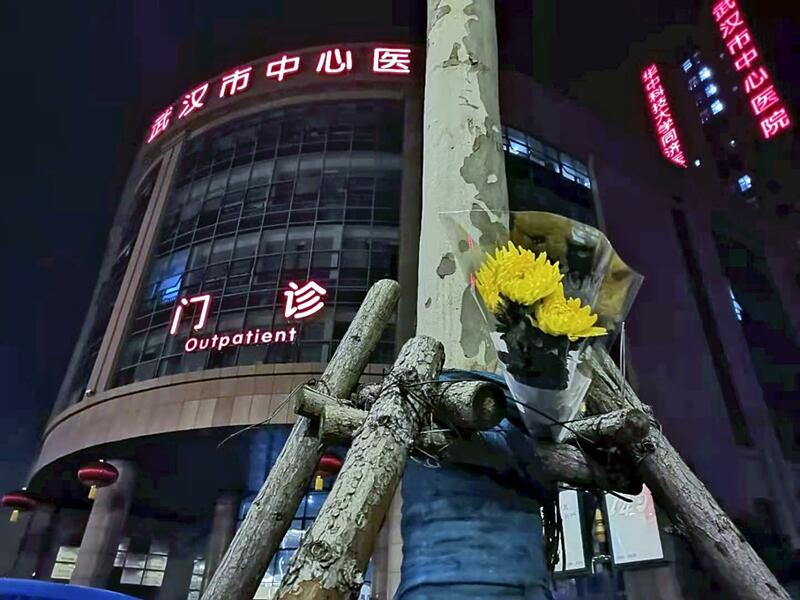
Before dawn Sunday, three police vehicles were patrolling around a hospital where Li worked. Areas near doorways of the hospital were blocked by fences on which "being repaired" signs were posted. The fences were suddenly set up several days ago.
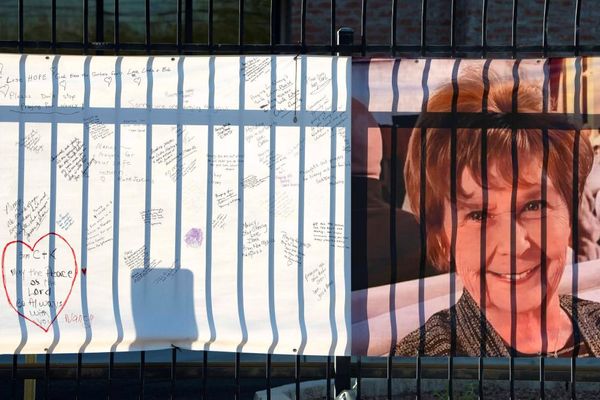
Chrysanthemum bouquets and other items dedicated to Li, which had been placed on trees and exterior walls of the hospital, all disappeared by Sunday morning. It seems that they were carried away by the authorities.
The authorities were initially harshly criticized because they punished Li on charges of spreading false information.
Later, the authorities nullified the punishment and gave Li the title of "martyr." The title is given to Chinese who have performed acts of devotion for the nation.
But on Sunday, police deterred people from entering the cemetery where Li's grave is located.
Human rights activists in Wuhan produced a statue of Li with money donated by about 100 people in China and abroad. But they have not been able to find a place to set up the statue because of pressures from the authorities.
In Beijing, artist Wang Peng prepared to hold an exhibition to mourn Li in late January. But his studio was demolished by the local authorities, on the purported grounds that the studio had been illegally built.
It is said that Wang received a warning: "The exhibition is not permitted. Don't taint the nation's image."
While Li was hospitalized, he argued for the importance of diverse opinions during an interview with a Chinese magazine. He said, "A healthy society should not be dominated by a single voice."
However, the Chinese authorities have not listened to Li's voice, and instead have been trying to blanket the nation with propaganda that infections in China were contained by the leadership of the administration of President Xi Jinping.
A female doctor who was a colleague of Li and who treated infected people turned down a request for an interview from The Yomiuri Shimbun. She explained, "I was warned by authorities and told I must not be interviewed by foreign media."
Li was an ophthalmologist at Wuhan Central Hospital. On Dec. 30, 2019, he posted a message on a social networking website, "Seven people were diagnosed as having SARS [severe acute respiratory syndrome] and isolated."
The following day, the Wuhan city government announced that it was confirmed that there were patients suffering from pneumonia with an unknown cause.
On Jan. 3, 2020, local police admonished Li, alleging that he spread false information. On Feb. 1, 2020, Li revealed that he was suffering from pneumonia after being infected with the novel coronavirus. He died before dawn, on Feb. 7.
Read more from The Japan News at https://japannews.yomiuri.co.jp/