Bereaved families have been experiencing a lot of issues regarding expenses for funerals for coronavirus victims, and are being charged hidden fees for the disinfection and safekeeping of the bodies of their loved ones before a funeral.
The National Consumer Affairs Center has so far provided 20 consultations for families of those who died from the coronavirus that claim that funeral service operators have been charging them a hefty sum.
They have complained that such firms are racking up the costs under the pretext of disinfection fees, among other expenses. Such complaints are believed to come from the lack of uniform guidelines in the industry.
"Preparing for a family member's funeral is very important, and families should consult with several funeral service operators before a person passes away," an official of the center said.
In mid-April, a man in Tokyo had cremated his elderly father, who died of the coronavirus, and was surprised to receive a bill from the funeral service operator along with his father's ashes.
"Disinfection had cost more than 30,000, yen and I thought that was very expensive," he said.
A funeral was held only for the cremation service, and a vigil and memorial service were not held out of concern for infections.
Although the cost for a cremation service would normally be about 200,000 yen to 300,000, yen the firm charged about 500,000 yen.
The breakdown of the bill included a 33,000 yen charge for disinfection to prevent infection, and a 39,600 yen charge for holding the body before cremation. The operator provided no prior explanation of these charges to the man.
His father, who was looking forward to attending day care services for the elderly, suddenly developed a high fever and was admitted to a Tokyo metropolitan hospital in early April.
For two weeks, from the time the infection was confirmed to his death, the son was not allowed to see his father or attend his deathbed.
"At least [a photo of] the family will be with you when you leave" he thought, hoping that a photograph of the family would be placed in the coffin, but he was not allowed to do so.
"Perhaps [these measures] were important to prevent the spread of the infection, but I wanted the operator to explain these things to me in detail," he said.
The funeral service operator declined to comment.
Funeral service operators that handle the bodies of infected people cover them with bags and disinfect the vehicles that transport them, making the total cost more expensive, according to Susumu Takahashi, representative director of a nonprofit organization for information on funerals, which includes funeral service operators.
"I think 500,000 yen is a lot for only a cremation service," Takahashi said. "To avoid being suspected of piggybacking expenses, funeral service operators should show a detailed breakdown of costs."
Since April, when the spread of the virus became more serious, the center has received 20 complaints about funerals from families nationwide who lost loved ones to the virus.
The complaints include such things as, "I was charged 300,000, yen nearly double the usual amount, for protective clothing and other expenses," or "I was advised to hold a funeral ceremony in a spacious and expensive hall to avoid the Three Cs, even though the number of people who attended the funeral was less than 10."
The Three Cs are closed spaces, crowded places and close-contact settings.
According to the All Japan Funeral Directors Co-operation, a Tokyo-based association of funeral service providers, there is no uniform standard for funeral expenses, and it is up to funeral firms to decide whether or not to charge for disinfection and other expenses.
"It may become difficult for a bereaved family to refuse the service if the prevention of infection is emphasized more than necessary," an official of the center said. "It is recommended that families remain calm and get quotes from several funeral service operators."
Funeral service firms and cremation operators are also looking for ways to handle "living in the coronavirus era."
Linkmore, a funeral service provider in Aomori, started offering online funerals for free in April by livestreaming the service on YouTube.
The service is very popular among mourners living in the Tokyo metropolitan area as they are hesitant to return home because they are concerned about the spread of infection, the firm said. So far, Linkmore has held five online funeral services.
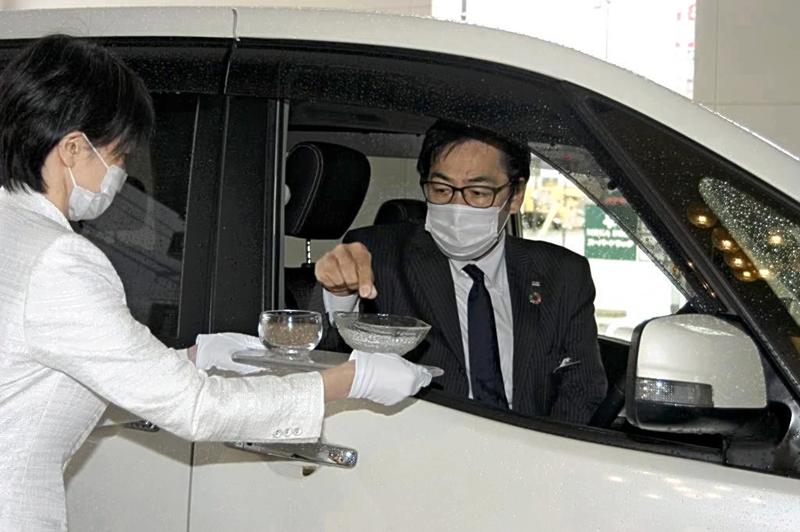
The company also offers a drive-through condolence service, in which people can burn incense while remaining in their cars.
"We created this service so people can pay their last respects to the deceased with peace of mind while avoiding the Three Cs," Linkmore President Motoyuki Funahashi said. "We hope to continue offering this new style of funeral service even after the coronavirus crisis for the benefit of the elderly, who may find it difficult to [physically] attend the ceremony."
Read more from The Japan News at https://japannews.yomiuri.co.jp/