St Cuthbert’s Church in Kentmere sat plain and pious against a backdrop of bulging volcanic terraces descending from a heavy autumn sky. Perched on a slight raise, the pairing of religiosity and mountain spectacle was positively Alpine.
A local couple walked past as I was admiring it from the road into Kentmere village. “It doesn’t have stained glass in the windows,” said the woman, almost apologetically. “But from inside you can see the fells all around, so why would you need it?”
In Kentmere, as elsewhere in the Lake District, cataclysm and cuteness go hand-in-hand; sheep graze amid glacial wreckage and huge boulders are inventively incorporated into dry stone walls. Above those pretty pastures rise fells which, though inconsequential in height and smoothed by age, can still evoke the sublime shiver that is the hallmark quality of mountains anywhere in the world.
We climbed Garburn Pass into a ceiling of grey, not relishing the prospect of completing all 12 miles of the Kentmere Horseshoe in a dim cloud-cocoon. It was an even denser murk than the one Lakeland usually offers, sending the day into premature dusk and me into subdued introspection.
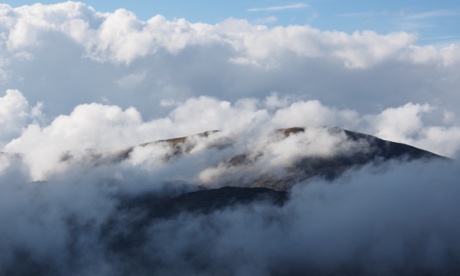
Then somewhere around Yoke, a transformation began to unfold. Imagine the exultation of being in a plane surfacing into open sky, but drawn out over an hour. Blue sky and tall towers of cumulus appeared, then fog-wreathed mountains, their tops gasping in the clear air. Mist lapped against Ill Bell’s craggy eastern side. A humble ridge became a breathtaking aerial walkway; even the sheep took on a momentarily epic appearance. Mountains are measured not in size, but in atmosphere.
Just after we descended Froswick, the sun hit the ridge, and everything was the fire and rain of autumn. Ripped-up remains of clouds evaporated slowly. Moisture sparkled like diamond dust in grass the colour of turmeric. The remaining miles, with views stretching from the golden Pennines to a burning Irish Sea, felt like a gift.