Veteran female athletes who've participated in the Olympics and won medals after giving birth have had various thoughts about career-family-life balance.
They looked back on careers during which they experienced not only the joy and fulfillment of being mothers, but also conflict.
Tomomi Okazaki, a 48-year-old speed skater who starred for Japan at the 1998 Nagano Winter Olympics by earning the bronze medal in the women's 500 meters, was one the country's top speed skaters for years.
There was a time when she figured her life would be all competition and nothing to do with child rearing. But at the end of 2010, after competing at the Vancouver Olympics earlier that year, she gave birth to a daughter.
Okazaki returned to skating the following year and set a goal of skating at the 2014 Sochi Olympics, but was unable to make it happen.
Speed skating requires explosive power. Okazaki, who was in her early 40s at that time, looked back on the days and said, "Aging also affected [her failure to qualify for the Olympics].
"I wonder if nursing my child led to loss of nutrients. I wasn't able to get back to my normal weight [after giving birth], and I wasn't able to get back to my peak self," she said.
However, she said the moments when she was at her best as a mother combined for an unparalleled experience.
"My dream of going to the Olympics with my child didn't come true, but I did all I could as an athlete," she said.
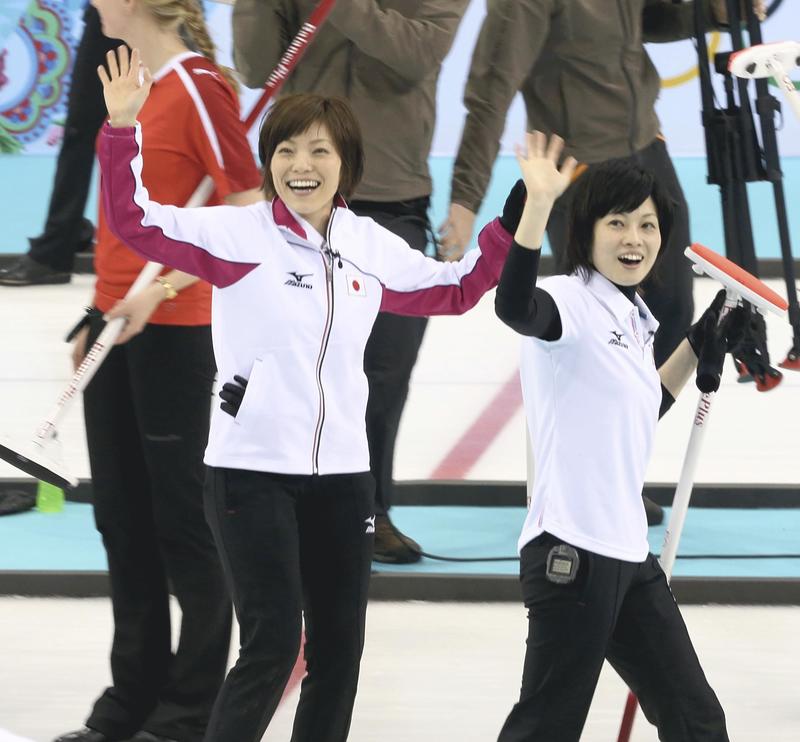
Ayumi Ogasawara, a 41-year-old curler who gave birth to her first son in 2009, returned to the sport in 2011 after a hiatus.
The construction of an exclusive curling facility near her home in Sapporo became a major factor in her continuing the career. It was also significant to have a fellow mother who was as an athlete.
"[Yumie] Funayama gave birth around the same time, and as the members of the team slowly came together, I made the decision [to continue curling]," said Ogasawara, whose team -- which included Funayama -- was fifth at the Sochi Games.
"In foreign countries, many female athletes give birth and go on as usual, and that is common. I didn't think I was doing anything new at all."
In addition to the unique circumstances of curling, which is a sport you can do at any age, it was also important to have support from the group around her, though small in size.
Okazaki also received financial assistance from the Japan Skating Federation to cover travel costs for family members who accompanied her to domestic competitions and cared for her daughter.
Top athletes cannot avoid being separated from their children during overseas trips, but veteran skaters have pushed ahead.
Said Ai Otomo, a 38-year-old volleyball player who gave birth to a girl in 2006 and returned in 2008: "I was worried every day that I was making my daughter feel lonely because I didn't have much time with her.
"[Still,] I set a goal of getting a medal in the Olympics and returning the favor to the people who supported me and my daughter."
She achieved that goal with a bronze medal at the 2012 London Games, the first medal in 28 years for Japan in women's volleyball.
"It's harder than people imagine. It was hard for me and my family," Ogasawara said. But she encouraged active athletes by saying, "If you are in an environment that allows you to do what you want and you make your own choices, you won't have any regrets, no matter what the result is. You will have a fulfilling life."
Read more from The Japan News at https://japannews.yomiuri.co.jp/