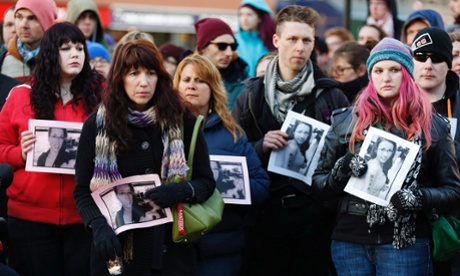
The mother of Rehtaeh Parsons, the Canadian teenager who killed herself after a photograph of her reported rape was passed around school, has spoken out in support of the decision to let the boy who took the image walk free from court without serving any jail time.
Judge Gregory Lenehan, sitting in a youth court in Halifax on Thursday, provoked a storm of protest on Twitter when he sentenced the then teenager, now aged 20, to a one-year conditional discharge. “Someone hunting deer out of season would be given more punishment,” said one angry respondent, while another wrote: “How do we teach our daughters they are worthwhile when the criminal justice system says they are not?”
But in a post on the memorial page she maintains for her daughter on Facebook, Leah Parsons commended the judge for his sentencing comments that showed, she said, that “he truly understood the many layers of suffering Rehtaeh endured”. She asked those who had felt despondent about the decision to let the male defendant walk free to reflect on what kind of justice they wanted the court to serve.
“There is nothing that will bring my daughter back. I cant [sic] go back in time so what is justice? A jail cell? What would jail do to help the situation?”
Parsons wrote that in her vision of justice, “We need to pray for that male that he becomes the type of person the judge hoped he would become. One that values women and feels remorse, one that moves on in his life to reflect his lessons. We dont [sic] need more angry males out there for another female to cross paths with and be assaulted.”
Rehtaeh Parsons died on 7 April 2013 after she was taken off life support, having attempted to commit suicide three days earlier. In November 2011, then 15, she attended a small gathering including four male friends in which she got drunk. As she was vomiting out of the window, she was allegedly raped, and the photograph of the event was then disseminated around her school.
She reported the incident to police, but nine months later they said they were not pressing charges as there was insufficient evidence of sexual assault. The taking and distribution of the image was a “community matter”, not a criminal one, Rehtaeh’s parents were told.
After her death, and amid a nationwide outcry, the case was reopened and one of the boys, the one sentenced on Thursday, was charged with producing child pornography. He pleaded guilty in September.
The yearlong taunting and humiliation that Rehtaeh endured before she died prompted deep soul-searching across the country, leading to the passing of a new law against cyber-bullying. Even after this week’s sentencing, the case continues to provoke outrage because of a court-imposed ban that prevents Canadian media outlets from mentioning Rehtaeh Parsons’s name, despite persistent pleas from her parents that she should be honoured in death by being identified.
In the wake of the ban, Canadian publications refer to Rehtaeh as merely “the girl in a high-profile Halifax child pornography case”. Local Twitter feeds allude to her under the campaigning hashtag #youknowhername.
During sentencing, the judge described the photo taken of her alleged rape as “vile, degrading, dehumanizing”. He said the defendant “should never forget the promising, vibrant young life that was eventually destroyed by his choice to record an act of sexual degradation”.
“In a few seconds, you set in motion a series of events that led to a great deal of shame, humiliation, anger, despair, anguish, loss, hurt and destruction for Rehtaeh Parsons, for her family, for you, for your family, for the entire community,” he said.
In comments read to the court before the sentence was issued, Leah Parsons set out what she hoped for her daughter’s tormentor: “I wish that he make a life for himself where other females he encountered are treated with respect and dignity. That he somehow learns to value females and that he does so in memory of my daughter. To me, that is the only way to move forward in a healing manner. What I do know is that I have to forgive him. I know this to be true.”
Rehtaeh’s father, Glen Canning, told the defendant: “It’s hard knowing that (my daughter), being the person she was, would have forgiven you if you’d only said you were sorry.”