Summary
Just after midnight in Baghdad, we’re going to close our rolling coverage of the first day of the battle for Mosul, the largest military operation in Iraq since 2011, with a summary of the last 24 hours’ events.
- The first day of a long awaited mission to retake Mosul from the Islamic State (Isis) ended with Iraqi forces “ahead of schedule”, according to the Pentagon. “By midday they had achieved roughly what they had intended to do,” spokesman Peter Cook said. “It’s day one, it’s early, but this had kicked off certainly the way the Iraqis had hoped.”
- Starting at about 6am Baghdad time, about 30,000 coalition forces advanced on Mosul: Iraqi troops from the south, Kurdish peshmerga from the east and US air strikes and ground special forces supporting both. Some 6,000 jihadi militants, some who set oil and tire fires to hide their positions in smoke, are believed to be in the city.
- By 10pm local time, Kurdish president Massoud Barzani said the peshmerga had taken approximately 80 miles (200km) of territory from Isis, and commanders said they had cleared nine villages.
-
Isis militants laid IEDs throughout the towns and sent a series of suicide attacks on Kurdish and Iraqi forces, slowing the march. Near Mosul, the Guardian’s Martin Chulov saw a fighter jet “engaged in a kind of cat and mouse game with a very active Isis mortar team”, and throughout the day Isis fought Iraqi and Kurdish forces with small arms and artillery.
- The Pentagon said about 5,000 American military personnel are in Iraq, and that special forces are advising Iraqi and Kurdish units and guiding strikes, some near the outskirts of the city. “We are crystal clear that Americans are in harm’s way in Iraq, but they are not in a lead role,” Cook said.
- One resident told the Guardian that Isis militants are trying to hide among civilians, storing IEDs in family homes, and are riding through the city on motorcycles to evade airstrikes. “People have had enough in Mosul,” he said. “We have seen too many beheadings, people being drowned in cafes, thrown from buildings.”
- About a million civilians are believed to remain in Mosul, and hundreds of thousands of children are thought to be in danger. The United Nations and aid groups fear a humanitarian crisis of as many as 700,000 people. The groups have set up refugee camps, able to hold about 60,000 people, in nearby Kurdish-held territory.
- Iraqi prime minister Haider al-Abadi addressed the nation early Monday, telling residents in Mosul: “These forces that are liberating you today, they have one goal in Mosul, which is to get rid of Daesh and to secure your dignity. They are there for your sake.”
- The coalition against Isis intends to drop seven million leaflets in 48 hours over the city, which Cook said would either warn civilians how to flee or have “some specific guidance as to the safest place to be in your homes, if there’s air strikes or artillery or if the fight comes to be in your neighborhood.”
- Residents and Saudi Arabia’s foreign minister warned against allowing Shia militias join the fight against Isis, for fears of the sectarian violence that so traumatized Iraq in the civil war of the 2000s. Mosul’s post-Isis fate is also uncertain: it could become a humanitarian crisis, and the city has significance to Kurds and Sunni and Shia Arabs.
Updated
A Kurdish television network, Kurdistan24, recorded footage – earlier today of the moment a vehicle-based IED exploded in an attack on coalition forces.
The film was taken at some distance, but the ensuing explosion is massive enough to veil nearby vehicles in clouds of dust and sand.
Near the front lives of Mosul with the men and women of the Kurdish peshmerga, my colleague Martin Chulov reports from the front lines, 10 miles from Mosul. “I know how much they would hate getting killed by a woman,” Lt Nivan Vechivan, 23, told him.
“It would be my honour to kill them.” Her soldiers, all in their early 20s, nodded in agreement. “We would all be martyrs if we had to be,” added another.
Minutes later, a large mortar thumped into the soil next to an armoured truck less than 40 metres away. Then came a second shell, which nearly scored a direct hit on a still-working digger. The Isis mortar team had maintained its range and rhythm, despite the Kurdish attacks.
Analysis Five key questions about the battle for MosulIraqi and Kurdish Peshmerga forces have begun a ground assault to oust Islamic State from Iraq’s second biggest cityRead more
Back up the mountain, another smoke fire had been lit in an area that seemed to be behind Kurdish positions. The fire came from a cluster of homes set against Bashika mountain, which the Kurds had bypassed as they pushed ahead. Two more mortars, which had to have come from the same area, crunched into the peshmerga command post, one damaging a home and the other nearly killing a group of men walking just below.
Further along the road to Erbil, a large empty refugee camp stood in the dust waiting to receive inhabitants that are yet to arrive. Aid agencies guess that more than 1 million people will attempt to flee Mosul and its surrounds as the offensive pushes closer. For now though, those who are able to leave are making long, difficult journeys to another camp, Dibaga. There, one man who arrived from Mosul on Sunday said the terror group was becoming ever more ruthless as pressure mounted on its last urban redoubt in Iraq.

“Isis became terrible with the residents lately,” said the man, 28, who claimed to have been part of a nascent resistance unit along with his brother, uncle and father. “Their situation is awful and they have started to flee. We haven’t seen many of them in the street lately, even at the checkpoints. There is no security. We’ve been arrested by them. They said we were (Mosul resistance). They knew we were planning to leave and they came to my house. We decided to run, because they were going to kill us. We all left at night, all the women too. We went to another house and then we left the city through a farm.
“You see them most at night. That’s when they leave their bases to make checkpoints and ask for identification. They’re mostly from Mosul. The foreigners left a while ago. I don’t know where they went. They have made a lot of trenches around the city. That’s all they can do. Burn things and run.”
Updated
Mosul resident: Isis trying to hide with civilians
A 35-year-old Mosul resident, using the pseudonym Abu Mohammed, has told Fazel Hawramy, reporting for the Guardian, that Isis forces are trying to mix into the population, and that civilians have seen “too many beheadings, people being drowned in cafes, thrown from buildings”.
Everyone is staying at home because we don’t know what else to do. Daesh [an Arabic acronym for Isis] are mostly moving around on motorbike and have small and heavy guns. The planes started bombing Mosul around one in the morning today, and they are in the sky constantly and occasionally striking targets. I would say the airstrikes are very precise but around 10% of casualties, in my estimate, are civilians.
Daesh are moving into civilian houses and mixing with the population. For example Daesh has placed a large depot of IEDs in a house next to my cousin’s. I begged him to leave his house and bring his family to stay with me, as the house could be targeted by coalition. He refused and said [he accepts] whatever destiny brings.
People have had enough in Mosul. The majority want Daesh to go as soon as possible and would like to see the Iraqi army and peshmerga to enter the city.
We have seen too many beheadings, people being drowned in cafes, thrown from buildings, etc. People have even offered to sacrifice animals if they see Daesh [go[ and get rid of them. I myself saw a man thrown off a building near the governor’s office around three months ago. I could not sleep for a week afterwards.
It’s difficult for civilians to leave the city because a ditch has been dug around many neighborhoods, especially east of the city. There is also fighting – we cannot leave our houses.

Updated
Kurdish president: Peshmerga take 80 sq-miles from Isis
The head of Iraq’s Kurdish region, Massoud Barzani, has said in a statement that Peshmerga forces have retaken 80 sq-miles (200 sq-kilometers) from Isis on the first day of the campaign.
Barzani called the gains a “turning point in the war against terrorism,” but warned defeating Isis in the city would not mean the end of sectarian violence or terrorism in Iraq.
He added that Kurdish forces will not enter the city itself, and declined to say who would govern territory seized by the Peshmerga. In the past, Kurdish officials have said all territory retaken by the peshmerga will be incorporated into the largely autonomous Kurdish region.
The general command of peshmerga forces also released a statement, saying that as of 10pm local time, their troops “had achieved their key objectives: clear nine villages and extend control over the Erbil-Mosul road.”
In less than 24 hours nine villages were cleared in an area measuring approximately 200 square kilometres. The villages include Baskhira, Tarjala, Kharbat Sultan, Karbirli, Bazgirtan, Shaquli, Badana Bchuk, Badana Gawre, Shekh Amir and a tile factory West of Hasan Shami.
Peshmerga forces also secured an additional significant stretch of the Erbil-Mosul road. The operations in east and south Mosul are in coordination with Iraqi Security Forces in a shared effort to clear Isil from Ninevah province.
Global coalition warplanes attacked 17 Isis positions in support of Peshmerga forces. At least four Isis VBIEDs were destroyed. Counter-IED teams will continue to clear the heavily-mined area.
The region’s prime minister, Nechirvan Barzani, also released a statement, calling the campaign “an important event for the entire world since Isis used the city as a launching pad for attacks”. He praised peshmerga troops’ “resilience and heroism against the most dangerous terrorist organization in the world”, and said the Kurds are “proud to protect all different ethnic and religious groups in the region”.
You can read his full statement here.

Updated
The UN’s humanitarian coordinator for Iraq, Lise Grande, has said that in a worst case scenario about 700,000 civilians would need shelter – far more than the 60,000 capacity of current emergency cites.
The displacement could become the single largest, most complex humanitarian operation in the world, the AP reports.
“Our capacity to support 700,000 people in the short-term we couldn’t do it. And certainly if we had to mount a response over the intermediate-term, if they couldn’t go back to Mosul quickly, if there was too much damage in the city, then it would test us to breaking point,” Grande said.
The news agency has also spoke with Iraq’s commander of the joint military operation, army lieutenant general Talib Shaghati, who said the campaign “is going very well”.
Shaghati declined to give details in the interview, which took place in the town of Khazer, but said troops were moving according to plan.
He praised the role of the U.S.-led International Coalition as “very important” through carrying out airstrikes and sharing intelligence. Citing intelligence information, he claimed some IS militants were fleeing Mosul to Syria along with their families.
The AFP’s Ammar Karim is also on the ground near Mosul, where he has tweeted figures from the coalition and video of Iraqi forces.
Steady progress on all fronts in first day of #Mosul operation. Coalition strikes destroyed 52 targets in 24 hours.
— Ammar karim (@ammar_afp) October 17, 2016
#Iraq 9th division advances toward #Mosul from south eat, several villages has been recaptured . pic.twitter.com/HYRy1xwTfD
— Ammar karim (@ammar_afp) October 17, 2016
What we know so far
- The first day of a long awaited mission to retake Mosul from the Islamic State (Isis) ended with Iraqi forces “ahead of schedule”, according to the Pentagon. “By midday they had achieved roughly what they had intended to do,” spokesman Peter Cook said. “It’s day one, it’s early, but this had kicked off certainly the way the Iraqis had hoped.”
- Starting at about 6am Baghdad time, as many as 30,000 coalition forces advanced on Mosul: Iraqi troops from the south, Kurdish peshmerga from the east and US air strikes and ground special forces supporting both.
- The Pentagon said about 5,000 American military personnel are in Iraq, and that special forces are both advising Iraqi and Kurdish units and guiding strikes, some near the outskirts of the city. “We are crystal clear that Americans are in harm’s way in Iraq, but they are not in a lead role,” Cook said.
- Peshmerga seized seven villages east of Mosul, but their progress was slowed by IEDs, and Isis claimed to have sent a series of suicide attacks against Kurdish forces. Near Mosul, the Guardian’s Martin Chulov saw a fighter jet “engaged in a kind of cat and mouse game with a very active Isis mortar team”, and throughout the day Isis fought Iraqi and Kurdish forces with small arms and artillery.
- About a million civilians are believed to remain in Mosul, and hundreds of thousands of children are thought to be in danger. The UN and aid groups fear a humanitarian crisis, and have set up refugee camps in nearby Kurdish-held territory.
- The coalition against Isis intends to drop seven million leaflets in 48 hours over the city, that Cook said would either warn civilians how to flee or have “some specific guidance as to the safest place to be in your homes, if there’s air strikes or artillery or if the fight comes to be in your neighborhood.”
- Residents and Saudi Arabia’s foreign minister warned against allowing Shia militias join the fight against Isis, for fears of the sectarian violence that so traumatized Iraq in the civil war of the 2000s. Mosul’s post-Isis fate is also uncertain: it could become a humanitarian crisis, and the city has significance to Kurds and Sunni and Shia Arabs.
Updated
The Pentagon spokesman elaborates a bit on efforts to alert Mosul residents about the dangers of the mission, noting leaflets, radio broadcasts and a television broadcast earlier today by prime minister Haider al-Abadi.
The instructions are meant to “make [residents] as aware as possible of the dangers they face, and they’re not insignificant, of course,” Cook says.
A reporter asks about the spat between Ankara and Baghdad over the presence of Turkish forces in Iraq to fight Isis.
“Our advice to the Iraqis as to the Turks is to sit down and discuss” their disagreements, Cook says. “Forces operating in Iraq, international forces, need to be there at the consent of the Iraqi government.”
He says it’s at the discretion of al-Abadi’s government to decide whether other groups, such as Shia militias – who with Sunni militias sowed chaos during Iraq’s brutal, post-invasion civil war – will take part in the fight. A Mosul city councilman told the Guardian earlier on Monday that he and his colleagues had urged al-Abadi not to let Shia militias join the fight for fear of sectarian violence.
With that, the briefing concludes.
Cook calls the assessment of Mosul over the last two years as “pretty abysmal” under Isis, and that although the coalition is worried about the humanitarian situation, “the goal first of all is to remove Isil”.
He says the coalition plans to drop 7 million leaflets in Mosul over the next 48 hours to try to educate the residents of the city on how to stay safe or, if possible, escape Mosul.
“Certainly there has been resistance from Isil,” Cook says, alluding to footage of artillery, small arms combat and explosions circulating online. “This is a big fight with multiple locations so fighting may be more intense in some locations than others.”
A reporter asks about the simultaneous campaign in Syria, and Cook says the Pentagon is optimistic: “We think Isil is on the run, both in Syria and Iraq, and that’s a good thing.”
Another asks whether the US intends to send special forces on the ground to assist Turkish troops who have had recent successes in Syria. “You know me better,” Cook replies, “than for me to tell you where US special forces are going anywhere in the world.”
My colleague Julian Borger, who is at the briefing, asks about the leaflets being dropped for the residents of Mosul.
“These leaflets make clear that help is on the way,” Cook says. “There may be some specific guidance as to the safest place to be in your homes if there’s airstrikes or artillery or if the fight comes to be in your neighbourhood.”
He says that in certain parts of the city residents are being warned to stay in their homes, “because they may be safer in that context than trying to flee the city.”
Updated
“Most American forces are not anywhere close to the frontline,” Cook says, but he concedes that many remain in danger near Mosul and elsewhere in Iraq.
“We are crystal clear that Americans are in harm’s way in Iraq, but they are not in a lead role.”
The Pentagon spokesman says Isis has had two years to prepare for this campaign by setting traps in and around Mosul, “to plant IEDs to do what they can to make life more difficult for the Iraqi security forces, certainly to make life more difficult for the people of Mosul.”
He calls Isis “an enemy with a substantial ability to make life much more difficult”.
Cook is again asked about Iraqi progress in the campaign. “This is the biggest military operation we’ve had in Iraq by the Iraqi forces,” Cook says. “Plenty of Americans have contributed to getting Iraqi forces into this position.
“By midday they had achieved roughly what they had intended to do. It’s day one, it’s early, but this had kicked off certainly the way the Iraqis had hoped,” he says. “Day one, so far, has gone according to plan.”
He is asked whether there is an indication that Abu Bakr al-Baghdadi, the leader of Isis, might be in Mosul.
“I don’t have any information at this time,” Cook says.
Updated
“There are Americans on the outskirts of the city,” Pentagon spokesman Peter Cook tells reporters, “but I’m not going to get into the disposition of every single American”.
He declines to get into any specifics about the movements or positions of various forces. “I can’t speak to the movement of every single Iraqi brigade or every single American.”
“There was a plan for Americans to provide that advisory role as they have through the course of this,” he says. “It is too soon to say at this point where these movements will go, where these Americans will go in this advisory capacity.
“But what is important is that it will be the Iraqis in the lead.” He says Americans “are behind the forward line of troops, and they are providing the same sort of advice and assistance in Iraq as they were previously”.
Cook is asked about the plan for if and when Isis militants are ousted from Mosul, but declines to get into specifics. “We do have concerns about the humanitarian situation,” and he says simply that the US has been coordinating with Baghdad and the UN.
Updated
Pentagon: Iraqi forces are ahead of schedule
Peter Cook, a spokesman for the Pentagon, is holding a press conference about military operations in Iraq and Syria.
He begins by hailing “significant progress in northern Syria”, noting that Turkish and Syrian rebel forces have taken six villages, including Dabiq, the town that plays a key role in Isis’s apocalyptic mythology. Their propaganda magazine is named after the town, Cook notes.
He thanks Turkish forces for their cooperation, in particular, and moves on to the campaign on Mosul.
The operation began at 6am Baghdad time, Cook says. “On the first day of what we assume will be a difficult campaign that will [take] some time,” he continues. He can say that Iraqi and Kurdish forces “have met their objectives so far and that they are ahead of schedule”.
“The enemy gets a vote here,” he warns, noting the very early stage of the campaign. “We will see whether Isil stands and fights.”
“We’re on day one here,” he says.
He explains a bit about US involvement in the campaign, saying there are about 5,000 American military personnel in Iraq, “many of those people are in enabler roles, they may be trainers”, and that there are “a number of people providing logistical support”. Earlier on Monday a general acknowledged that there are JTACs, the elite units that guide airstrikes from the ground.
Cook says any target on the ground would be screened by both American and Iraqi commanders. “We are not doing anything in this fight without the consent and approval of the Iraqi government.”
“We’re going to be deferring to the Iraqis because this is their fight,” Cook says. He says that in the last month the US-led coalition has launched more than 10,000 strikes, including more than 70 in and around Mosul.
He also notes that Mosul, like Dabiq, has a symbolic role to Isis: it is where the group’s leader, Abu Bakr al-Baghdadi, announced a “caliphate”, and the city had a diverse, multi-ethnic and multi-faith population of a million people before Isis took control.
Pentagon's Spokesman Peter Cook says Apache helicopters not used in #Mosul so far.
— Zaid Benjamin (@zaidbenjamin) October 17, 2016
Updated
IEDs slow Kurdish advance
AP reports that as columns of armored vehicles have moved toward Mosul, Kurdish forces have captured several small, mostly unpopulated villages to the east of the city.
But their progress was slowed by roadside bombs left behind by the militants, and IS unleashed a series of suicide car and truck bomb attacks, one of which struck a Kurdish tank. It was not immediately clear if there were any casualties from that incident or fighting elsewhere.
Long columns of armored vehicles followed by hundreds of pickup trucks advanced on a cluster of some half dozen villages on the Ninevah plain outside the city. The area, historically home to religious minorities brutally oppressed by IS, was almost completely empty of civilians, allowing air power to do much of the heavy lifting.
Lt Col Mohammad Darwish of the Kurdish forces known as peshmerga said the main roads and fields were littered with homemade bombs and that suicide car bomb attacks had slowed the troops’ progress.
A peshmerga major said some Kurdish fighters entered the villages in Humvees, “but they didn’t do anything, not even walk outside on the street.” He spoke on condition of anonymity as he was not authorized to brief the press.
The major said his men were still waiting for engineering teams to clear the villages. But just a few hundred meters from the front line a bomb disposal team sat idle hours after the operation began, explaining that they had not yet received orders to deploy.
An estimated 25,000 to 30,000 troops are involved in the offensive, including Iraqi military forces, Kurdish peshmerga and Sunni tribal forces. Reuters reported that helicopters and explosions could be heard near the city’s eastern front, and that an estimated 4,000 to 8,000 Isis militants are thought to be in Mosul.
“Daesh are using motorcycles for their patrols to evade air detection, with pillion passengers using binoculars to check out buildings and streets,” Abu Maher, using an Arabic acronym for Islamic State, told the news agency.
Reuters and AP both report that aid groups fear a crisis for civilians trapped or trying to flee the city. “Civilians who attempt to escape the city will have little choice but to take their lives into their own hands and pray that they are able to avoid snipers, landmines, booby traps and other explosives,” Aleksandar Milutinovic, the International Rescue Committee’s Iraq director, told AP.
“We set up a fortified room in the house by putting sandbags to block the only window and we removed everything dangerous or flammable,” Abu Maher said. “I spent almost all my money on buying food, baby milk and anything we might need.”

Updated
Khalaf al-Hadidi, a member of Mosul’s city council who now lives in Erbil, the Kurdish stronghold, has told my colleague Mona Mahmood that the council is doing what it can to help the military operation with a plan to help displaced civilians – and to convince those civilians that they should help the Iraqi army by reporting human rights violations.
“We have also set up an emergency plan to deal with any abnormal circumstances up till the Iraqi forces get into Mosul,” he said.
Mosul’s city council has 15 members, he said, “and we are all working now with the military forces to provide them with logistical information of sensitive places in Mosul, and how to avoid targeting heavily populated areas during the battle against Isis.
I live in Erbil but I went today to al-Qader district near the town of al-Hamdaniya, the backward lines of the military operations. The visit was meant to find out whether there are any civilians fleeing the city. We have prepared a camp of more than 6,000 tents for locals who might get stuck during the battle. We also asked the military forces to provide us with some information to guide the besieged civilians on how to flee the city through safe routes.
However, I learnt that the military forces are urging the civilians to stay at their homes because they have put a sealed security plan, which entails careful targeting of Isis sites to try to avoid harming civilians and their possessions.
I left Mosul the day Isis took over the city two years ago, because I’m a member of the city council and they were chasing all Mosul politicians and key men to kill them for collaborating with the Iraqi government. I was a headmaster of a secondary school in Mosul before I joined the council.
Hadidi added that the council adopted a decision, which it passed to the Iraqi government, to reject the participation of Shia militias in the mission to retake Mosul. “We do not want to go back to the time of sectarian war and killing civilians. The involvement of Shia militias would have hurt morale.
“Today the prime minister confirmed that no Shia militia would take part in the fight. I haven’t seen any of them today, only peshmerga and the Iraqi army.”

Updated
Elite special forces units from the US are playing a major role in the battle for Mosul, my national security editor Spencer Ackerman reports, noting that the fight is the first in a long string of “advisory” operations that US officials have openly acknowledged.
In a statement on Monday morning, the American general in charge of the coalition’s war in Iraq and Syria, Lt Gen Stephen Townsend, openly acknowledged the presence of “forward air controllers” among the US “advisory” contributions to the battle.
Those controllers, known as joint terminal air controllers, or JTACs, and drawn from US special operations forces, are the troops on the ground who spot for airstrikes, in an attempt to ensure greater accuracy of aerial bombardment. Their presence indicates that US troops, while not formally in a combat role, are on the frontlines and willing to use substantial airpower on Iraq’s second city.
The US command’s acknowledgment of their presence is a departure from previous battles in two years’ worth of war against Isis. Members of Congress have criticised the Pentagon for relaying airstrike spotting through coordination cells far from the fight, including in an operations centre in the Iraqi Kurdish capital of Erbil.
Having US troops spotting airstrikes is both the latest departure from Barack Obama’s pledge against having “boots on the ground” and an effort at ensuring greater specificity and lethality against Isis targets in the city.
“JTACs are the difference between precision bombing and area bombing,” said Christopher Harmer, a former US Navy pilot who said their presence indicated the US is willing to “incur casualties” in Mosul.
“With JTACs, you can select individual targets in real time and accurately strike them. Without JTACs, you can only bomb a general area and hope for success.”
The UK and France are also believed to have their own special forces involved in retaking Mosul. Earlier this month, two French special operations forces training peshmerga were seriously injured by abooby-trapped Isis drone that exploded after crashing near them in Dohuk, 46 miles (75km) north of the city.
While it is unclear what specifically the UK and French contributions to the battle are, it is believed British special forces will also aid in calling in airstrikes. France has sent approximately 150 troops to operate four 155mm Caeser howitzers as part of its Task Force Wagram. The French aircraft carrier Charles de Gaulle, carrying 24 Rafale combat planes, is also in the eastern Mediterranean to support the war.
As the long-anticipated battle began on Monday, US warplanes launched substantial bombing runs on positions around Mosul. The US reported attacking three units of Isis fighters, two staging areas for their operations, 12 Isis rally points and even a bridge. Six tunnel entrances, an anti-artillery system, four generators powering communications-signal towers and four mortar systems were destroyed, according to the US military.
In a sign that the coalition is bracing for a gruelling campaign, Townsend said the fight was likely to last “weeks, possibly longer”.
Updated
Fawaz Ali, an engineer from Mosul, who now lives in Turkey, told my colleague Mona Mahmood that his family remaining in the Iraqi city are afraid they may face repercussions from the Shia militias fighting to oust Islamic State. He said:
My family contacted me yesterday to say: ‘Look, we can’t call you any more, all mobiles are monitored by Isis. We just want to let you know that we are OK and Mosul centre is quiet. All the people are staying indoors in fear of bombardment by US jets against the city.’
I cannot go to work here in Istanbul because I’m so worried about my family and uncles. I feel like I’m paralysed and tied to the internet waiting for any glimpse of good news, but I can’t find any relatives or friends from Mosul to talk to, they have all switched off their mobiles because if you want to make a phone call, you have to go upstairs to get a network and you might be spotted by Isis militants.
People are scared of the aftermath of Mosul liberation and that the result would be Shia militia and Iraqi army taking the city, who would start to detain people although they are innocent, accusing them of being Isis supporters … The locals believe that peshmerga is better than Shia militia because they are not sectarian.
I won’t go back to Mosul if it is taken by Shia militia or the Iraqi army to be detained just because I’m Sunni. It is going to be a real disaster to have Shia militia who want to get revenge for Imam Hussein. Neither Isis nor Shia militia are good, they are both pure vice.
Updated
Ranj Alaaldin, a Middle East scholar at the London School of Economics, writes on Comment is Free that victory over Islamic State will not solve Iraq’s problems:
Arab Sunni tribal groups are expected to do most of the fighting in the city itself but these groups have their own rivalries and do not necessarily have support and legitimacy among locals in Mosul, particularly since they receive support and training from rival political factions in Iraq and external powers that are widely disdained by locals …
The conditions that gave rise to Isis in the first place are still there and have been exacerbated, rather than alleviated, over the past two years since the jihadis took control of Mosul in 2014. While President Obama clearly does not want Isis (or rather the “caliphate”) to outlive his presidency, there are no guarantees the US and the international community will continue their support and help to remedy these shortcomings, as well as mediate between rival factions.
In the short and medium term, Isis will continue to commit terrorist atrocities such as the July bombing in Karrada that killed close to 300 people, and it still has its apparatus in Syria as a launching pad for attacks and atrocities elsewhere. This latest offensive on Mosul won’t change that – and without substantial investment for rebuilding it’s unlikely to help Iraq become a more peaceful, stable country.
Updated
Unlike with previous Iraqi-led attacks on Islamic State strongholds, the US has said its troops are on the frontlines.
In a statement, Lt Gen Stephen Townsend, the commander of the coalition taskforce, included forward air controllers among the US personnel “supporting” the invasion of Mosul.
The US is therefore acknowledging it has put people on the frontlines in order to ensure greater precision for aerial bombing in a densely populated urban area.
The absence of spotters in Iraq and Syria, known by their military acronym JTACs, has been a frequent object of criticism for the Pentagon in Congress.
Townsend also prepared the public for “weeks, possibly longer” of battle.
He said:
Earlier today, Iraqi security forces launched their counterattack to liberate Mosul from Isil, also known as Daesh. This operation to regain control of Iraq’s second-largest city will likely continue for weeks, possibly longer. Iraq is supported by a wide range of coalition capabilities, including air support, artillery, intelligence, advisers and forward air controllers. But to be clear, the thousands of ground combat forces who will liberate Mosul are all Iraqis.
This liberation battle comes after more than two years of Daesh oppression in Mosul, during which they committed horrible atrocities, brutalised the people and asserted the city was one of their twin capitals. Isil’s cruelty and reach has shown that they are not just a threat in Iraq and Syria, but to the region and the entire world.
Over the course of these past two years, a coalition of more than 60 nations has united to defeat Isil. We have conducted tens of thousands of precision strikes to support Iraqi operations, trained and equipped more than 54,000 Iraqi forces, and supported our Iraqi partners as they fought to liberate their country.
As we provide our support, we will continue to use precision to accurately attack the enemy and to minimise any impact on innocent civilians. We can’t predict how long it will take for the Iraqi security forces to defeat Daesh in Mosul; but we know they will succeed – just as they did in Bayji, in Ramadi, in Falluja and, more recently, in Qayyarah and Sharqat.
Updated
The success of the Mosul attack will constitute the almost complete reversal of Islamic State’s blitzkrieg advance in 2014, which brought under its control the lives of millions of people in the heart of the Middle East.
My colleague, Jason Burke, has been addressing the question of what this could mean in the longer term. He writes:
Mosul is of profound significance to both Kurds and Arabs, and to Sunni and Shia Muslims. Its recapture may widen faultlines between these communities, rather than heal them. Iraq’s Sunni minority have long felt alienated by the country’s Shia-led government in Baghdad, and it is Shia-dominated government forces who will reoccupy the city.
The defeat of Isis as a territorial power would dramatically rearrange the bloodstained three-dimensional chessboard of the Syrian civil war too. It could potentially benefit the regime of Bashar al-Assad, or other rival Islamic militant groups there, such as the major al-Qaida-linked faction now known as Jabhat Fatah al-Sham. This is a conflict where unforeseen consequences have long been the rule, not the exception.
The most intense discussions have been about the threat an Isis without territory may pose to the west. Many analysts and officials predict a spike in attacks, particularly in Europe. Some of these, analysts predict, will be carried out by trained and commissioned extremists which the group will unleash as it is forced out of its final redoubts. Others will be by individuals who will return to European nations from the Syrian or Iraqi battlefields seeking revenge and, possibly, martyrdom. Then there may be some “freelance” attacks, by angry sympathisers.
Updated
Shia militias will turn Mosul into a bloodbath, Saudis warn
The Saudi foreign minister, Adel al-Jubeir, says Mosul will turn into a bloodbath and mass killings if the Iraqi government allows Shia militias to enter the city, as it has in other Iraqi cities liberated from Islamic State control. In a rare press conference in London he said:
We oppose any kind of involvement by the Shia militias. When they went into Falluja they committed mass atrocities, including a mass grave of 400 people. We tracked what happened on the internet and the amount of traffic for extremist websites and recruitment shot up by 150%.
If they go into Mosul which is many times larger than Falluja I would expect the negative reaction will be tremendous and if there are mass killings, it could end up being a bonanza for violent extremists, and recruitment for Daesh. It could add fuel to the sectarian fires raging in the region and so we have urged the Iraqi government not to use the Shia militias. That is the greatest danger that we see. We actually told them to disband them, and yet they have not. They are being managed by the Iranian Revolutionary Guards. They are brutal.
He added that although there had been reassurances from the Iraqi government about the deployment of Shia militias, he was not sure the Iraqi government was fully in control. He said the Iranians played a role, the Revolutionary Guards played a role, and sometimes the militias acted independently of the government. He said he supported the attack on Mosul, adding: “We support any objective which is to destroy al-Qaida absolutely.”
But he did not propose the Saudis should play a role in the reconstruction of Mosul if it is liberated. He said:
I think the Iraqis have the second largest oil reserves in the world.
There are a number of tribes that extend from Saudi Arabia into Iraq so a lot of Iraqis have kinsmen in Saudi Arabia so our history is intertwined, and so is our future, but we have to get off this sectarian track.
The Iraqis need to find a way to have a more incredible government – they found a way in 2014 when they removed Maliki.
Jubier said that if the Daesh were forced out of Mosul, they were likely to go on to Syria, adding its president, Bashar al-Assad, would allow them to grow.
Updated
My colleague, Mona Mahmood, has conducted a second interview with Iraqis affected by the battle for Mosul. Abu Firas, a father of five, is a secondary schoolteacher from Telafer in Mosul. He recently fled Mosul and now lives in Sulaimaniya.
I’m in Sulaimaniya, counting the days to get back home. It has been a real hardship since I left Mosul seven months ago and fled to Turkey with my family. I stayed in Turkey for 15 days and then returned to Sulaimaniya as I could not cope with expensive life in Turkey. It was so hard to stay in Telafer after Isis militants took over of Mosul. I’m a government employee and did not get a salary for more than a year and a half – how can I feed my five kids?
If I had stayed in Mosul my family would have died, there was no work, no freedom, no life. The strict rules of Isis were a nightmare that I challenge any human being to be able to accept them.
I still have three brothers in Mosul with their families, they said that the battle is still at the suburbs of Mosul. They could not flee because they could not afford the cost of traveling to Turkey. Besides it is very risky, if Isis militants get hold of any one fleeing, they will execute him immediately. I paid more than $2,000 to flee with the help of a smuggler who took us to Syria and then to Turkey.
When Isis first came, they said they came just to change the situation for the interest of Mosul civilians who suffered a great deal of injustice from the Iraqi army. Something that made all the people happy to have them and look at them as saviours from the devil, but it turned that was not right and they began to impose their hardline Islamic doctrine on people. They made our life a complete hell.
When I had to flee I could not take anything with me and thought it was better to let my neighbour stay in my house. At least he would guard it and Isis would not confiscate it. I will get back to Mosul as soon as it is liberated. Only God knows how long the battle will last because Isis won’t give up easily. They have been reinforcing their forces to be ready for the attack. They will not hand over Mosul easily, which is one of their main fortresses in Iraq.
I will get back to my home, even if Shia militia take the city as they did in other Sunni-liberated areas in Iraq. I do not care any more, I prefer to die in my home and not to be a refugee. I will never repeat this mistake again.
I live with my sister in Sulaimaniyia now and we are really struggling to provide the daily basics for the kids. I have run out of all my savings and am borrowing money from sister all the time.
Updated
The UN refugee agency has called on warring parties in Iraq to spare the lives of civilians and not to use them as hostages or human shields, the Associated Press reports.
Speaking to reporters in Baghdad, the UN high commissioner for refugees, Filippo Grandi, says he raised the issue of the protection of civilians with the Iraqi government and received “strongest assurances” from the prime minister, Haider al-Abadi.
Grandi underlined that protection for civilians “will be indispensable for the future of Iraq, for the future in which the people of Iraq live together and build a prosperous country.”

Updated
Isis says it has counterattacked with suicide bombers
An Islamic State news agency says the group has launched a series of suicide attacks targeting Kurdish forces leading the assault on Mosul.
The Aamaq news agency is claiming eight suicide attacks against Kurdish peshmerga and says Isis destroyed two Humvees belonging to the Kurdish forces and Shia militias east of the city on Monday, according to an Associated Press report.
The update comes as US Army Maj. Gen. Gary J. Volesky, the top commander in the US-led coalition in Iraq, says he is confident that the attack on Mosul will succeed.
Mosul will be a hard fight, but the Iraqi security forces are ready. They’ve been waiting to liberate Mosul for two years, and today is the day.
The US is supporting Iraqi and Kurdish with airstrikes, and US soldiers are serving in a support role on the ground.

Updated
The aid agencies War Child and World Vision are also sounding the alert over the risk posed to civilians by the battle for Mosul, echoing the earlier warning from Save the Children that half a million children could be in the firing line.
World Vision has raised concerns that identification documents may have been confiscated during the Isis occupation, which could lead to issues with registration. Separating fathers from the family for protracted periods during screening may also make families vulnerable, the charity has warned.
Khalil Sleiman, World Vision’s response manager for northern Iraq, said:
We’re already supporting half a million people who fled Mosul when it was first occupied over two years ago. We’re now poised for another massive influx of children and families who will have been through horrific experiences most of us could never imagine.
They will arrive with nothing but the clothes on their back and will be thirsty, hungry, and need urgent medical attention.

War Child says it is poised to support thousands of children in locations around Mosul with specialist services including learning spaces, trained education staff and mobile child protection teams. However, it says that more funding is needed.
Sameena Gul, War Child UK’s country director in Iraq, said:
Our staff are working with children who are dealing with the impact of conflict in Iraq every day. The boys and girls we support can face a range of problems, from long-term psychological trauma, sexual assault, recruitment to militias and disruption to education. War Child will be dealing with thousands of children fleeing the fighting in Mosul. It is crucial the international community therefore provides the necessary support to ensure these children are protected from harm.
Updated
Families do not have clear routes of escape from Mosul, aid workers have warned, leaving thousands at risk of being caught in the fighting.
Aleksandar Milutinovic, the Iraq director for the International Rescue Committee (IRC), said those civilians who do try to flee will run a gauntlet of snipers, landmines and booby traps, as well as oil burning in trenches around the city.
And even if they do escape, there is not enough capacity in refugee camps and aid centres to assist them, he added. In a statement, Milutinovic said:
It is estimated that as many as 200,000 people could flee from the city in these first weeks, though there are currently only 60,000 tents available in seven emergency camps. In total, up to 1 million people could flee their homes in search of safety during the military operation, with an estimated 700,000 requiring shelter, food, water and other vital aid.
With emergency camps not ready for the large numbers likely to flee, the IRC anticipates that many people will find their way to abandoned buildings, schools and mosques in the towns and villages around Mosul. The IRC’s mobile response teams are ready to reach 60,000 of the most vulnerable, whether they flee to the north, east or south of the city. The IRC teams will provide $420 in cash to 5,000 families (30,000 people) so they can buy food, pay rent and buy clothes, blankets and cooking utensils. Another 30,000 will be given essential items, provided with legal support or identified as needing specialist care. With more funding the IRC could increase the reach of its response to 90,000 people.
After escaping the city, men and boys over the age of 14 will be security screened. This may take several days and it will be critical conditions are suitable, and people are provided with food, water, medical care and adequate communication on the process. The IRC will be one of the few aid agencies present at these centres, helping to ensure that the most vulnerable are identified, prioritised and, if necessary, given medical care.
Updated
My colleague Mona Mahmood has conducted a phone interview with Hassan al-Allaf, the deputy governor of Mosul who is in charge of supporting aid for civilians on the left bank of the city. He is at the Mosul Dam military operations centre. He says:
I’m in charge of supporting aid for civilians at the left bank of Mosul. We deal with displaced families and Mosul infrastructure. We support the army with potential residential sites in Mosul that should not be targeted to avoid killing innocent people. I’m a university professor, I teach chemistry at the College of Agriculture and Forestry in Mosul.
I left Mosul the day Isis took over the city. I have not seen my relatives who are still inside Mosul for two years. I just talked to the head of a tribe in Mosul, he lives at the western bank of the the city. They are so glad for the beginning of the battle for Mosul liberation. The battle started yesterday at 2am Iraq time.
People are desperately observing the marching of the Iraqi forces to Mosul. The mobile network is too weak and people are so scared to talk. The head of the tribe told me that all the city now is in a state of alert and he claimed that some of the Isis families are fleeing the city. Some of the roads are blocked by concrete walls, caravans and damaged cars to stop the progress of the city.
It is too early to talk about the liberation of Mosul city, all the battles now and bombardment is against the deterrence wall set up by Isis at the suburbs of the city like al-Hamdaniya district, al-Hamam, Britla, al-Guwair and Ba’ashiqa.
The battle now is at the surrounding areas of Mosul, it might take a few weeks to get to the city centre. We have set up camps for the people who would flee the city, however, up till now, we did not receive any. None of the people are fleeing outside Mosul but they are moving from the west bank to east bank which is relatively safer. None of the tribal militia formed by the tribes of Mosul is taking part in the battle so far. There is a tribal militia at the southern part of Mosul, they are holding the ground. Their job is to keep the security inside the city after the battles.
There are six axes for the battle of Mosul liberation – two axes are from the south-eastern part of Mosul, al-Khaziq and Ba’ashiqa, where the battles are going on now. Other axes are still quiet, like the northern one in Aski Mosul, Zumar, Mosul Dam and Telkief. We think at night the army would march to these three axes. I have not seen any of the Shia militia here, they might take part in the Telafer liberation.
Updated
The Turkish president, Recep Tayyip Erdoğan, says Turkey is determined to be part of the operation to recapture Mosul, and possible talks on the city’s future.
Associated Press reports that Erdoğan has reiterated Turkey’s concerns that the operation could lead to sectarian clashes. He also maintained that efforts in Iraq to keep Turkey away from the Mosul offensive were linked to Ankara’s efforts to prevent any possible demographic change in the region.
Turkey has been warning about possible sectarian clashes in Mosul if the majority Sunni region were placed under Shia militia control. Erdoğan says that once Mosul is liberated, Turkey cannot allow “a Sunni-Shia strife” in the city.
He insisted Turkey “will be in the (Mosul) operation and we will be at the table. It is not possible for us to stay outside”.
Updated
A defeat in Mosul would be a massive ideological blow to the Islamic State’s ideology, with the city representing the heart of the caliphate that the group declared in the region two years ago, according to one terrorism expert.
Dr Natasha Underhill from Nottingham Trent University, an expert on terrorism in the Middle East, said that if the city was recaptured it could spell the beginning of the end for Isis as we know it. She said:
If the campaign to retake Mosul is a success, it would not only be a massive military defeat for IS but more importantly it would be massive blow to its ideological stance. Mosul symbolises the heart of the caliphate for the group and removing this would mark the beginning of the end for a group who is already struggling for survival. The group is no longer the powerhouse that it once appeared and is in fact struggling not only to gain support but to keep the support in place that it currently has.
The international community needs to be extremely careful in how it approaches this campaign, keeping in mind that this is not just a fight for territory, but also a fight for the hearts and minds of those who are the most fragile – the citizens of Iraq. In order for this to be a success there cannot be a repeat of the debacle that followed the 2003 invasion where the US-led coalition were essentially understaffed and unplanned for the scope of instability that would emerge across Iraq. For IS this would almost certainly be the hardest blow and would make it almost impossible for them to continue their propaganda campaign built around their creation of the caliphate.
If Mosul were to be retaken by the allied coalition, a desperate IS may increase its levels of suicide attacks and other such methods to try to show its strength, but in reality the group is already weakened and has made little real ground in the last year. If anything they have been pushed back to levels not seen since its rapid emergence in 2014. It may be the beginning of the end for IS as we know them.
Updated
Smoke is rising over Mosul from the artillery and mortar fire and airstrikes from the US-led coalition backing Iraqi and irregular forces’ assault. As these pictures show, the battle is intensifying for control of the city.


Updated
The assault on Mosul may cause up to 100,000 Iraqis to flee to Syria and Turkey, the UN refugee agency warned.
The UNHCR has issued an appeal for an additional $61m (£50m) for Mosul-related humanitarian work in Iraq, Syria and Turkey following the attack on the city. It says the money will be spent on tents, camps, heating stoves and other “winter items”, Reuters reports.
Meanwhile, Numan Kurtulmuş, Turkey’s deputy prime minister, has said his country is ready for the hundreds of thousands who may flee because of fighting although, he added, there will be no influx of refugees if the operation is run correctly.
Updated
The Turkish leader, Recep Tayyip Erdoğan, has said Iraqi demands that Turkey stay out of the battle for Mosul are “out of the question”.
#BREAKING Erdogan says 'out of question' for Turkey to stay out of Mosul operation
— AFP news agency (@AFP) October 17, 2016
Reuters earlier reported that 1,500 irregulars trained by Turkish forces at a base in northern Iraq were due to join the advance on Iraq’s second-biggest city, which has been in Islamic State hands for two years.
The agency later posted a brief report saying that Turkey’s deputy prime minister, Numan Kurtulmuş, had revealed that 3,000 Turkish-trained forces were taking part in the operation.
The deployment of Turkish soldiers in Iraqi territory had led to tensions between the two governments, with Baghdad saying the soldiers are violating Iraq’s sovereignty and demanding they leave the country, a call Ankara has ignored.
A source told Reuters that the Turkish-trained force is comprised of Shias, Yazidis and Christians, as well as Turkmen fighters. Their presence could cause friction with Kurdish fighters, since Turkey regards its domestic Kurdish separatist groups as terrorists.
Updated
Elsewhere in Iraq, militants have continued their campaign against the government forces and militias arrayed against the Islamic State group with a suicide car bomb at a security checkpoint south of Baghdad this morning.
Ten people were killed and 25 were wounded when the driver of a car packed with explosives detonated his vehicle as a convoy of Shia paramilitary fighters drove past the checkpoint in Yusufiya, nine miles (15km) south of the Iraqi capital, sources told Reuters.
It caused casualties among police and army personnel manning the position, as well as Shia fighters and civilians, the agency said.
Updated
Peshmerga seize seven villages east of Mosul
Iraqi Kurdish peshmerga forces have taken control of seven villages east of the city of Mosul, Turkey’s state-run news agency has reported.
Peshmerga soldiers have also taken control of the main road linking Mosul to Irbil, the Iraqi Kurdish regional capital, which is further to the east, according to the report cited by the Associated Press in its latest update on the battle.
Helgurt Hikmet, a press officer in Irbil, has been quoted by Anadolu press agency as saying the seven villages that were taken from Islamic State control are: Tercele, Basahra, Little Bedene, Great Bedene, Kebervi, Baskelan and Sheikh Emir.
Two would-be Islamic State suicide bombers were “neutralised” during the operations on Monday morning, the agency also said, without providing details.
Here are a few videos purporting to show the situation in and around Mosul this morning. The first is from ITV news’ middle east editor, so we can be sure it is reliable.
Kurdish #Peshmerga fired from rockets launcher on #ISIS positions near #Mosul . pic.twitter.com/GFEfClSUPh
— Lutfi Abu Aun (@lutfiabuaun) October 17, 2016
Iraqi airforce dropping leaflets in & around #Mosul, warning local civillians to avoid ISIS held areas & promising victory. pic.twitter.com/pAFg2Qovaq
— Afarin Mamosta (@AfarinMamosta) October 17, 2016
EXCLUSIVE: US-led coalition warplanes target #ISIS positions - East of #Mosul
— Kurdistan24 English (@K24English) October 17, 2016
More videos: https://t.co/wEMwjeQybb#TwitterKurds #Iraq pic.twitter.com/GXRz9zQfvR
Updated
About 1,500 Iraqi fighters trained by the Turkish army are to take part in the attack on Mosul, Turkish military sources have told Reuters.
Their involvement comes despite a row between the Iraqi and Turkish governments over the presence of Turkish soldiers at the Bashiqa camp, in northern Iraq, where some 3,000 irregular fighters have been trained, and over who should take part in the attack, the agency reports.
“Around half of the 3,000 are currently taking part in the operation. The other half are being kept in reserve,” one of the sources told Reuters.
“There is currently no participation in the operation by the Turkish military, but developments are being watched very closely,” the source added.
The source said there were Shi’ites, Yazidis and Christians in the force, which also included Turkmen fighters.
Here are some pictures filtering through of Kurdish peshmerga preparing for the attack on Mosul. As mentioned just before, Kurdish forces are said to be leading the first attack on the city’s eastern parts.


Updated
Kurdish peshmerga forces are leading the first attack on Mosul’s eastern front, an Iraqi special forces commander has told the Associated Press.
According to the US news agency’s latest report from the battle:
Lt. Col. Ali Hussein says his men are also anxious to move out to the front line as soon as possible but that he expects they will wait near the town of Khazer for another day or two. He spoke just hours after the long-awaited battle for Mosul began on Monday morning.
According to Hussein, an earlier political deal between the country’s Kurdish region and the central government in Baghdad has agreed that Kurdish forces would advance first and bring a cluster of villages the home of Christian, Shabak and other minority groups under their regional control.
Saud Masoud, also with the special forces, says that after the Kurdish troops ‘take the area that they want,’ the special forces will then move to the new front and continue the push into Mosul.
Guardian reporter Martin Chulov is with Kurdish forces, so we may hear more from him about their movements soon.
Fears over the safety of civilians in Mosul come after reports that Isis militants have banned any from leaving the city, setting up checkpoints on roads and blowing up the homes of those who have already fled to deter others.
Militants have already moved into residential areas to try to deter US airstrikes from making targets of positions near homes. One refugee who recently fled Mosul, Abu Ammar, 47, told the Guardian that he and his family spent six hours walking through the night, through fields they feared were peppered with mines, to escape. He said:
My kids hadn’t left the house for weeks, because they were afraid of the US airstrikes, they were bombing residential areas, close to our home. The noise is horrible, windows get broken, the whole house shakes, and people get hysterical.
I only went out if I needed to do some shopping, and tried my best to avoid Isis militants. Mostly we borrowed wheat from a neighbour, because we couldn’t afford to buy it. I’m a government employee and haven’t been paid for two years. The only places that are open in Mosul are petrol stations, and shops with goods from Syria.
I was trying to find a way out for months, a job somewhere to feed the kids, but I was scared to take the route to Erbil because it is planted with mines. I finally agreed to leave with four other families one night, but at the last minute the others dropped out.
They said they had been tipped off that Isis had set up many checkpoints along the way and might capture us. I insisted on going anyway. We walked through the night for more than six hours, with my kids frightened and begging to go back.
Amina Najib, 45, speaking from Mosul city centre, told the Guardian that she and her family had decided the risk of trying to escape was too great. They have stockpiled a few essentials in a room in their house to use as a shelter. She said:
People here have nothing to talk about except the horrific war that will be launched against the city soon. But in the end we reckoned it was better to stay home than risk getting caught by Isis trying to flee. My son has already had 20 lashes just for using a mobile in the street.
I prepared a room in the house as a shelter with just some wheat to make bread and a few kilos of rice.
Most locals don’t have any cash because the government stopped paying its employees two years ago, and all our savings are wiped out. Pensioners are the lucky ones, they still get their pension via credit card, so our money comes from my cousin who is a retired teacher.
People are worried about what comes after liberation. It is true we want to get rid of Isis but can you trust who will take power after?
A senior U.N. official says he’s “extremely concerned” for the safety of civilians in Mosul, who may be trapped between the lines or held as human shields as the attack begins on the city.
Stephen O’Brien, the under-secretary-general for humanitarian affairs and emergency relief coordinator, said in a statement last night:
Families are at extreme risk of being caught in cross-fire or targeted by snipers. Tens of thousands of Iraqi girls, boys, women and men may be under siege or held as human shields. Thousands may be forcibly expelled or trapped between the fighting lines. Children, women, the elderly and disabled will be particularly vulnerable. Depending on the intensity and scope of the fighting, as many as one million people may be forced to flee their homes in a worst-case scenario.
I renew my call on all parties to the conflict to uphold their obligations under international humanitarian law to protect civilians and ensure they have access to the assistance they are entitled to and deserve. Nothing is more important.
O’Brien gave a warning that despite the efforts of aid workers, there is not enough capacity to handle a humanitarian crisis of the scale the attack could bring.
Despite generous contributions from donor countries, funding has been insufficient to prepare fully for the worst-case scenario. With the resources available, humanitarian partners have done their best to prepare as efficiently as possible. Working under some of the most difficult and insecure conditions in the world, humanitarian partners will be doing everything possible to help as many people as possible in the days and weeks ahead.
What we know so far
- Iraqi forces and peshmerga fighters have started their offensive to take control of the northern Iraqi city of Mosul from Isis.
- The offensive was announced in the early hours of Monday morning by Iraqi PM Haider al-Abadi who said “the decisive battle will be soon”.
- Around 45,000 Iraqi army soldiers will lead the assault from the south of Mosul, while peshmerga forces move into position so they can block Isis escape routes to the north and east.
- The US-led coalition is providing support for the Iraqi and Kurdish fighters.
- Some one million civilians remain inside the city, including half a million children.
- Martin Chulov, the Guardian’s Middle East correspondent, has joined peshmerga fighters who are about eight miles north-east of Mosul. He says fighting is intensifying as Isis starts to push back against the advancing armies.
- The US said on Sunday night that it was proud to stand with its allies in the offensive to retake Mosul. In a statement, the defense secretary, Ash Carter, said: “This is a decisive moment in the campaign to deliver Isil a lasting defeat.”
- The UN meanwhile voiced grave concern over the risks faced by civilians remaining inside the city.
Images taken this morning show peshmerga fighters setting up artillery east of Mosul.


US-led coalition providing support for Iraqi and Kurdish fighters
From the Associated Press:
Lt. Gen. Stephen Townsend, commander of Combined Joint Task Force Operation Inherent Resolve, says the US-led coalition is providing wide support for the Iraqi and Kurdish forces in the battle for Mosul.
But he stressed, “to be clear, the thousands of ground combat forces who will liberate Mosul are all Iraqis.”
Townsend’s statement came shortly after Iraqi Prime Minister Haider al-Abadi announced the start of operations on Monday to liberate the northern city of Mosul from Islamic State militants.
The US commander pledged the coalition will continue to use “precision to accurately attack the enemy and to minimize any impact on innocent civilians.”
He says: “This may prove to be a long and tough battle, but the Iraqis have prepared for it and we will stand by them.”
Photojournalist Souvid Datta recently visited the frontline, spending time with Yazidi female fighters, refugees at the Debaga camp and communities trying to get on with life in the shadow of Isis.
Updated
Fighter jet engages Isis mortar positions
This again from Martin outside Mosul:
We have come to a stop a number of kilometres outside of Mosul in the middle of a parched field. We appear to be between two battles raging away in villages either side.
There has been a jet in the sky which has been engaged in a kind of cat and mouse game with a very active Isis mortar team.
The jet has been struggling to pinpoint the location of the mortar because of the thick black smoke which has enveloped parts of the battlefield.
It appeared a few minutes ago that the mortar had been taken out but then a shell landed near to our location just now so if one team had been taken out, there is another one there.
Tweets from reporters on the ground show air strikes hitting villages close to Mosul, US special forces surveying the enemy and a peshmerga fighter sitting on a hillside clutching his rifle.
Another big airstrike from coalition warplane hit a village south of #Mosul. pic.twitter.com/eJsXfKF8pj
— Hamdi (@HamdiAlkhshali) October 17, 2016
US special forces looking out at ISIS over Zertek mountain in Khazir #Mosul pic.twitter.com/rgQfRncMTU
— Josie Ensor (@Josiensor) October 17, 2016
Taking a break from the fighting #Peshmerga # Mosul pic.twitter.com/LYynvjvZfk
— Orla Guerin (@OrlaGuerin) October 17, 2016
'The mortar fire is intensifying' – audio
Martin Chulov, who has joined a peshmerga forces convoy en route to Mosul, explains that fighting is intensifying around them as the group closes in on four villages to the north-east of the city today, a move that will put them on the edge of the city limits.
Iraqi PM promises the nation will 'celebrate victory as one'
The hour has struck. The campaign to liberate Mosul has begun. Beloved people of Mosul, the Iraqi nation will celebrate victory as one
— Haider Al-Abadi (@HaiderAlAbadi) October 17, 2016
The Wall Street Journal has an interesting line – which we cannot confirm – in its piece on the battle for Mosul, suggesting that Isis has decided to give up on the city.
A mid-ranking Islamic State commander said in an interview over Facebook that the group has made a tactical decision to partially abandon Mosul, recalling their “human resources” to Syria where they hope to strengthen their foothold. “There will be no big great epic battle in Mosul,” the commander said. “The tactic now is hit-and-run.”
Mona Mahmood and Emma Graham-Harrison wrote on Sunday about how Mosul’s 1 million residents were bracing for the assault.
Those stuck in Mosul are digging makeshift bomb shelters, stockpiling food and, as the battle draws closer, mostly staying at home to avoid bombs or provoking militants.
Isis has banned mobile phones, but after midnight the city is alive with whispered calls, as the people of Mosul catch up with loved ones outside the city, or sometimes plan their own escape.
Read the full story here:
Updated
Peshmerga forces eight miles from Mosul
Mortar rounds are landing nearby as the convoys advance steadily to ward Mosul. We are now roughly eight miles from the city limits.
There has been a large explosion about two miles ahead. Speculation is that it was a car bomb.
As we go by I have just seen, only five minutes ago, a number of new fires which have been lit by Isis. Large mushroom clouds of black smoke are rising up from them.
Footage has emerged on Twitter purporting to show peshmerga fighters on the move towards villages near Mosul.
The sun has come up on the #MosulOffensive as #Peshmerga advance on several villages and smoke rises from airstrikes. pic.twitter.com/x1hV1Iiaxl
— Rudaw English (@RudawEnglish) October 17, 2016
Half a million children in the firing line
While the fighters prepare for the assault, it is worth pausing to consider the plight of the civilians living inside Mosul.
Save the Children has warned that the lives of more than half a million children now hang in the balance.
Aram Shakaram, Save the Children’s Deputy Country Director in Iraq, said:
Unless safe routes to escape the fighting are established, many families will have no choice but to stay and risk being killed by crossfire or bombardment, trapped beyond the reach of humanitarian aid with little food or medical care.
Those that try to flee will be forced to navigate a city ringed with booby traps, snipers and hidden landmines. Without immediate action to ensure people can flee safely, we are likely to see bloodshed of civilians on a massive scale.
Images from outside Mosul show peshmerga fighters and the Iraqi army preparing for the assault.


More here from Martin Chulov as the convoy he is with moves forward:
Isis held villages now several miles away. Shrouded in a black haze caused by oil poured into moats around Mosul and set alight. The defence of the city has been medieval.
Bulldozers are now moving forward to breach earth berms. There are likely to be explosives hidden in the ground.
Updated
In an analysis of the challenge facing the Iraqi authorities in Mosul, Martin Chulov and Patrick Wintour write that while victory over the terror group appears very likely, gnawing doubts remain over what comes next.
While military moves are at an advanced stage, the questions of how to provide for up to 1.3 million refugees, or how to re-establish governance in a city brutalised by two years of tyranny is increasingly consuming aid agencies and regional officials, some of whom believe that whatever emerges from Mosul will determine the fate of Iraq.
Read the full story here:
The battle plan
The sun is over the horizon and a large column of battle trucks and bulldozers are edging across a mountain towards Isis held villages. Artillery is thudding.
Isis is believed to have heavily mined roads leading into its territory. They are thought to have placed large numbers of IEDs in the villages it continues to cling to.
The Iraqi government had previously asked for Mosul residents to stay in their homes however aid agencies are bracing for as many as 300,000 people to flee the city in the coming days.
Updated
Reporters on the scene have been tweeting about the beginning of the offensive.
Advancing across the plains #Peshmerga in the battle for #Mosul pic.twitter.com/A46TYX4dMR
— Orla Guerin (@OrlaGuerin) October 17, 2016
Sun coming up over Mosul. Growing # of thuds from airstrikes & artillery in the area.
— Alexander Marquardt (@MarquardtA) October 17, 2016
Peshmerga now firing mortars down from hill In Bashiqa. Can hear thumps as they land #Mosul
— Josie Ensor (@Josiensor) October 17, 2016
Peshmerga forces moving forward on the Khazir front this morning pic.twitter.com/nwCY7fQEy7
— Mike Giglio (@mike_giglio) October 17, 2016
Columns of armour started moving toward towns to the north-east of Mosul just after 5.30am local time.
Earlier Kurdish forces had stood around bonfires singing battle hymns before the move. You could hear airstrikes sounding in the distance from midnight along with a regularly artillery barage.
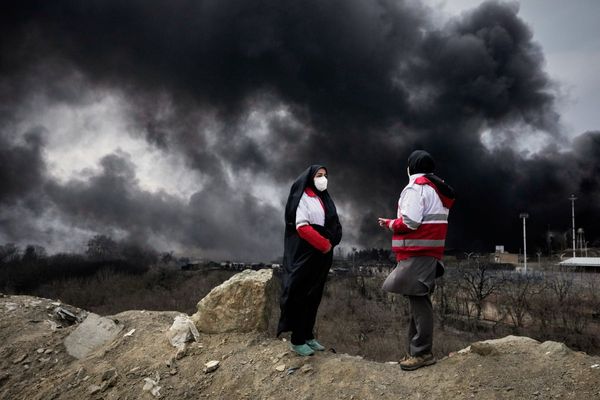
An acrid smog has hung over the mountains and the plains leading to Mosul caused by oil fires that Isis had lit in anticipation of this attack over the past few days. It has shrouded the battlefield in a noxious haze.

Updated
Battle for Mosul begins
A long-awaited offensive to seize back Mosul after two years of Isis control has begun with columns of armour and military starting to move on the Northern Iraqi city.
The start of the offensive, which has been months in the planning, was announced in an address on state television by Iraq’s prime minster in the early hours of Monday morning.
Haider al-Abadi said: “We have been battling Isis for more than two years. We started fighting Isis in the outskirts of Baghdad, and thank God we are now fighting them in the outskirts of Mosul, and God willing the decisive battle will be soon.”
Read the full story here: