Orsino (Twelfth Night, William Shakespeare)

"If music be the food of love, play on…" Capricious, kinky and borderline bisexual, Orsino may have only 59 lines in Twelfth Night but his oversexed obstinacy provides the lifeblood of Shakespeare's sexiest comedy. Easily transferring his affections from Olivia to Viola over the course of the play, the lovesick Duke of Ilyria doesn't really care who his sweetheart is, as long as she lets him showcase his brilliant performance as the ultimate literary romantic poseur. You know how much he'd want this title; he'd wear nothing but a rose-strewn velvet loincloth to the awards ceremony. Vote Orsino now.
Heathcliff (Wuthering Heights, Emily Bronte)
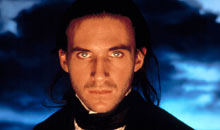
Heathcliff can largely be held responsible for the hundreds of modern young women currently weeping about their hopeless addiction to bastards into their fourth glass of rosé. From the moment teenage girls are forced to read Wuthering Heights in school, the course of their miserable love lives is set. We know that nothing good will ever come of a psychologically scarred, pathologically jealous demon-foundling from Liverpool; we know gypsy looks and brooding sulks do not bode well; but then deep down what girl doesn't really want "a fierce, pitiless, wolfish man" willing to disinter her grave? Case closed. Click here.
Huckleberry Finn (The Adventures of Huckleberry Finn, Mark Twain)
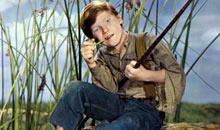
In the classic literary sense, romance isn't about wet shirts and quivering dames but freedom of spirit, celebration of nature, and the value of ordinary things. This makes the barely articulate, brilliantly irreverent and defiantly adventurous Huck Finn our most Romantic hero with a capital R. Whether fleeing down rivers to emancipate slave boy Jim, lying to protect those he loves or reconnoitring dressed as a girl, Huck has the kind of hapless, big-hearted, dirty-kneed heroism that is rarely recognised by po-faced society. Until now. Get behind the boy who just won't be 'sivilized' and click here.
The Black Knight (Ivanhoe, Sir Walter Scott)
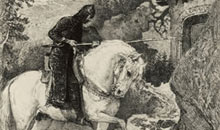
His name is pretty hard to beat, and that's without the addition of shining armour, noble steed and seriously desirable family connections. Although he is eventually revealed as England's rightful king Richard Lionheart, it is as the mysterious warrior Le Noir Faineant that Scott's crusading hero wins our hearts. Protecting the poor and the persecuted and even mucking in to help Robin Hood, the charitable Richard could quash even Guardian readers' hostility towards blood-hungry monarchy. Lofty enough to command our respect yet humble enough to earn our love, the Black Knight is the template of compassionate chivalry. Bow your knee.
Gabriel Oak (Far From The Madding Crowd, Thomas Hardy)

Why does heroism have to involve posturing machismo? As strong, stoic and sheltering as his name, Hardy's pastoral paladin Gabriel Oak embodies the unglamorous virtues of honesty, integrity and patience while he waits for the wilful love of his life, Bathsheba Everdene, to realise that shepherds always regain their lost sheep. A humble healer possessing a store of rural wisdom and a naively blunt way with words, Oak could have sprung from a Wordsworth ballad; just read the novel's very first paragraph describing his smile, and you'll understand why he's the best romantic hero you'll ever meet. Vote Oak now.