ATLANTA _ Voting in Georgia's runoffs has ended in most of the state, with the exception of polling places in two counties where poll workers had difficulties operating new voting equipment.
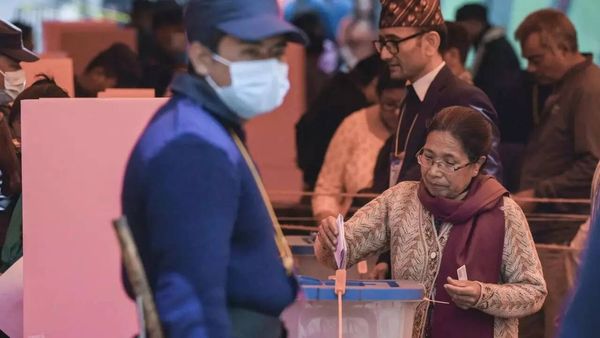
Most voters said their experience was quick and easy, a sharp contrast to a rough primary that kept some Georgians in lines for hours.
But there were still scattered problems Tuesday.
A judge ordered all voting locations in Floyd County, about an hour northwest of Atlanta, to be held open two additional hours, until 9 p.m. Election officials said poll workers' access cards didn't work and they couldn't start voting machines.
That means results won't be reported until late in the closely watched Republican runoff for the U.S. House, where Marjorie Taylor Greene faces John Cowan to represent Georgia's 14th District, which includes Floyd County.
In Macon-Bibb County, problems with voter check-in tablets prevented two polling places from opening on time. Technicians made fixes by 7:30 a.m., and those voting locations will be held open 30 minutes late Tuesday night.
The lower-turnout runoff, along with better-prepared poll workers, led to voters generally waiting no more than 10 minutes.
Elections will be more strained in November's presidential election, when turnout is expected to exceed 5 million voters.
Some voters said they never received the absentee ballots they requested, a problem that forced them to vote in person. Other voters experienced delays when poll workers had trouble operating voter check-in computers and voting machines.
The runoff was another test of elections held during the coronavirus pandemic on a new voting system.
"I'm worried about November," said Hershey Millner, a graduate student at Georgia State University after voting at Fanplex across from the old Atlanta Braves stadium in downtown Atlanta. "I had requested an absentee but didn't get it. It's concerning to me."
Another voter, Donald Hickman of College Park, said he was glad he didn't have to wait more than two hours to vote as he did for the June 9 primary at New Life Presbyterian Church.
"Compared to last time, this is awesome," said Hickman, a truck driver. "Some machines went down and people had to wait. It was just awful. Things should not be down on election day."
Polls were to be open from 7 a.m. to 7 p.m. at voting locations across Georgia. Voters were deciding on candidates for the U.S. House of Representatives, the Georgia General Assembly, school boards and courts.
Election officials said they learned lessons from the June 9 primary to avoid the kind of extreme lines that some voters encountered last time.
Poll workers have been retrained. Technicians were on hand at every voting location in Cobb, DeKalb, Fulton and Gwinnett counties. Voting machines were delivered well in advance of election day.
Still, some voters experienced problems and long waits at the polls.
Alexis Gilmer, a voter at Israel Baptist Church in Kirkwood, said she waited over an hour and a half Tuesday morning.
The polling place lacked voter access cards, and when they finally arrived, some of them didn't work because they appeared to be coated with a salty material, she said. Then when poll workers tried to give Gilmer an emergency paper ballot, they didn't have a key to unlock them from storage.
"We care enough to vote. I'd like the system to care for us too," said Gilmer, a business consultant. "People have to work. They can't wait in line all day. People will walk out or get discouraged."
At Cross Keys High School, the site of a major meltdown in June, poll workers and voters describe a smooth process.
"I came early just in case there was a rush," said Ashley Townes. "It was simple, easy and fast. The staff was great and they sanitized everything."
Nearly 377,000 Georgians already voted in advance of election day, most of them casting absentee ballots. About 60% of early votes were absentee; the rest were cast in person during three weeks of early voting.
With so many voters using absentee ballots, election results might be slow to come in Tuesday night.
Absentee ballots will be counted if they're received by county election officials before 7 p.m., but each ballot has to be fed through a scanner to be counted, a process that can take days. Election officials say it's normal for absentee vote-counting to take some time.
But that means close races might not be settled on election night.
The winners of Tuesday's runoffs will advance to the general election in November.