BENGALURU: Despite a National Green Tribunal (NGT) order, many fuel stations in the city are yet to install vapour recovery systems (VRS), which capture vapour displaced when filling fuel tanks of vehicles with petrol.
In 2020, the Central Pollution Control Board (CPCB) issued guidelines recommending installation of VRS at all existing retail outlets selling more than 100kl per month and located in million-plus cities and those selling more than 300kl per month and located in cities with a population between 1 lakh and 1 million.
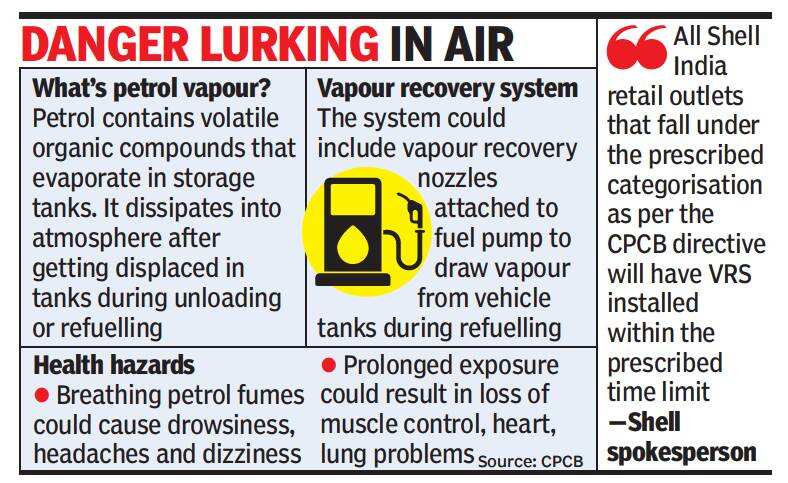
CPCB in September 2020 instructed private operators like Shell India to complete the installation of VRS by July 2021. Some city outlets of Shell in places like Mysuru Road and Kengeri have been closed for the past few days for installation work. CPCB asked three Oil Marketing Companies (OMCs) — IOC, BPC and HPC — to install VRS at retail outlets and storage terminals with fixed timeframes between July 2021 and March 2024.
Statistics show Bengaluru has 1,069 fuel outlets — IOC (406), BPC (260), HPC (212), Shell (62), Reliance (12), Essar (112), and MRPL (5). Only 17 outlets of IOC have VRS and data for others are not available. Sources said only a few outlets have installed VRS so far.
“Fuel outlets started after 2018 have modern dispensing units with in-built VRS facilities. Also, vapour recovery devices are required for outlets selling more than 300kl. We are in the process of adhering to CPCB guidelines,” said an oil industry source. However, CPCB in 2018 imposed a fine of Rs 1 crore each on three OMCs for their failure to install VRS at fuel stations in Delhi.
“VRS in petrol bunks helps in recovery of vapour released during filling of petrol which, in turn, reduces release of volatile organic compounds in the environment. As a result, pollution caused by them is reduced,” said a source.
In 2016, the Union ministry of environment, forests and climate change had issued a direction under section 5 of Environment (Protection) Act, 1986 to install Stage I and Stage II VRS in petrol refuelling stations with a capacity of 300kl per month and more, located in million-plus cities by December 2017. However, the deadline was later extended multiple times. The NGT had stated VRS is required to safeguard against VOCs released in the process of transfer of petroleum products. VOCs are highly toxic in nature


.jpg?w=600)