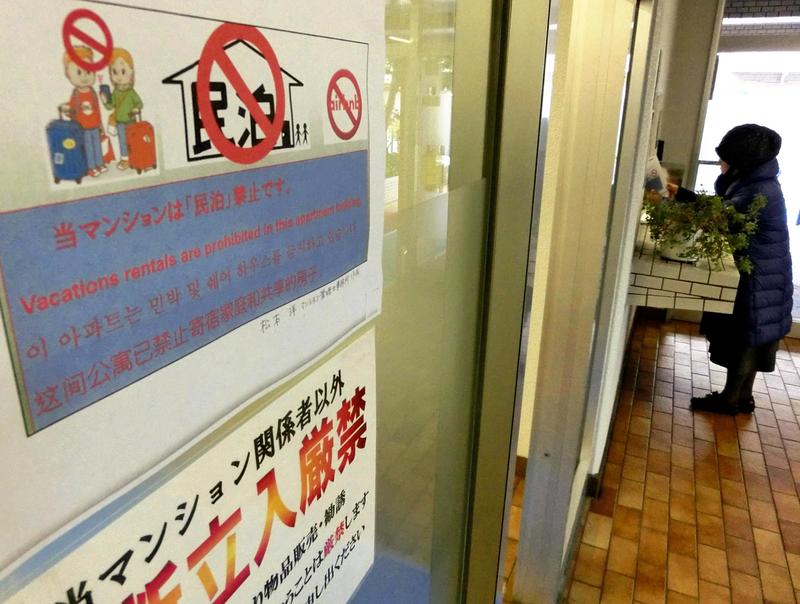
Although a law allowing and regulating minpaku private lodging services (see below) across Japan is set to take effect in June, residents in many condominium apartment buildings -- as many as 80 percent, according to some estimates -- will be barred from offering these services by their management associations due to concerns over noise and safety.
Before the law comes into effect, a growing number of these associations are scrambling to amend or introduce rules to prohibit residents from offering minpaku services, in which travelers and other visitors stay short-term in vacant rooms for a fee.
Apartment owners intending to offer minpaku lodging will be able to start registering with prefectural governments from March 15. If management associations cannot carve out a clear minpaku policy before then, it could lead to problems among residents. The Land, Infrastructure, Transport and Tourism Ministry is urging such associations to quickly decide on their position on this issue.
JR Ikebukuro Station in Tokyo is a magnet for foreign tourists. At a December meeting of the management association of a condominium with 301 units in Itabashi Ward, Tokyo -- an about 10-minute train ride from Ikebukuro Station -- there was stiff opposition to offering or allowing minpaku services. "If guests are noisy late at night and can't follow the rules for sorting trash, it will cause problems," one attendee said.
The 11 trustees of the association unanimously agreed on a resolution to prohibit residents from offering minpaku services. The resolution is expected to be included in the association's rules at a general meeting in May.
"We took preemptive action to prevent our quiet living environment from being spoiled," said Hajime Hashizume, the association leader.
The management association of a 115-unit condominium in Minuma Ward, Saitama, also plans to change its rules at an extraordinary general meeting on March 11 and prohibit minpaku-style accommodation. "Criminals could use a room in someone's home to lie low," said worried resident Hideo Kakinuma, 72.
According to the tourism ministry, condominiums across Japan have a total of about 6.33 million housing units, and are home to about 15.08 million residents. The Condominium Management Companies Association, a general incorporated association, estimates about 80 percent of management associations will ban minpaku accommodation through setting rules or by decisions of governing boards.
Start date looming
If management associations of condominiums do ban minpaku accommodation, a resident's application to register to offer private lodging will not be accepted. There are concerns trouble could arise in cases in which management associations have not settled on a clear plan before March 15 -- the date residents can start notifying prefectural governments of their intention to offer minpaku services.
Model regulations that the central government previously drew up for management associations contain no clear stipulation prohibiting minpaku lodging. If March 15 rolls around while an association has yet to finalize its stance on the issue, it would effectively amount to tacitly approving minpaku services. Under a provision of the private lodging business law, if management associations change their rules before the ban on minpaku services is lifted on June 15, they can prohibit residents from offering these services. However, deciding on a ban after the fact could anger apartment owners who have already registered, potentially sparking trouble among residents.
The management association of a condominium in Chuo Ward, Osaka, filed a lawsuit seeking damages from the owner of an apartment who had offered lodging without approval.
The association claimed the man had violated a rule prohibiting minpaku services. In January 2017, the Osaka District Court accepted the rule had been broken and ordered the man to pay damages of 500,000 yen for what "amounted to illegal acts toward other residents, including loud noise and neglecting garbage." The ruling was finalized.
"It's important that management rules clearly establish the policy of the association," an official of the tourism ministry's Condominiums Policy Office said.
"If rule changes are not made in time, it is important to quickly deal with the situation by deciding on a policy at a general meeting or a governing board."
Chance to earn money
There also are moves to use minpaku services as a way to boost income. Clover Community Inc. is a Tokyo-based apartment management company. The management association of a condominium that Clover manages in Ota Ward, Tokyo, initially decided to amend its rules to prohibit residents from offering minpaku services. However, after Clover suggested these services could "broaden options for residents to increase their income," the association backtracked and amended its rules again to allow minpaku lodging.
"I think apart from condominiums where most of the owners bought apartment units as an investment and rent them out, only a limited number of places will allow minpaku services," said Yasuhisa Kawakami, head of Zenkanren (National coalition of condominium management associations), a Tokyo-based nonprofit organization that helps condominium management associations across the country.
Units in rental apartment buildings managed entirely by the owner can be used for minpaku services at the owner's discretion, much as a privately owned house can. However, it is possible that guests staying overnight could annoy other residents by being too noisy -- just like at a condominium building.
"Owners of rental apartments need to be considerate of the living environment of other renters and nearby residents. They should seek their approval before registering to offer minpaku services," said Hiroshi Matsumoto, representative director of Japan Mansion Support, a general incorporated association.
--Minpaku private lodging
A system under which tourists and others can stay in a vacant room of a regular private home or apartment for a fee. In response to the surge in foreign visitors to Japan and rampant unauthorized or illegal minpaku services, the government passed the private lodging business law (minpaku law) in June 2017. If the owner of the accommodation registers with the prefectural government, they can operate a minpaku business for up to 180 days a year from June 15, 2018, when the law comes into force. If there are concerns minpaku services could negatively affect the living environment of nearby residents, local governments also can independently issue ordinances to restrict where such services can be offered.
Read more from The Japan News at https://japannews.yomiuri.co.jp/


.png?w=600)