Morrisons looks set to cling on to its place in the FTSE 100 after the supermarket delivered its first quarter of sales growth since December 2013 giving a boost for new boss David Potts.
The UK’s fourth biggest grocer looked set to be kicked out of the blue chip index as a result of its declining value, but the shares inched up nearly 2% after new sales data - meaning the retailer might now retain its position in the prestigious FTSE 100.
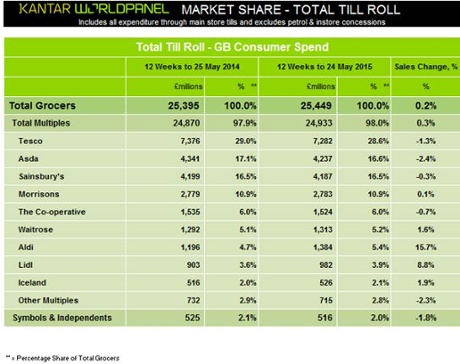
The data was the latest market share figures published by analysis firm Kantar Worldpanel. It showed sales ahead just 0.1% in the 12 weeks to 24 May. But the increase marked out Morrisons as the only one of the UK “big four” British supermarkets to register growth over the last three months.
The news boosted the retailer’s shares to 172.5p which on Tuesday night appeared to have lifted Morrisons’ market value above mobile power company Aggreko, to maintain its place in the leading index rather than be demoted to the FTSE 250 mid-cap index.
The likely index changes need to be ratified on Wednesday by the FTSE committee, which compiles the stock market indices. It is still possible that Morrisons could be demoted, if a very large trade which went through just after the market closed is taken into account by the committee.
But the tiny increase in sales is a sliver of good news for Potts, who on Thursday faces his first annual shareholder meeting at Morrisons headquarters in Bradford. The former Tesco executive joined the company in March.
The retailer is expected to receive criticism for paying out a £1m bonus to its former chief executive Dalton Philips, who was ousted after months of falling sales and profits. Sir Ken Morrison, the group’s former chairman and chief executive, who built his father’s business into a national chain, is expected to attend. Last year he attacked Philips’s strategy as “bullshit”. His views on Potts are not yet clear.
Fraser McKevitt, head of retail and consumer insight at Kantar Worldpanel, said Morrisons’ sales were being lifted by a combination of online growth and the success of its Match & More loyalty card - both initiatives begun under Philips.
But he said some of Potts’ initiatives, such as putting more staff into stores and bringing back staffed express check-outs, also appeared to be bearing fruit.
“A committed core of loyal Morrisons consumers is responding positively to recent initiatives and business has been boosted by online sales,” said McKevitt. “Morrisons’ performance is an improvement on what was a difficult May 2014, so this is only the first step in any future recovery.”
Morrisons’ rise in sales shows a marked improvement from a 1.1% fall in sales revealed last month by Kantar. In contrast, Asda continued to trail its rivals in the latest figures, with sales falling 2.4% . Sales declined 1.3% at Tesco and there was a 0.3% dip at Sainsbury’s.
All the major supermarkets are suffering as they struggle to bring their prices on basic goods closer to those of the fast-growing discounters Aldi and Lidl.
Both the German discounters are also seeing sales growth slow as they too have been forced to cut prices to maintain their price lead on the traditional supermarket chain.
Lidl’s sales growth slowed to 8.8% in the latest period – the first time it has dropped to single digits for two years.
McKevitt said: “Like everyone else, Lidl is cutting prices and that’s taking money out of the till. If anything, discounters’ prices are falling more quickly [than the major supermarkets] because of their focus on fresh produce and own-label. Brands are able to sustain prices better.”
He said the stores were also seeing growth slow as many of their established stores were now at full capacity - with full carparks and queues at the till.
Aldi’s sales were up 15.7% in the three months – taking it to a new market share high of 5.4%. Its pace of growth was very slightly ahead of the three months to the end of April but well short of the 30%-plus it was seeing a year ago.
“We deem it fair to say that the ‘free lunch’ for the discounters has come to an end with growth now more dependent upon new space, and more expensively fitted out space at that to accommodate growing fresh & chilled participation,” said Clive Black, an analyst at Shore Capital.
He said that a rise in the volume of goods being sold was another positive sign for traditional supermarkets. The latest Kantar figures suggest a 2.5% rise in volumes - the strongest for some time.
“We believe that the industry is through the worst in this respect and we anticipate ongoing volume growth, which with supply chain work makes for a better basis to release productivity and working capital gains,” he said.