As the general election campaigns reach their conclusion, recent research from our agency, Aesop, explored how well (or not) the main political parties are communicating with the electorate.
The reason for this research? We wanted to understand which party is telling a believable story, which of the leaders are considered charismatic, who manages to articulate a vision for the future best, and how well the parties are doing in articulating the country’s main problems and challenges.
The research, conducted online in April 2015, of 1,500 nationally-representative UK adults aged 18-years-old and over, threw up some interesting findings, which included:
- 24% believe the story that the Conservative party is telling
- 49% of the electorate do not believe the Tory story
- David Cameron and Nigel Farage were voted the “most charismatic” leaders
- Only 14% believe Clegg to be charismatic
- The Ukip story is resonating more with men than women
- 26% of respondents claim not to know who Natalie Bennett is
- The Tories and Ukip were identified as the best political storytellers
The election campaign is the final, furious sprint in the long race to establish a credible, compelling narrative. Each day of the campaign must clearly reinforce the central tenets of each party’s story – no easy task given politicians operate in such highly-mediated environments.
Their messages are often not communicated directly, while swirling counter narratives actively try to distort or invalidate their central story.
More truth, less spin
Perhaps as a result of this environment, half of the electorate do not believe what the political parties are telling them. Almost one-quarter (24%) of those surveyed identified the Tories as telling a believable story, with close to half (49%) citing the incumbents as “not believable”. It’s a pattern common to all contenders – only 12% of those polled believe the Lib Dems to be telling a believable story, with just over half (51%) not buying in to the story that Ukip is telling.
It’s because the electorate has become wise to the process. It’s now commonly understood that politicians are surrounded by spin doctors and election consultants. The electorate knows it’s being spun, so it naturally discounts what’s being said or promised.
Charisma and personality remain important
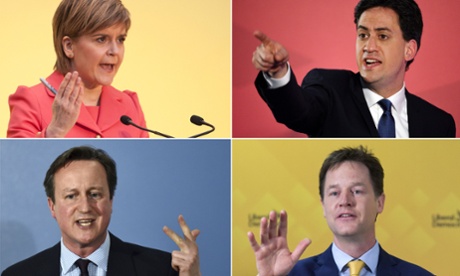
The survey also revealed two charismatic frontrunners: David Cameron and Nigel Farage. Almost one-third (30%) believe the Tory leader to be charismatic, with Ukip’s Farage nipping at his heels, polling 29% of the “charisma” votes.
This is in stark contrast to Labour’s Ed Miliband and the Lib Dems’ Nick Clegg, who polled only 16% and 14% of the votes respectively, with almost 60% of eligible voters citing the Labour leader as “not charismatic at all”. Close to one-quarter (24%) of those surveyed identified the SNP’s Nicola Sturgeon as having charisma, while the Green Party’s Natalie Bennett suffered at the hands of a low profile, with 26% of those polled stating they don’t know who she is.
The lesson? Whether it’s a good for our democracy or not, the electorate judge politicians as much for their personality and backstory as their policies. Politicians who reveal more of their individual character can be easier to relate to and trust – especially if we like the sound of their backstory
The Ukip effect
Of those polled, 28% believe that Ukip is successfully articulating the country’s main problems and challenges, with 26% citing the party as successfully painting a vision for the future.
The Ukip narrative has been consistent for years: a clear agenda, a strong central character, and a shortlist of antagonists. It seems that respondents are willing to concede the party tells a good story in purely narrative terms, even if they don’t like it. The stories of the mainstream parties tend to be broader and more generic; they employ vaguer themes that lack the same clarity and particularity of the Ukip story, making them more difficult to discern.
There are clear storytelling lessons here for all parties: primarily that they need to introduce greater clarity when explaining their narrative.
Ed Woodcock is head of narrative at Aesop
This advertisement feature is brought to you by the Marketing Agencies Association, sponsors of the Guardian Media Network’s Agencies hub