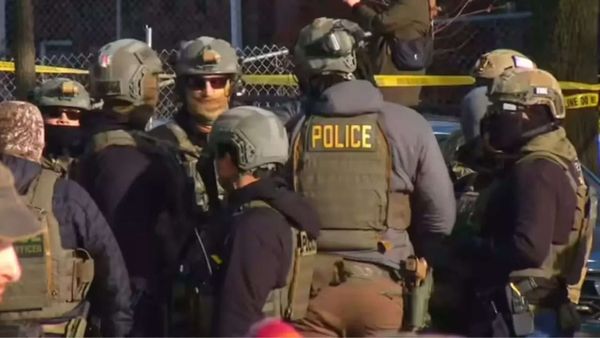
The shooting death of Davis, Calif., Police Officer Natalie Corona Thursday again exposed a conundrum that faces law enforcement every day: How do you train a cop for an ambush?
Police academies try. They drum into trainees to be hyper-vigilant. When you see someone coming, quickly look at their hands. Glance at their waistband.
But police experts said all that training probably could not have prepared Corona for what happened at a routine car accident scene in downtown Davis. Kevin Douglas Limbaugh � armed with a semiautomatic handgun � rode up to the crash scene on a bicycle, emerged from the shadows and opened fire, police said. Limbaugh, 48, was later found dead in a nearby home from a self-inflicted gunshot.
Corona, 22, had been on the force only since July, and had finished her field training the month before. But police training experts said that even a veteran officer's experience probably would not have mattered.
Corona was checking driver's licenses after the accident in downtown Davis. The last officer killing in Davis occurred in 1959, a generation before Corona was born.
Witness Christian Pascual, who was in the car crash, said he had handed Corona his license when Limbaugh fired a gun at the officer from just behind his right shoulder. Whether Corona saw her killer is unclear.
At least 71 law enforcement officers have been killed in California by an assailant while on duty in the past 17 years, according to the state Department of Justice. The leading cause of death was from gunshot wounds over the past two years.
But the apparent circumstances of Corona's death �� among bystanders at an otherwise calm scene �� are shocking.
Former Sacramento County Sheriff John McGinness said officers are at the highest risk of danger when they make traffic stops, checking on domestic violence scenes, or when they are arresting someone. "Officers are well-trained for those," he said.
When knocking on someone's front door, officers step to the side and away from windows in case of a surprise assault. When they pull a vehicle over, they alert a dispatcher and run the vehicle's license plate on their computer. Then, as they approach the vehicle, officers are trained to look into the car to see who is there, and in particular, what their hands are doing.
"I call it hyper-vigilance," said former Sacramento city Police Chief Rick Braziel, now a law enforcement consultant. "You're aware of your surroundings. Your mind is always working."
When taking an accident report on the sidewalk with willing participants, Braziel and others said, an officer is likely to be alert, but less so.
"Generally a traffic collision is a fairly �� nothing is routine ��but a fairly routine call," said Paul Doroshov, the Davis Police Department public information officer. An officer may call for backup if someone is needed to direct traffic, but otherwise accidents are one-person jobs.
In some police departments, the task is handled by community services employees, not sworn officers.
And in Davis, a college town where a lot of people would be walking around downtown on a Thursday evening, it wouldn't be unusual, from an officer's viewpoint, to have someone approach you on the street as you are doing your work, police experts said.
Corona's lack of experience was not likely to have been a factor in her death, Braziel and others said. California Highway Patrol Academy commander James Mann said rookie officers may be more cautious than veterans.
He said he tries to instill a stark reality in the cadets he trains: They need to be ready, because there is no guarantee they won't run into chaos on the first day alone on patrol.
"We train for a worst-case scenario," Mann said. That includes drills that force cadets to think and act quickly in situations that may not be what they seem at first. The academy even conducts exercises that involve shooting paint cartridges at trainees.
Corona was a graduate last year of a six-month academy run by the Sacramento Police Department, where 40 percent of cadets typically drop out. She then received about six months of field training in Davis.
Braziel said that although stopping a surprise killer might have been impossible, police will look into Limbaugh's past in hopes of preventing another such incident. They'll ask: Did police have previous interaction with this person? Did other local officials, such as mental health professionals, ever deal with him? And, if yes, is there anything to be learned from those interactions that might help in the future?
Yolo Superior Court records show that Limbaugh was charged in September with battery with serious bodily injury, an incident that a source said stemmed from his punching a co-worker in the face at Cache Creek Casino after a dispute. The case was resolved as a misdemeanor conviction, and California Department of Justice records show that he agreed to surrender a black .223-caliber Bushmaster AR-15 rifle in November.
But sources also said little before the attack on Corona �� other than the battery case �� indicated that Limbaugh was capable of ambushing a police officer. Probation authorities found no other criminal charges or any signs of mental health problems when the battery case was resolved, a source said, and public records show few other dealings with authorities, other than a traffic case in Florida and an unpaid tax lien in New Mexico.
Doroshov and other police officials said many departments send officers on patrol alone, regardless of experience.
It's often a budgetary issue. Vacaville police spokesman Lt. Chris Polen said all officers in his department ride solo, unless they are in training.
"We're obviously trying to serve as wide an area as possible, efficiently," he said. "We're operating on budgetary constraints. Most of these cities aren't rich with cash. Doubling the size of your police force is difficult."
Some larger cities double up officers in cars, especially at night in neighborhoods with high crime or more parolees. The CHP also partners officers during the graveyard shift when they are most likely to deal with drunken drivers.
Susie McCullough, from Corona's hometown Arbuckle, said she once asked Corona if she was afraid to patrol alone. She said, "No, there's four beats in Davis. I always have an officer behind me.'"
Sgt. Shaun Hampton of the Sacramento County Sheriff's Department said his agency sometimes pairs up deputies. "We encourage it," he said. But some deputies like riding alone, and the department gives them the option.
Hampton said pairing up doesn't necessarily make things safer. "You look at Danny Oliver; he was with a partner."
Oliver's 2014 shooting death at the hands of undocumented immigrant Luis Bracamontes near a former Motel 6 on Arden Way drew national attention. The killer later that day shot and killed another officer, Placer County sheriff's Detective Michael Davis Jr., who was also with a partner at the time.
"Whether you have one day on the job or 30 years, it is dangerous," said Tim Davis, head of the Sacramento Police Officers Association.
An aspiring officer last week in Davis said Corona's shocking death put a dose of fear in her.
Cynthia Ochoa, 24, a Davis resident and Sacramento State criminal justice student, said she plans to work in law enforcement after graduation �� perhaps in probation, perhaps as a police officer � but Thursday's shooting was a reminder of how dangerous that work can be.
"It really does make me nervous. I have a child at home. It doesn't make me reconsider, but it really puts me on edge," Ochoa said. "My family, when I told them I wanted to be a police officer, my mom freaked out. She didn't want this for me. And it breaks my heart to see it here now."