More than three and a half million women – almost 30% of the female workforce – are set to receive a pay rise as a result of George Osborne’s “national living wage”, research has found.
The tendency for women to be in low-wage jobs means that they will receive 61% of the benefits of the minimum wage rise for the over-25s, which formed the centrepiece of Obsorne’s budget.
In a move regarded as a political coup, positioning his party as the friend of the low-paid, Osborne announced that the national living wage will rise to £7.20 for the over-25s in April, 50p more than the £6.70 rate that will apply starting in October. It will then increase to 60% of median earnings by 2020 – expected to be about £9.35 an hour.
The thinktank the Resolution Foundation, whose work on the future of the minimum wage was cited by the chancellor when he announced the policy in July’s budget, calculates that by 2020 3.7 million women are likely to have seen their wages rise as a result of the policy. That’s 29% of all female workers.
The estimate includes both women who currently earn less than the new wage-floor and those whose income is likely to be lifted by a “ripple effect” further up the pay scale. As a result, the gender pay gap is likely to narrow slightly more rapidly than expected over the years ahead.
Conor D’Arcy, the author of the report, said: “Because of their concentration among the low paid, women will account for the majority of the winners. This will have a positive – though modest – effect on the gender pay gap.”
He also stressed the historic nature of the unexpected move by the chancellor, which was greeted in the House of Commons with a victorious fist-pump by the work and pensions secretary, Iain Duncan Smith. “The pace of [national living wage] increases over the parliament will move our labour market into uncharted territory,” said D’Arcy.
Sam Smethers, chief executive of gender equality charity the Fawcett Society, said: “It is good to see that so many women will benefit from an increase in the national living wage, but that is only because so many of them are in low-paid work in the first place. It is a stark reminder of the segregation between men and women that still exists in the workforce, with women concentrated at the bottom and men at the top.
By branding the top-up to the minimum wage for the over-25s a national living wage, Osborne sought to seize on the successful campaign run by pressure group Citizens UK, which convinced a growing number of employers to adopt a wage calculated according to the costs of meeting basic needs, including housing. The living wage is currently set at £9.15 an hour for London, and £7.85 elsewhere.
In total, the research suggests that as many as 6 million people will see a pay rise as a result of the national living wage. However, because so many women work part time, their average cash gain will be lower, at £690 a year, against £860 for men by 2020.
The Resolution Foundation also stresses that the income boost many workers will receive from the minimum wage rise will be more than offset by the cuts to tax credits and other benefits that were also announced in the July budget — particularly for lower-income households.
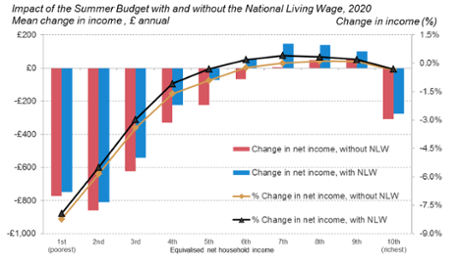
Nicola Smith, head of economic and social policy at the TUC, said, “it’s very welcome that some low-wage workers are going to see a small pay rise as a result of this minimum wage supplement. However, it’s very likely that many of those people will also be seeing substantial cuts to their household incomes as a result of the cuts to welfare.”
There are also wide regional variations in the potential impact of the policy. In London, 14% of workers are likely to be affected; in Yorkshire, it will be twice that proportion, at 28%. In the east Midlands, the West Midlands and Wales, 27% of the workforce will see a pay rise.
Businesses were taken by surprise by the chancellor’s policy, and as yet it is unclear how sectors that rely heavily on low-paid staff, such as hospitality and retail, will afford to pay their employees the new minimum rates.
Supermarket Sainsbury’s announced last week that it would give its shopfloor staff a 4% pay increase, lifting them above the £7.20 level that will become mandatory for the over-25s from next April. But chairman of pub chain JD Wetherspoon, Tim Martin, has warned that the policy could cost jobs.