
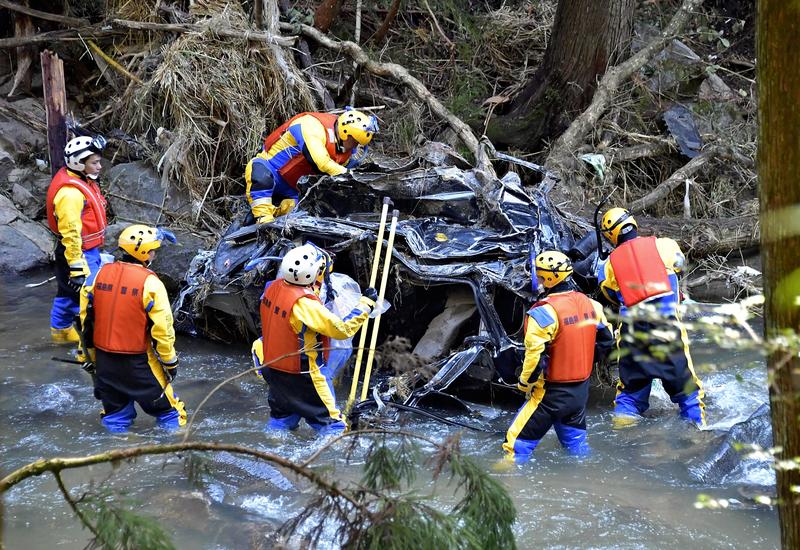
In areas devastated by Typhoon No. 19, which hit eastern Japan last weekend, 21 of 78 victims died in their cars, in circumstances such as a car falling into a swollen river.
Many victims of past flood disasters perished when they were engulfed by muddy water in their cars, and experts and government authorities have pointed out the danger of evacuating by car.
Organizations such as police and fire departments continued searching for 16 people who were still missing in the affected areas on Thursday.
As of noon Thursday, 78 people in 12 prefectures were known to have been killed by the typhoon. According to the results of a Yomiuri Shimbun survey conducted on the basis of statements made by disaster-hit municipalities and police authorities, cases in which people died in their cars occurred in nine prefectures.
In Midori Ward in Sagamihara, Kanagawa Prefecture, a car carrying four family members, including two elementary school children, fell into the Kushikawa river from a road that was washed out by muddy water late on the night of Oct. 12, when heavy rains hit the area. Their bodies and the wrecked car were found downstream. According to sources, the family members were going to check on a relative's house in the ward and the police theorize that the road collapsed beneath the moving car, sending it into the river with the four inside.
In the wake of torrential rains in western Japan in the summer of last year and heavy rainfall hitting the Kanto and Tohoku regions in 2015, similar situations in which people died in cars occurred. There were also many cases in which people were hit by tsunami while evacuating by car to higher ground or inland at the time of the 2011 Great East Japan Earthquake.
When a typical passenger car moves through water about 30 centimeters deep, the water can reach the bottom of the car, potentially flooding the interior and stopping the engine, according to the Japan Automobile Federation. Parts of the car such as the driver's seat will flood later than the engine, so by the time the driver notices that water has gotten in, the car may be afloat and the driver may no longer be in control of the vehicle.
The Cabinet Office has called for cautious evacuation in the event of a disaster, saying, "Walk in principle."
Prof. Motoyuki Ushiyama of the Shizuoka University Center for Integrated Research and Education of Natural Hazards said: "People tend to think they are safe in a car, because they are not fully aware of the situation outside the car and they do not get wet. However, I want people to recognize that the risk of being swept away while evacuating by car is not that different from the risk while on foot."
Read more from The Japan News at https://japannews.yomiuri.co.jp/









.jpg?w=600)



