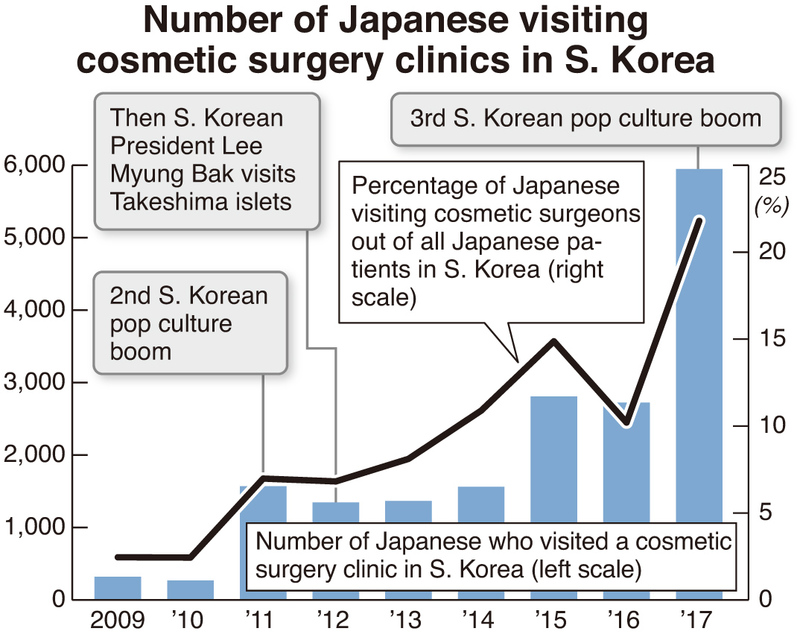
SEOUL -- The number of Japanese people visiting South Korean medical institutions for cosmetic surgery swelled to about 6,000 in 2017, an almost 20-fold increase from nine years earlier, according to South Korean authorities.
In addition to South Korea's close proximity to Japan and relatively cheap surgical costs, the surge in Japanese clients has apparently been inspired by the popularity of K-pop stars.
However, some clients have also reported post-surgery problems, and the National Consumer Affairs Center of Japan is urging potential clients to "think hard" about whether they really need such surgery.
In early September, a first-year university student from Kanagawa Prefecture traveled to Seoul during her summer vacation. She visited a cosmetic surgery clinic and had an operation that made the bridge of her nose three millimeters higher and changed her nose's shape.
"Your facial swelling will go down in about 10 days," the South Korean doctor said, according to the 18-year-old student.
"I'd had a complex about my flat nose since I was a junior high school student," she said. "I wanted to have confidence in my facial appearance."
The surgery cost about 400,000 yen (3,570 dollars), around half of what the bill would have been in Japan. The student decided to have the operation in Seoul because she admired the face of a member of Twice, a popular South Korean girl group. She had never been to South Korea before and does not speak Korean. The student took a liking to a post-surgery photograph of a nose posted on a blog written in Japanese and decided to visit the clinic.
Three specialist doctors work at the clinic. Ninety percent of the about 30 clients who visit the clinic each day for surgery or consultations are Japanese. About 80 percent of them are in their late teens or 20s, and the majority go under the knife to change the shape of their nose or eyes. The clinic's reputation has spread through word of mouth, Twitter and other channels, and its number of customers reportedly has more than doubled since it opened in 2015.
According to South Korea's Health and Welfare Ministry, 319 of the Japanese who visited South Korean medical institutions in 2009 did so for orthopedic surgery such as cosmetic surgery.
In 2011, this figure skyrocketed to 1,570 on the back of the second South Korean pop culture boom in Japan, in which groups such as Shojo Jidai (Girls' Generation) and KARA became sensations. The third wave of the South Korean boom in 2017 pushed this number up to 5,947 people -- about 19 times the 2009 figure. The number of Japanese clients is hugely influenced by the popularity of South Korean pop culture.
In South Korea, many celebrities and well-known personalities have openly admitted to undergoing cosmetic surgery. According to sources, many Japanese clients show doctors images of popular idols and say, "I want my face to look like this."
Regular checkups vital
As the number of Japanese people having cosmetic surgery in South Korea has increased, so also has the number of problems arising after these operations.
Doctors at Dr. Spa Clinic, a cosmetic surgery clinic in Shibuya Ward, Tokyo, have recently noticed an increase in clients coming in for consultations about problems stemming from cosmetic surgery performed in South Korea. According to sources, most of these queries are about operations in which facial bones have been shaved to make the face appear smaller, but several years later sagging skin becomes noticeable around the face.
Yoshiro Suzuki, head of the clinic and a director at the Tokyo-based Japan Association of Aesthetic Medicine, said: "I often doubt whether doctors in South Korea properly explain the problems that could emerge after surgery. Cosmetic surgery does not end when the operation does. It's necessary to regularly visit the clinic for follow-up checks."
According to the national center, consumer affairs centers across the nation are also receiving inquiries relating to cosmetic surgery in South Korea.
In January, a man in his 20s who had his cheekbones made smaller in an operation in South Korea complained of facial swelling and deteriorating eyesight after he returned to Japan. He told one of the centers that he had insufficient time to thoroughly discuss the surgery with his doctor and "ended up with a face different from what I wished for."
An official at the national center said: "Once a person has cosmetic surgery, that body part won't go back to the way it originally was. People should think hard about whether they really want to have surgery overseas, where they often won't be able to properly communicate with the doctor."
Read more from The Japan News at https://japannews.yomiuri.co.jp/