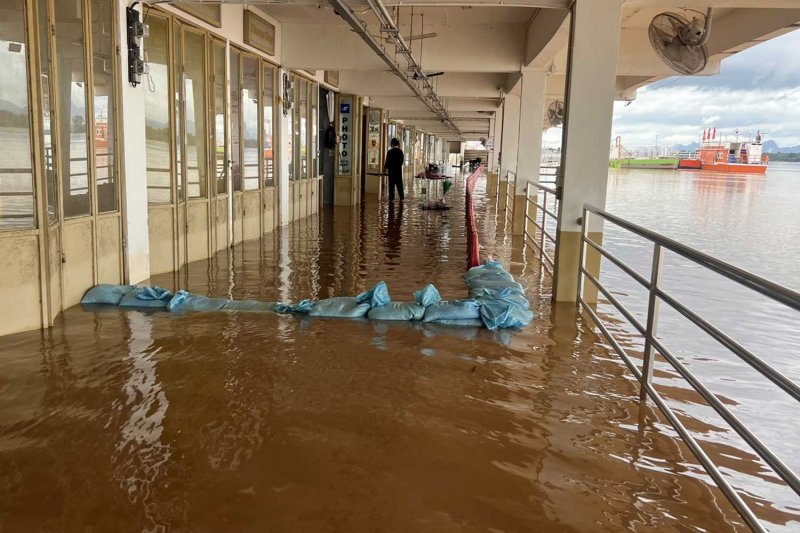
Flooding has worsened in Nakhon Phanom and Bueng Kan as swollen rivers inundate farmland, while heavy rain has triggered flash floods in Lampang.
In Nakhon Phanom, the Mekong River has reached a critical level of 12 metres, preventing major tributaries, including the Oun and Songkhram rivers, from draining normally.
Water in the Oun has exceeded its capacity by 60%, with levels about 4 metres above the riverbank.
More than 20,000 rai of rice fields have been affected, with the worst-hit areas in Si Songkhram and Na Wa districts, where more than 10,000 rai have been flooded. If the Mekong does not recede within one to two weeks, losses could become severe.
In neighbouring Bueng Kan, floodwater from Thailand and Laos has overflowed into farmland along the riverbank about 28 kilometres from the provincial town. More than 100 rai of banana, bamboo and aromatic coconut plantations have been submerged, with water reaching 1 metre deep. Floodwater has also covered more than 3km of concrete road.
In Lampang, four days of heavy rain have triggered flash floods in eight villages in Wang Nuea, Chae Hom and Hang Chat districts. Floodwater affected homes, farmland and pig sheds, although conditions have begun to improve as rainfall eased.
An overflow from Mae Luen reservoir in Wang Nuea on Tuesday flooded farmland and nearby communities. Water levels have since fallen, but continued runoff from surrounding hills means further heavy rain could trigger more flooding.
The Meteorological Department warned on Wednesday that Thailand would see heavy rain from Aug 13-18, particularly in the North, Northeast, Central, East and western South.
Residents were urged to beware of flash floods, runoff and overflowing rivers, especially in foothill areas, near waterways and low-lying areas.
The department also warned of rough seas, with waves in the upper Andaman Sea reaching 2-3 metres and exceeding 3 metres during thunderstorms. Small boats should remain ashore in the upper Andaman from Aug 12-17.