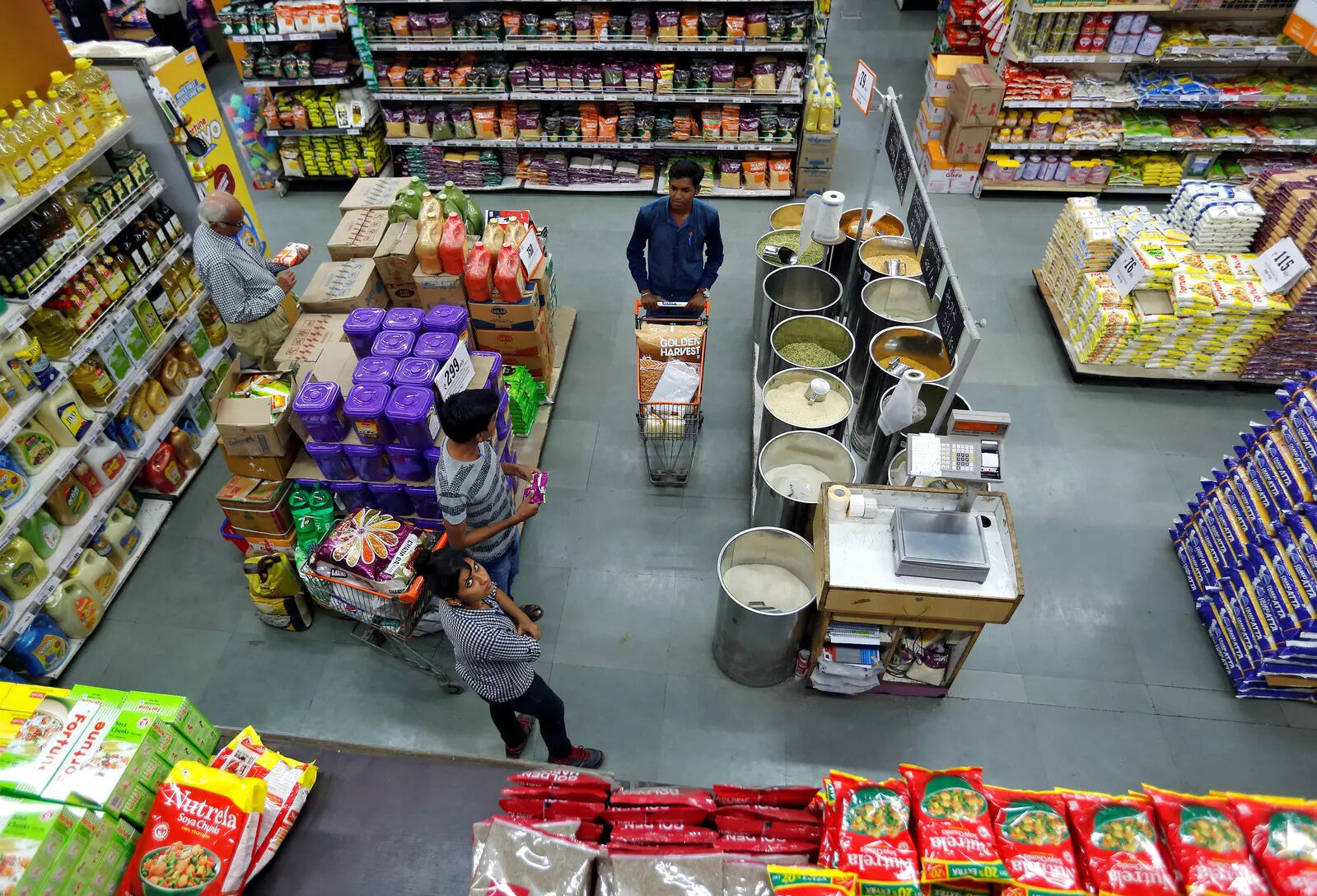
NEW DELHI: The Reserve Bank of India (RBI) may be forced to raise repo rate yet again in December with retail inflation rising to 5-month high of 7.41% in September, mainly on account of rising food prices.
India's retail inflation stood at 7% in August.
Food inflation, which comprises almost 40% of inflation basket, accelerated sharply to 22-month high of 8.4% in September from 7.6% a month ago. This was manily due to rise in price of cereals, vegetables, pulses and milk.
"While cereal inflation (wheat and rice) remains elevated, lower rice sowing acreage this kharif season will add to the worries. Tomato and potato were the drivers of vegetables’ inflation in September," said Dharmakirti Joshi, chief economist, Crisil.
Aditi Nayar, chief economist at ICRA, said the excessive rainfall in early October may adversely impact the kharif harvest and delay rabi sowing, thereby posing a material risk to the food inflation outlook.
Sequentially, headline inflation rose by 0.6% (August: 0.5% mom) led by food and beverages inflation (0.9% mom). "The sequential pickup was largely due to vegetables, cereals, spices, meat and fish, and pulses. High frequency data continues to show upside to prices of cereals, pulses, and vegetables.
Meanwhile, fuel and light inflation moderated to 10.4% (August: 10.8%) but increased sharply by 0.4% month-on month. Rural and urban inflation also increased by 41 and 55 bps to 7.56% and 7.27%, respectively.
September core inflation (CPI excluding food, fuel, pan, and tobacco) increased by 9 bps to 6.26%. Sequentially, core inflation moderated to 0.32%. Clothing and footwear increased to 10.2%, followed by household goods and services at 7.68% (7.53%), while moderation was visible in recreation, and personal care and effects
This is the eigth straight month when inflation figures have remained above the RBI's tolerance band of 2-6%. The RBI has been tasked by the government to keep inflation in the 2-4% range, with a margin of 2% on each side. Since the RBI has officially missed its inflation target for the third successive quarter, it will have to write a letter to the government explaining the reasons for its failure and the steps it will take to correct this.
According to Crisil, the burden of inflation is more on the poor as the price of esential items, such as food and fuel, occupy a greater share in the consumption basket of lower income classes.
"Imported inflation continues to be a concern given the depreciation in the rupee and elevated international energy prices amid persisting geopolitical tensions. This was reflected in a sequential pick-up in fuel inflation. We thus maintain our CPI inflation forecast of 6.8% for this fiscal, higher than 5.5% previous year," it added.
Moreover, amid this rising inflation pressure, the RBI is expected to hike benchmark lending rates further, thereby adding to the financial burden of the common people.
"Headline inflation remains elevated and above the RBI’s upper threshold of 6% for the eighth consecutive month. The near-term inflation outlook remains clouded with uncertainties emanating from (1) ongoing geopolitical tensions, (2) global financial market volatility, and (3) weather-related supply disruptions. While inflation remains elevated, we expect headline inflation to have peaked in September and favorable base effects to guide the inflation trajectory to sub-6% levels from March 2023. Accordingly, we maintain our FY2023E CPI inflation estimate at 6.6%," said Upasna Bhardwaj, chief economist at Kotak Mahindra Bank.
Given the uncertainties, especially from the global side, she sees the possibility of 35-50 bps of repo rate hike in the December policy.
IIP contracts
Meanwhile, the index of industrial production (IIP) shrank 0.8% in August, after growing 2.2% in July. The contraction was led by mining (-3.9%) and manufacturing (-0.7%), which have begun feeling the heat from the global slowdown. Export-oriented sectors such as textiles (-12.2% vs -8.6%), apparel (-18.3% vs 15.2%) and chemical products (5.3% vs 6.9%) also headed south.
An over 10% depreciation of the Indian rupee against the dollar this year has made imports costlier for consumers and businesses.
Electricity generation was the only sector to clock an uptick, with a 1.4% rise this August from a year ago and a 1.3% growth over July 2022.
"Crucially, there are signs of slowdown seeping to other segments as well. IIP fell for capex-related segments such as infrastructure and construction goods (1.7% vs 3.8%) and capital goods (5% vs 5.7%). Declines also steepened for domestic-oriented consumer non-durables (-9.9% vs -2.8%). ...India will not be immune to effects of global slowdown, which will play out over the next 12 months. The hit to agricultural incomes from uneven monsoon could also weigh on domestic demand. These factors are significantly adding downside risks for industrial outlook going ahead," cautioned Joshi.
Both the World Bank and the International Monetary Fund have revised down their growth projections for India to 6.5%and 6.8%, respectively, for fiscal year 2023, while the RBI too reduced its FY23 growth forecast to 7 per cent from 7.2 per cent estimated earlier.
On the bright side, thanks to a domestic demand-oriented economy, India's post-pandemic recovery remains on track, although slower than anticipated at the start of the year as inflation rose.
"High domestic inflation has forced RBI to tighten monetary policy and is curbing the purchasing power of the poor, because energy and food, key drivers of current inflation, account for a chunk of their consumption basket. But there are also factors supporting growth. A rebound in contact-based services is boosting growth. A broadly normal monsoon should support agriculture production and help control food inflation," wrote Louis Kuijs, chief economist Asia-Pacific, S&P Global Ratings in the Economic Times.