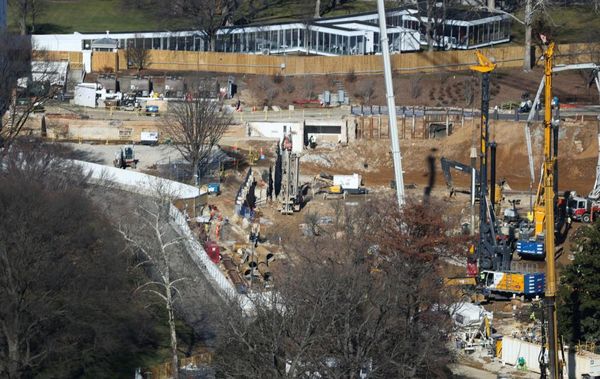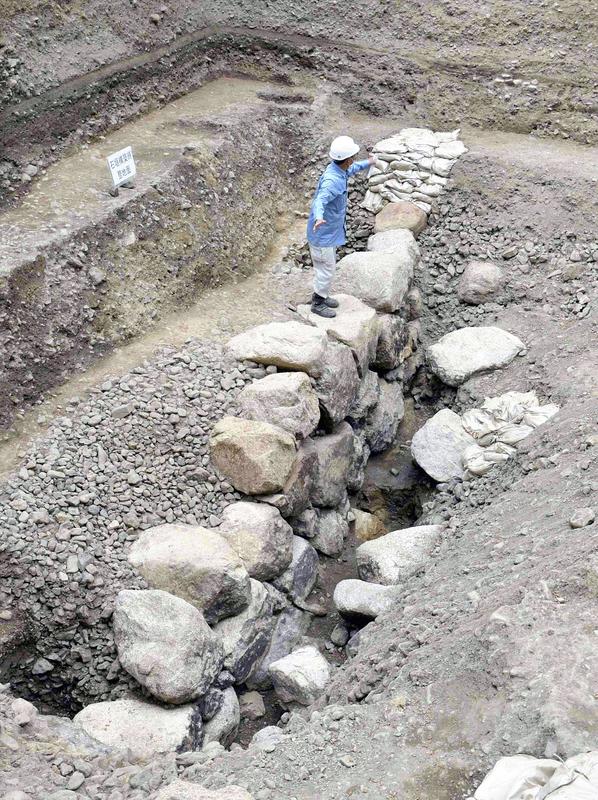
KYOTO -- Sections of stone walls and gilded roof tiles thought to be that of Kyoto Shinjo, a castle that feudal lord Toyotomi Hideyoshi (1537-1598) is said to have built a year before his death, were discovered at the Kyoto Sento Imperial Palace, the Kyoto City Archaeological Research Institute announced Tuesday.
This last castle of Hideyoshi, who had a hand in building fortifications such as Osaka Castle and Fushimi Castle, is described in court noble's diaries and other documents, but has been regarded as a phantom castle as it was demolished in about 30 years. The remains of the castle have not been confirmed.
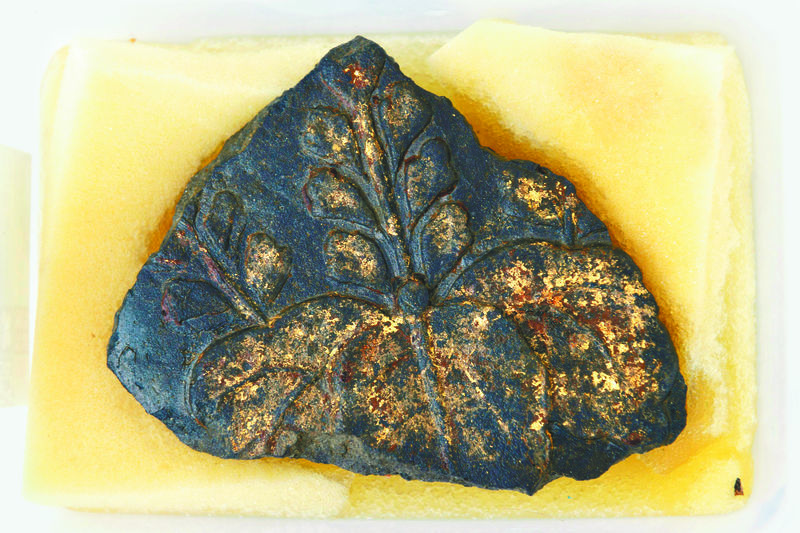
The stone walls discovered were between 1 to 1.6 meters high and about 8 meters long, stretching from north to south. The stones were piled in the nozura-zumi style, a construction technique of the Azuchi-Momoyama period (1568-1600) using natural stones stacked atop each other. The gilded roof titles are engraved with the paulownia seal that Hideyoshi adopted.
Prof. Hitoshi Nakai of the University of Shiga Prefecture who specializes in archaeology said, "It can be said that solid evidence of its existence has been found and it is the biggest discovery in castle research in recent years."
Kyoto Shinjo was a residence built to the southeast of the Kyoto Imperial Palace by Hideyoshi for his young son Hideyori in 1597. It is said that the castle was used as the residence of his lawful wife and for Hideyori's coming-of-age ceremony.
According to historical documents, the castle area is called for example "Taiko Gosho" or "Shinjo," and was about 400 meters from east to west and about 800 meters from north to south. Although the size of Kyoto Shinjo was slightly smaller than that of the Jurakudai Palace where Hideyoshi wielded his power as kanpaku, or chief adviser to the emperor, it was larger than the current Kyoto Sento Imperial Palace.
Just before the Battle of Sekigahara in 1600, the gate and stone walls of Kyoto Shinjo were broken, and it is thought that the castle was removed when the Sento Imperial Palace was built.
According to the Imperial Household Agency, which manages the palace, up to now no excavations had been conducted in the Sento Imperial Palace.
Read more from The Japan News at https://japannews.yomiuri.co.jp/