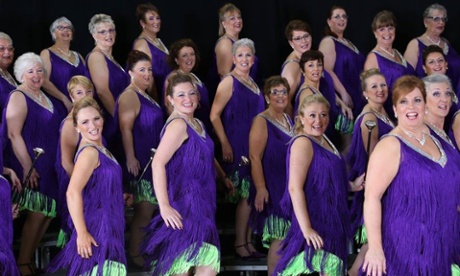
I’m sitting very still on a plastic chair while Hannah applies my fake lashes. The air is heady with hairspray. Jane and Michelle, the makeup team, are touring the room.
“Blusher.”
“I’ve got loads on!”
“You need more.”
Last month, 2,000 women descended on Bournemouth with sparkly dresses in their bags and determined looks on their faces. Don’t let the big hair and coordinated stage outfits distract you, though. This is the Ladies’ Association of British Barbershop Singers’ annual convention, and it’s all about the music.
I hope Gareth Malone made it down. His latest series, The Naked Choir, tapped into a trend for a cappella music that’s seen Out of the Blue’s Shakira cover go viral, Pentatonix play to stadiums and the Pitch Perfect series fill cinemas. My barbershop chorus, the Leeds-based White Rosettes – current European champions – are here to try and win a 15th gold medal.
Our musical director, Sally McLean, was one of the judges on The Naked Choir. Despite this, all of the barbershoppers went out early in the BBC show, unable to shake off their musical straitjackets and embrace the beatboxing and amplified solos of “modern a cappella”. But barbershop traditions are there for a reason: to produce an unmistakable sound.
The first time I heard the White Rosettes live, I remember scanning the chorus, trying to work out who was singing those stratospherically high notes. Nobody was. A properly tuned and held chord produces screaming harmonics – “lock and ring”, the crack cocaine of barbershop. They make your ears buzz and your heart race.
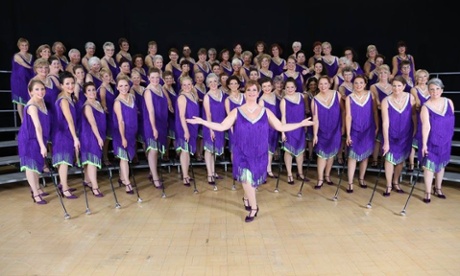
In that first rehearsal, I sat there with tears running down my face. The quest for these transcendent moments is part of what makes barbershop singers so fanatical about their hobby. Liz Garnett, author of The British Barbershopper, describes the community as having “a proselytising passion” for the style. It does feel a bit like being in a cult. Everyone has their tale of how they came to barbershop: how they found it and it changed their life. We shake our heads wonderingly at the people who don’t get it, who can’t see past the blazers-and-boaters cliche sent up so effectively by the Ragtime Gals.
Barbershop has developed beyond this stereotype, but it’s still peculiarly resistant to outside influence. Certain things get barbershoppers really excited, and they aren’t about to give any of them up. Songs are arranged for four parts only. Arrangements feature particular chords (including the barbershop seventh) and characteristic chord progressions. The second line carries the melody, while the top line harmonises above, the bass sings the lowest notes and the baritone fills in the gaps. There are no stars, no soloists and there’s absolutely no beatboxing; the aim is to create a blend where nobody’s voice sticks out. Audiences go wild for good performers doing their favourite barbershop stuff: posts (a single note held forever by one part while the others harmonise around it), swipes (where all parts move from one chord to another in an exaggerated yet perfectly tuned and coordinated glide) and the signature ringing chords.
Barbershop is all about engaging the audience, so the songs are fun to sing and entertaining to listen to – show classics, jazz standards, pop tunes. It’s an accessible hobby: all you need is to sing in tune, hold your line (without getting distracted by what other parts are singing) and sing without vibrato (it interferes with lock and ring). Everything else can be taught. But a chorus needs a fair amount of skill to achieve those distinctive barbershop effects, so you also need to like practising.
And competing adds another layer of pressure. Despite a surface veneer of cake and cackling, our schedule in the run-up to the convention has been intense. On top of weekly three-hour practice sessions, we’ve spent full weekends rehearsing, had visits from vocal coaches and organised section rehearsals for basses, baritones, tenors and leads. We’ve been fitted for dresses and shoes, pored over makeup tutorials and learned how to apply fake tan. We’ve had extra meetings to fine-tune choreography, and spent hours winding back videos and practising moves in the kitchen in our socks.
Competition, which seemed so odd at first, is a straightforward motivator. Instead of vaguely hoping we’re going to be ready for a concert soon, we’re thinking about scores. How can we improve on last time? What differentiates a performance that scores in the late 70s from one worth 80-something? Can we make the judges drop their pencils altogether? Stage costumes and music choices are guarded more closely than Great British Bake Off results, and we speak about advances in vocal technique strictly in code, for fear of industrial espionage.
But although it’s a competition, convention focuses on harmony – not just musical, but interpersonal. Women go up on stage to collect long-service pins celebrating 25, 30, 35 years of membership. Awards are presented for Unsung Hero and Young Barbershopper of the Year. Everyone hangs around in the bar until 4am, catching up with old friends and singing. Polecats – songs that everyone in the association learns – allow people from different choruses to sing together, and little groups huddle in corners to sing in scratch quartets or teach each other snippets of songs called tags. The feeling of being party to a massive, marvellous secret that the outside world doesn’t really understand just adds to the sense of closeness.
I’m a lifelong performance-phobe. But this harmony, the support among the 32 choruses competing, and everyone’s desire to see each other improve and progress, must be how I came to be standing on a stage in front of 2,000 people feeling light and confident. Competition was fierce this year, and we really weren’t sure what the outcome would be. We gave it our best shot. I visualised Gareth, leaping to his feet and hollering. I know we would have made him do it.
- The White Rosettes became National Champions, for the 15th time, at the 2015 Ladies’ Association of British Barbershop Singers Convention in November. Their Christmas show is in Harrogate on 12 December, and they are appearing on BBC Look North on 23 December.