Digital 3D models are being made of a growing number of structures, a process said to be useful in restoring buildings if they are harmed in such disasters as earthquakes or fires.
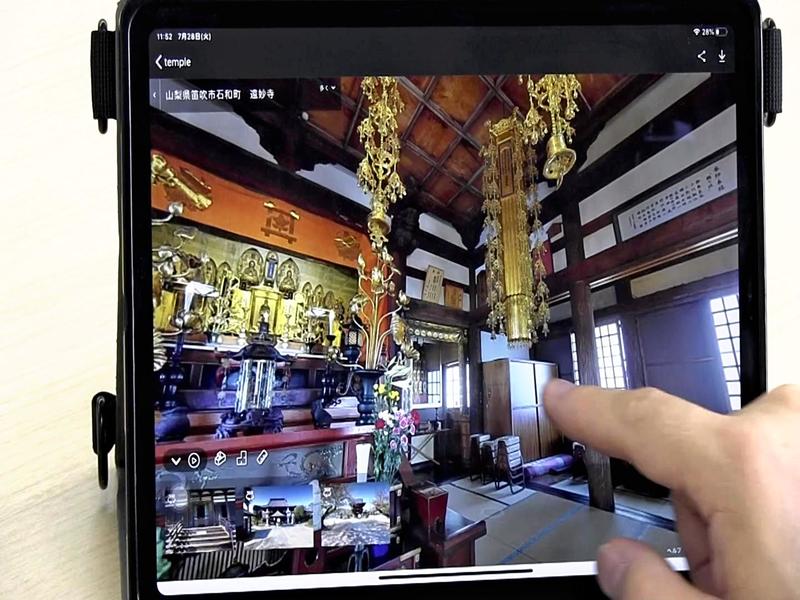
This type of modeling creates a 3D image of the interior of a building that is exactly the same as the real one, by linking together images taken with a 3D camera at multiple locations.
--Virtual tour inside structure
Once a structure is developed into a 3D model, people can tour the inside of the building on a computer, as if moving around inside the actual structure. The images can be viewed straight on or from different angles; it is also possible to enlarge certain areas and measure the distance between two points.
A key feature of 3D modeling is that a great deal of information can be included that cannot be ascertained from a design drawing. For instance, information on the quality of the material used in a pillar and its color can be preserved. Such a model can also be a complete record of the locations of objects inside a temple, including Buddhist statues.
--Even wood grain clear
Leading contractor Taisei Corp. has developed 3D models of about 60 buildings since 2014.
Onmyo-ji temple in Fuefuki, Yamanashi Prefecture, had 3D models created of parts of its structures, including the main building, this April to preserve their current state in digital data.
Images recorded at about 100 points inside the main building were linked together. Recorded in 4K high-resolution, even the wood grain of the flooring can be seen clearly. "With the preserved data, we can feel secure even if we're hit by a disaster," said chief priest Kosho Nagasawa, 64.
In addition to Onmyo-ji, Taisei Corp. has developed 3D models of such structures as a theater in Kyoto, a city hall in Chiba Prefecture and a private high school in central Tokyo.
Daisuke Yoshida, an associate professor at Osaka City University, has been working since this May to create a 3D model of Kishiwada Castle in Kishiwada, Osaka Prefecture, in cooperation with a local government.
"If we have a high-resolution 3D model, we can figure out how the castle was affected by a disaster, thus leading to its restoration," Yoshida stressed.
So how is a 3D model created?
The Yomiuri Shimbun asked Taisei Corp. to demonstrate the process using an about 50-square-meter conference room at the Yomiuri's headquarters in central Tokyo. First, photographs were taken in six spots over about 10 minutes with a special 3D camera. The data was uploaded to an online service for developing 3D models, and the model was completed in about 30 minutes.
--Condo model room
Mitsubishi Estate Residence Co., a leading condominium developer, has been posting 3D renditions of model rooms on its website since 2017. Access to the site in April and May, when a nationwide state of emergency was declared because of the spread of the coronavirus, rose by 30 percent to 40 percent compared with March or earlier.
"They [the 3D models] can be readily seen from people's homes, and can also be shared easily among family members. Our customers' understanding of our properties will deepen," said Kei Natsui, the head of a planning group at the company.
--Valuable data
Even after a structure is damaged or destroyed, a 3D model can be created by collecting relevant images from before the damage.
Shuri Castle in Naha was ravaged by fire in October 2019. Led by Rei Kawakami, a specially appointed associate professor at Tokyo Institute of Technology, a group of people interested in the castle's restoration created 3D models of structures including the façade of the Seiden main hall, the seat of the king of the Ryukyu kingdom.
About 2,000 sections of photographs assembled from contributors online were used to create the 3D model of the Seiden façade. "These images were contributed by people who want the castle to be restored, and it's very meaningful that we were able to create 3D models in cooperation with these people," said Kawakami.
Read more from The Japan News at https://japannews.yomiuri.co.jp/