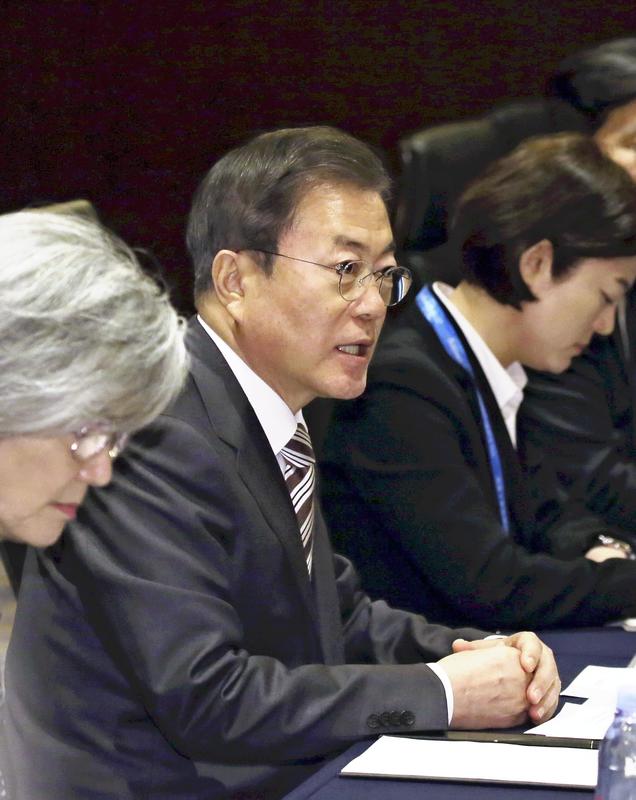
Japan and South Korea have unresolved bilateral issues, such as lawsuits involving former wartime requisitioned workers that the Japanese government calls "former civilian workers from the Korean Peninsula." South Korea's foreign policy regarding Japan largely depends on the personal character and beliefs of South Korean President Moon Jae-in. What is behind Moon's actions that have jeopardized the bilateral relationship?
Victim-centrism
In May 2000, former South Korean requisitioned workers filed a damages suit with the Busan District Court against Mitsubishi Heavy Industries, Ltd. (MHI), claiming that they had been forced to work by the Japanese company during World War II. One of the plaintiffs' attorneys was Moon, who gained renown as a human rights lawyer at that time.
After fellow lawyer Jung Jae-sung consulted with Moon, who was the head of their law firm in Busan to which the plaintiffs asked to handle the lawsuit, Moon readily agreed to take the case, reportedly saying, "Let's help as it's a good cause."
Before that time, lawsuits involving requisitioned workers saw the plaintiffs lose a series of court cases in Japan. The suit against MHI was the first case against a Japanese company in a South Korean court.
Moon appeared in court for oral arguments. When plaintiffs, members of civic groups and Japanese lawyers who supported the plaintiffs came to hearings, Moon is said to have arranged meals for and encouraged them, saying, "Let's do our best to win the case."
On Nov. 29, 2018, the South Korean Supreme Court recognized the plaintiffs' claims and finalized a ruling ordering MHI to pay 80 million won (about 8 million yen) per plaintiff.
The 1965 Agreement on the Settlement of Problems Concerning Property and Claims and on Economic Cooperation stipulates that the issues of claims between the two countries have been "settled completely and finally." The Japanese government has taken a stance that the South Korean court ruling violates the agreement. On the other hand, Moon has touted a victim-centric approach in which the plaintiffs' views should be respected as much as possible. Japan and South Korea have been at odds over this issue, which has become a great concern for both countries.
Digging into this background from which Moon formed his way of thinking to prioritize the opinions of the individuals concerned over an agreement between nations, his history as a human rights lawyer emerges.
"This victim-centrism is President Moon's belief and philosophy as he was a human rights lawyer," said Moon Chung-in, a special adviser to Moon for unification, foreign affairs and national security. "It's difficult to impose [other ideas] on him."
The special adviser then called Japan's stance of adhering to the agreement "nationalism." He described the current confrontation between the two countries as a "clash between two philosophies: nationalism and victim-centrism."
The role of lawyers is, above all, to protect the interests of their clients. On the other hand, a person in a presidential post is also required to pursue national and societal interests and keep the faith among nations without leaning to the interests of specific individuals. Moon appears to have failed to make decisions from a broad perspective as he has been unable to break away from his way of thinking as a lawyer. His obsession with victim-centrism raises questions.
For the nation or plaintiffs?
The law firm in Busan in charge of the lawsuit against MHI was established in 1982 by Moon and Roh Moo-hyun, who both became presidents of South Korea. The two served as joint representatives of the firm, known as a base for democratization during the military administration at the time.
When Roh became president in February 2003, Moon joined the administration as a close aide and was involved in the requisitioned worker issue as an administrative official. He was then appointed as the closest aide to the president for a public-private joint committee of 21 members established in March 2005 as an advisory body to the prime minister to decide on measures to help those who claimed to have suffered from Japan's colonial rule. Moon's post corresponded to that of the president's legal adviser.
Moon Chung-in, the presidential adviser, said Moon's strong insistence led to a consensus that individual claims cannot be nullified under an agreement concluded between governments without the victims' mandate. It follows the same line of reasoning as the South Korean Supreme Court's ruling that ordered Japanese companies to pay compensation despite the 1965 agreement.
At the committee's first meeting on March 14, 2005, it was announced that there were many lawsuits filed against Japan, including the one against MHI in which Moon was involved. At the final meeting in March 2006, the committee confirmed it was necessary for the government to consider measures to support victims indirectly, through private organizations and other means. This discussion process is described in a South Korean white paper published in 2007.
While Moon was involved in the governmental decision-making process, he was, at the very least on paper, the legal representative of plaintiffs until November 2006.
In South Korea, questions arose about the two hats Moon was wearing at the same time: one as a lawyer who pursues the interests of plaintiffs, and the other as the legal adviser in the presidential Blue House.
Kwak Sang-do, a former prosecutor and a lawmaker in the main opposition Liberal Korea Party, pointed out on Aug. 7, 2019, that there is the possibility of a violation of a public service ethics law, which stipulates the duty to prevent conflicts of interest.
A Blue House source said: "Moon left the legal profession in February 2003. The notification of the removal of the plaintiffs' counsel was the responsibility of the law firm." He added that the law firm only forgot to report his removal. Even if this explanation is correct, has he managed as president to break away from his past role as the plaintiffs' lawyer in tackling the issue regarding former requisitioned workers?
Moon wrote in his autobiography, "As a lawyer, I knew all about the law, but I was ignorant of the world when it comes to national affairs, and I was no better than an armchair theorist." He seemed to be bewildered when he was asked by Roh to take the position as his closest aide in the Blue House.
During last year's meeting on issues regarding the requisitioned workers lawsuit, a South Korean opposition party source said that Moon only repeated legal theories.
The president's indifference to agreements between nations also surfaced in his stance on the so-called comfort women issue.
After Moon's administration was inaugurated in May 2017, his government examined the accord between Japan and South Korea on the comfort women issue announced at the end of 2015 under the conservative administration of President Park Geun-hye. Paying attention to the fact that some former comfort women who received support from radical civic groups opposed the accord, the administration concluded that the agreement did not adequately reflect the women's opinions.
In July 2019, South Korea dissolved the Reconciliation and Healing Foundation, which had been supporting former comfort women based on the accord, effectively nullifying the accord.
Read more from The Japan News at https://japannews.yomiuri.co.jp/