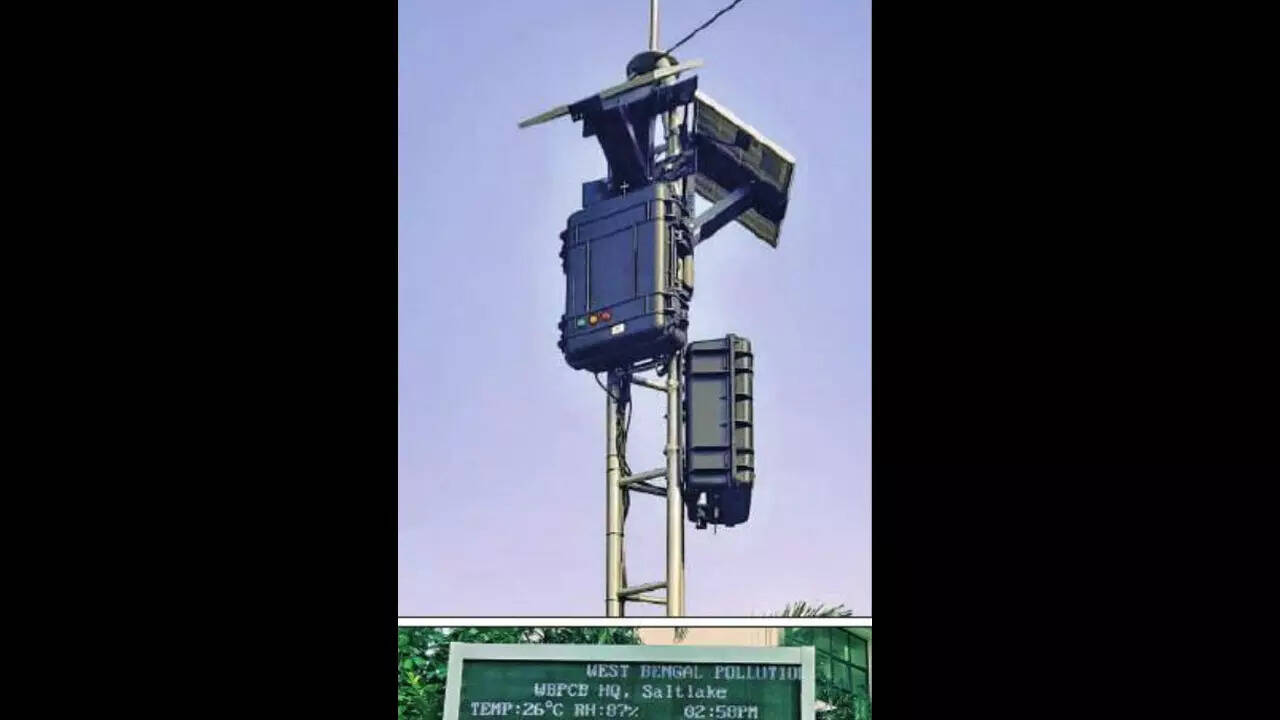
KOLKATA: The city can now get a robust picture of its ambient air quality with 10 new sensor-based continuous ambient air quality monitoring stations (CAAQMS) providing real-time air quality data along the length and breadth of Kolkata, apart from the seven existing CAAQMS.
Moreover, 10 more sensor-based stations are coming up at identified pollution hot spots across the city by March this year.
Among the new spots, Leather Complex (Bantala), Barrackpore police commissioner’s office, Sector V and Vivekananda Women’s College (Behala Chowrasta) recorded poor air quality on Friday while the rest recorded moderate air quality.
According to WBPCB chairman Kalyan Rudra, “The sensors are periodically calibrated against the reference-grade monitors and are being used for air quality management for the city and the rest of the state. The data represents broad trends of air pollution in the locality.”
Apart from its existing seven CAAQMS — at Ballygunge, Jadavpur, Rabindra Sarobar, Victoria Memorial, Fort William, Rabindra Bharati University campus (B T Road) and Salt Lake — the 10 new stations cover some critical areas where pollution is perceived to be higher than in the rest of the city. “We are now analysing data to identify the sources of air pollution to adopt appropriate remedial measures,” a senior PCB scientist said.
The data from 17 stations provides a clearer picture of the ambient air quality of the city. “For instance, Sector V, the city’s IT hub, is often found to have ‘poor’ air quality despite there being a lake nearby. However, we are trying to analyze the vehicular density of the area, which is much higher throughout the day. Behala Chowrasta is another polluted zone because of vehicular density and construction of the Metro corridor.
The air quality at Leather Complex, for instance, remains poor most of the time. The dhapa dumping ground may be one reason. “But, we may need to investigate whether pollution control devices at the leather units are functioning properly,” said a source.
Since all these CAAQMS are set up following the mandate of the National Green Tribunal (NGT), the next 10 sensor-based CAAQMS will come up at pollution hot spots, like sites of landfills, mega real-estate projects, under-construction Metro corridors, hospitals and sensitive zones.
“We have spoken to KMC, which will provide us with the appropriate sites for setting up the monitoring stations. Unlike conventional CAAQMS, these sensor-based stations are cost efficient and require less space,” said a WBPCB official.