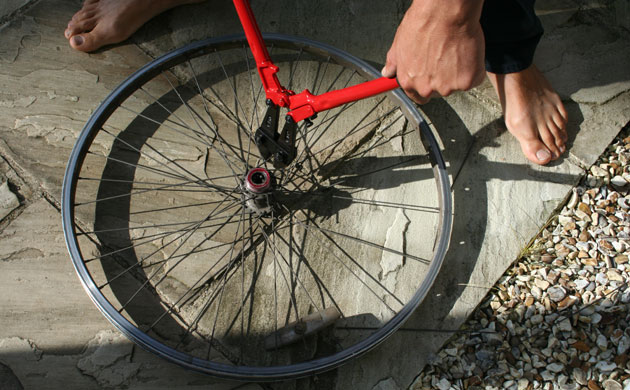
Go to a bike shop and ask for some old scrap wheels. If the wheel comes with a rubber rim tape, remove it and put it to one side. If you're very patient, unscrew all the spokes. If not, cut them off with boltcroppers or heavy-duty wire cutters. Cut close to the hub so that they're easier to bundle up and recycle Photograph: George Monbiot/Guardian
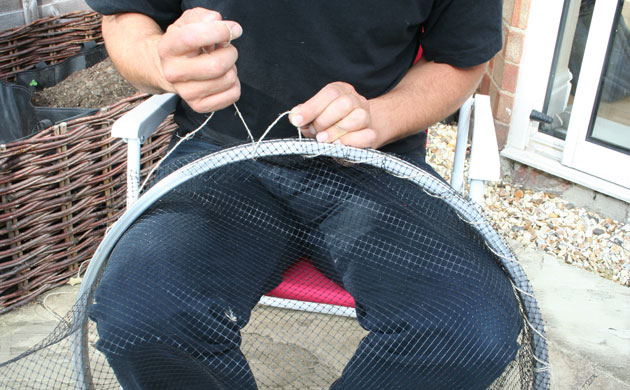
Cut a 4m length of string, cord or twine (preferably rot-proof). Poke it through the valve hole and tie it to the wheel rim, leaving a tail of about 10cm.
Then fold the edge of the netting over the wheel rim, so that it overlaps the netting below by about 2cm. Pass the string over the net and through the first spoke hole in the rim. Keeping the string tight, carry on until you're a quarter of the way round the rim Photograph: George Monbiot/Guardian
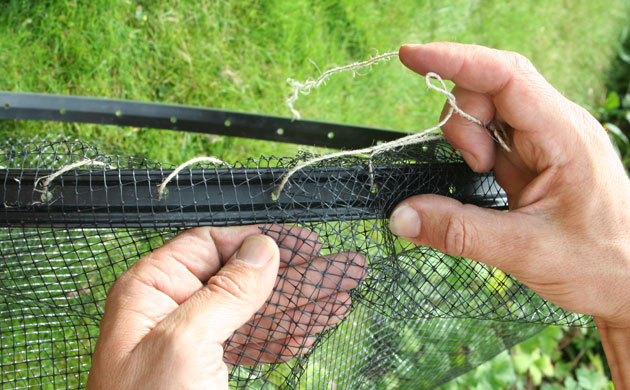
When you get back round to the valve hole, pass the string through it twice then tie the end to the tail you left when you started.
You should end up with a net about 30cm deep. Any less than this and the crayfish might scoot off when you are raising it; any more and it could get trapped in obstructions on the river bed.
If the wheel came with a rim tape, put it back on now, over the netting. This takes some of the pressure off the netting where it crosses the rim Photograph: George Monbiot/Guardian
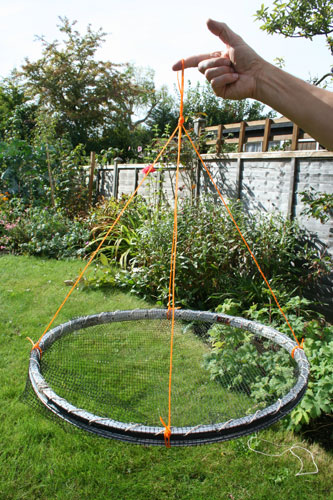
Tie on another length of cord, at one of the two remaining compass points. Wind it twice round the opposite point, then pull or loosen it until the two loops are of equal length and the net hangs horizontally. Tie it off.
Hang the net off your finger with both loops in order to find the point of balance, then bring the two loops of cord together with an underhand knot, leaving a fixed loop about 10cm high.
You've made your net. If you have time, make several of them Photograph: George Monbiot/Guardian
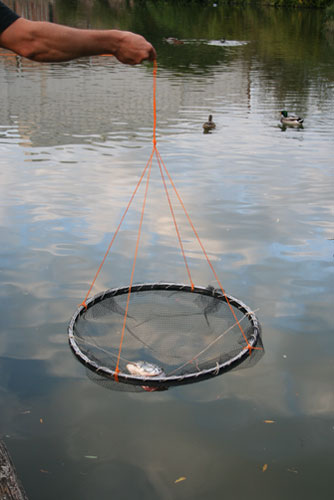
Pack the bait, the nets, a penknife, some cloth bags (or better still a hessian sack), some string and some stout cord or rope (or old washing line or telephone cable). Get to the river an hour before dusk. Peak fishing is an hour either side.
Tie a short piece of string to each side of the rim, then use the two lengths to tie on the bait, which should be positioned in the middle of the net. Tie the rope to the fixed loop with a bowline, sheepshank or half-bloodknot, and lower the net into the water beside the bank (vertically if possible).
If you've made more than one net, drop them a few metres apart. If you're clever and are next to a pub, grab yourself a pint Photograph: George Monbiot/Guardian
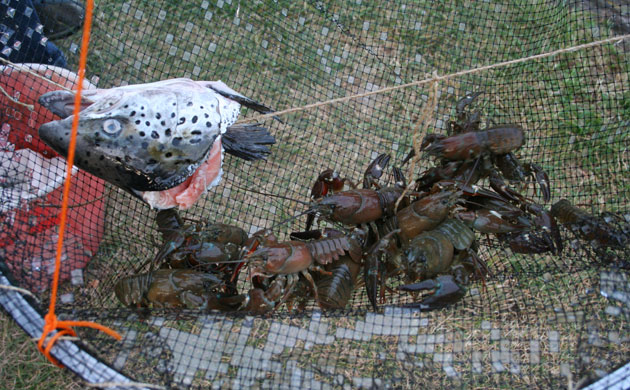
Pull it up gently and smoothly and swing it onto the bank. If you're in a good spot it should contain half a dozen or more; sometimes I've pulled up 20 or 30 crayfish at a time.
You should have made sure the spot you've chosen is not one of the few where the white-clawed crayfish still lives Photograph: George Monbiot/Guardian

If any cling onto the net, don't try to pull them off: they will just cling on tighter. Hold the net upside down until they fall off. Drop them into the sack and fold the top over, otherwise they'll climb out. Spare none of them, however small: in this case all the usual ecological rules are reversed.
Red signal crayfish are distinguished by the scarlet underside of their claws Photograph: George Monbiot/Guardian

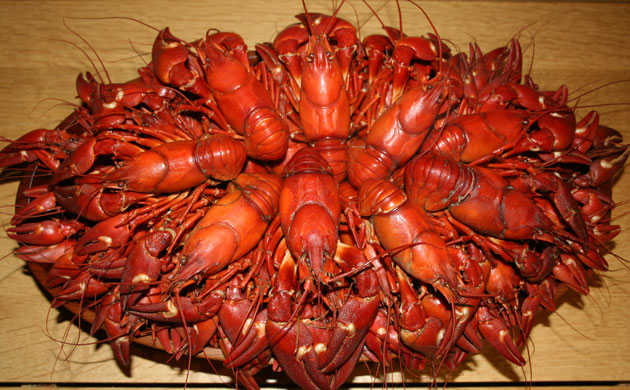
Wrap them up carefully in the wet sack or bags. As long as the fabric remains damp, they'll live this way for up to three days; they would die very quickly in a bucket of water.
When you're ready to eat them, wash them in the sink and boil up a large pot of salted water. Drop just a few in. This way the water temperature doesn't fall very far, so they die within 10 seconds. Cook them for no more than five minutes: generally for only as long as it takes for the water to return to the boil. Scoop them out and drop in the next batch Photograph: George Monbiot/Guardian
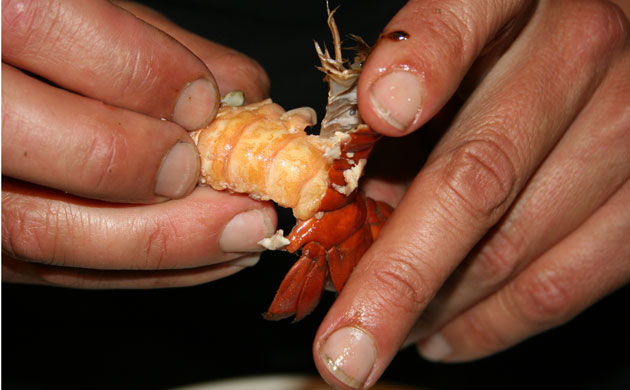
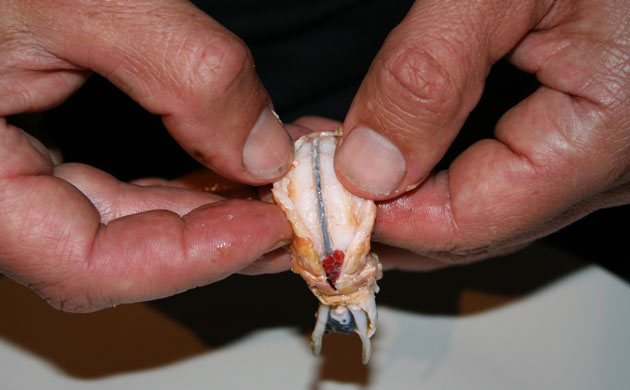
If the crayfish has big claws, crack them open with an empty wine bottle, then pull the smaller mandible off. If the flesh doesn't come out easily, use the small mandible to winkle it out Photograph: George Monbiot/Guardian
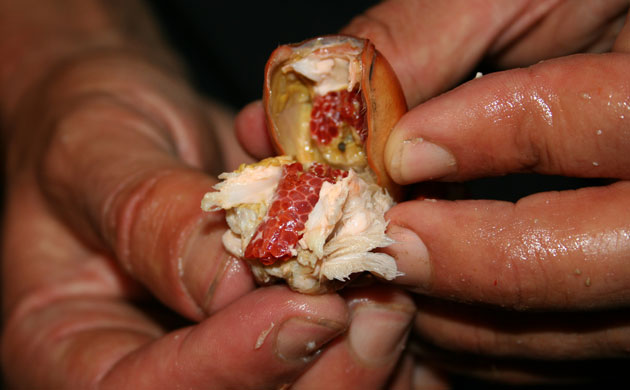
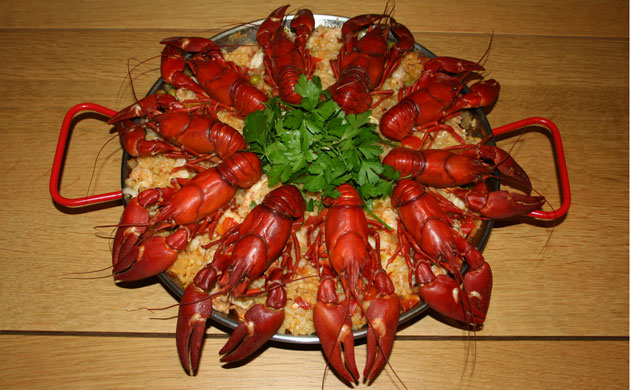
You can eat all this just as it is. The flesh has a sweeter, more delicate flavour than either lobster or prawns. Or you can eat it with mayonnaise, or make a bisque (a thick soup) or a crayfish salad. But my favourite dish is … Photograph: George Monbiot/Guardian