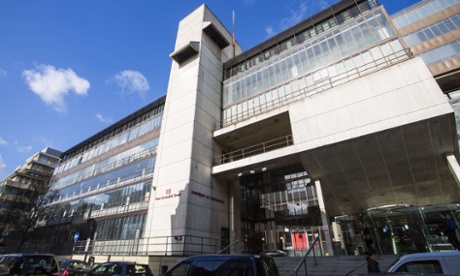
The London university attended by ‘Jihadi John’ militant Mohammed Emwazi has refused to bow to pressure from 3,000 students to cancel a talk by a controversial preacher accused of describing homosexuality as a “scourge” and “criminal act”.
The University of Westminster’s Islamic society was forced to postpone the event entitled ‘Who is Muhammad?” over security concerns on Thursday night after Emwazi was unmasked as ‘Jihadi John’.
However, the talk by preacher Sheikh Haitham al-Haddad is now expected to go ahead on Monday despite a petition attracting more than 3,000 signatures to stop him from “preaching hate on our campus”.
Controversy over the event came as the university confirmed that Emwazi, 26, graduated from a three-year course in information systems and business management in 2009.
Westminster university bosses on Friday insisted it has a zero-tolerance approach to Islamist extremism following fresh concerns about an “intimidatory atmosphere” on campus.
Sheikh al-Haddad said that the campaign against him, which was led by the university’s LGBTI society, was “completely misplaced” because his views on sexuality were not the focus of the discussion.
“In the religion of Islam it is clear-cut that homosexual acts are a sin and are unlawful in the Shariah. Trying to censor lawful speech does not change this fact,” he said.
Sheikh al-Haddad added his belief that his views were similar to “those of orthodox Christian or Jewish religious leaders” and that denying him a platform was to deny him his right to free speech.
The university’s Islamic society defended him, reiterating that sexuality was not the focus of the debate.
In a statement, the society said that inviting Sheikh al-Haddad was not intended to cause any offence, but was motivated solely by his standing among religious leaders.
Peter Tatchell, the prominent gay rights activist, said members of University of Westminster’s LGBT society and women’s rights campaigners had for years been targeted by hardline Islamist students.
“The atmosphere is intimidatory towards gay and women’s rights campaigners and towards fellow Muslims who don’t share their hardline interpretation of Islam,” he told the Guardian.
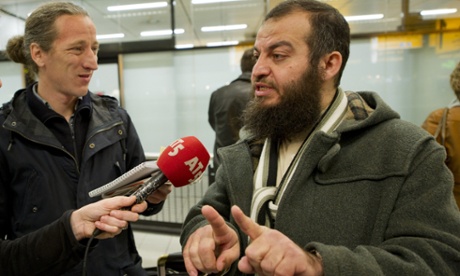
Tatchell, who has given talks at the university and has close links to its LGBT society, said the group’s posters had been torn down and defaced as recently as last year. “Gay and women students have also told me that they are too frightened to challenge Islamists on campus because they fear retribution,” he said.
A senior lecturer, who declined to be named publicly, said the overwhelming majority of Muslim students at the university were moderate in their beliefs and were upset that preachers like al-Haddad were invited to talk at the Islamic society event.
He said the university’s Islamic society was run by extreme figures between 2008 and 2011 but that they had all graduated.
There was now only a small number of hardline Wahabi Muslims who could cause problems, he said, citing the example of a Saudi Arabian student complaining six months ago that she was being “shouted at by other Muslim students simply because she was Saudi”.
Security on the university’s four campuses has been ramped up in recent years, with spot checks on students and restrictions on visitors. A sign at the university warns that security alert status was raised to amber due to a “heightened state of awareness of potential security problems or threats”.
The university has attempted to distance itself from Emwazi, saying in a statement that it was “shocked and sickened” by the news.
Asked about the allegations concerning LGBT students being targeted, a university spokeswoman said it “condemns the promotion of radicalisation, terrorism and violence or threats against any member of our community” and that any student found to be engaging in radicalised activity or intimidating others would be referred to disciplinary procedures.
In a separate statement, the university’s Islamic society said it has “nothing to do with” Emwazi and added: “It is not associated with any extremist organisations and that should be obvious and not need stating, but given the climate, it has become necessary to clarify such things in statements such as this.”
Since March 2012, the university’s Islamic society is estimated to have hosted 22 events featuring speakers with a history of radical Islamist views, according to the Henry Jackson Society thinktank. Previous speakers have included Anwar al-Awlaki, an al-Qaeda leader killed by a US drone strike in Yemen in September 2011; Hizb ut-Tahrir member Jamal Harwood; and Dr Khalid Fikry, who has given speeches in which he appears to suggest that Shia Muslims believe “raping a Sunni woman is a matter that pleases Allah”.
Former Westminster university student Yassin Nassari was jailed in 2007 for carrying blueprints for a rocket in his luggage when stopped by police at Luton airport. It is not known whether Nassari was radicalised at the university, but his Old Bailey trial heard that after taking a break from his studies he reappeared wearing long robes and referring to himself as “emir” of the student’s Islamic society.
In 2011, the university was in the spotlight after it emerged that the then-president and a vice-president of its students’ union had links to the extremist group Hizb ut-Tahrir, which has long called for the establishment of an Islamic state.
In 2012, a series of jihadist videos were posted on the Islamic society’s Facebook page in support of al-Shabaab, the Somali Islamist terrorist group that on 21 February this year called for attacks on US, UK and Canadian shopping malls.
Several students spoken to by the Guardian on Friday insisted that the university is not a hotbed of radical Islamism.
“I don’t want to use the word ‘extreme’: it’s a volatile word. There’s different scales. I’m a Muslim myself and there are liberal moderates and more conservative,” said Naj, 20, a second-year law student.
“The general thing is it’s not a crazy extremist university. Not at all. Everyone I know is condemning this Jihadi John. I don’t like how the media is painting this uni to be a hub of extremism.”
Recent graduate Haleema Abdullahi, 22, said the university stood out due to its “large Muslim population” and because many students choose to wear traditional Islamic dress.
“People say we’re extremist – the University of Westminster is very active with lots of events open to everyone and many sisters there are active. People say they are conservative as many wear abaya and hijab,” she said.
Abdullahi said she was “sickened” by Emwazi’s actions, but that was not fair to link him to the university because he graduated six years ago. She added: “Other extremists went to other unis – it happens.”
Speaking at the university’s Regent Street campus, a language masters student who declined to be named said the university may have a hardline reputation because some campuses have many Muslims.
“I’ve been here for four years and I haven’t seen any radicalisation and the university Islamic society has made efforts to include people and invite non-Muslims to events too,” she said.
However, another student said the university was “segregated” between Muslims and non-Muslims. “If you’re not a Muslim you won’t know what happens in that separate community,” she said.