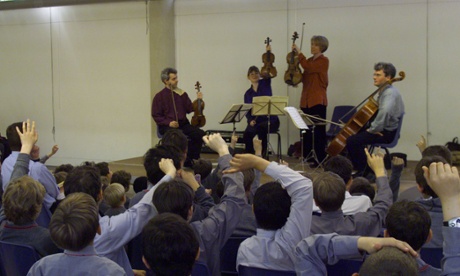
Good - if shockingly mundane - news to report from the Incorporated Society of Musicians (ISM). The government and Arts Council England confirmed on Monday that the ring-fenced money for music education hubs would indeed rise – as predicated and promised in the wake of the ISM’s Protect Music Education Campaign last year – by £17m, going up to £75m for 2015-16. This is of course to be welcomed, but it’s a pretty sorry state of affairs when it’s something to be celebrated in music education that a government simply sticks to its word.
In any case, it’s an important first step for Darren Henley, in his new job as chief executive of Arts Council England, to have been able to ensure the meaningful survival of the hubs, which were, after all, the key recommendation of his own report into music education, commissioned by this government early in its term. But while the entire cultural sector prepares for what will almost certainly be yet more cuts, whatever volatile strain of political marriage of convenience we’re all probably in for in May, there are special issues for music education, not least in reversing the conclusions of recent reports into the current hubs provision, which paint a picture that’s just as patchy as was the previous music-education ecology.
It’s surely a good thing that Henley is the man in charge, who ought to have a special interest in ensuring the success of what was his own project, but he will have a fight on his hands with government, with local authorities, and with the competing interests within the Arts Council itself to guarantee a developing – as opposed to dwindling – environment for music education over the next few years. If anything, he faces the most complex set of political and financial challenges that any Arts Council chief executive has ever encountered. Music education, especially, needs him to succeed.