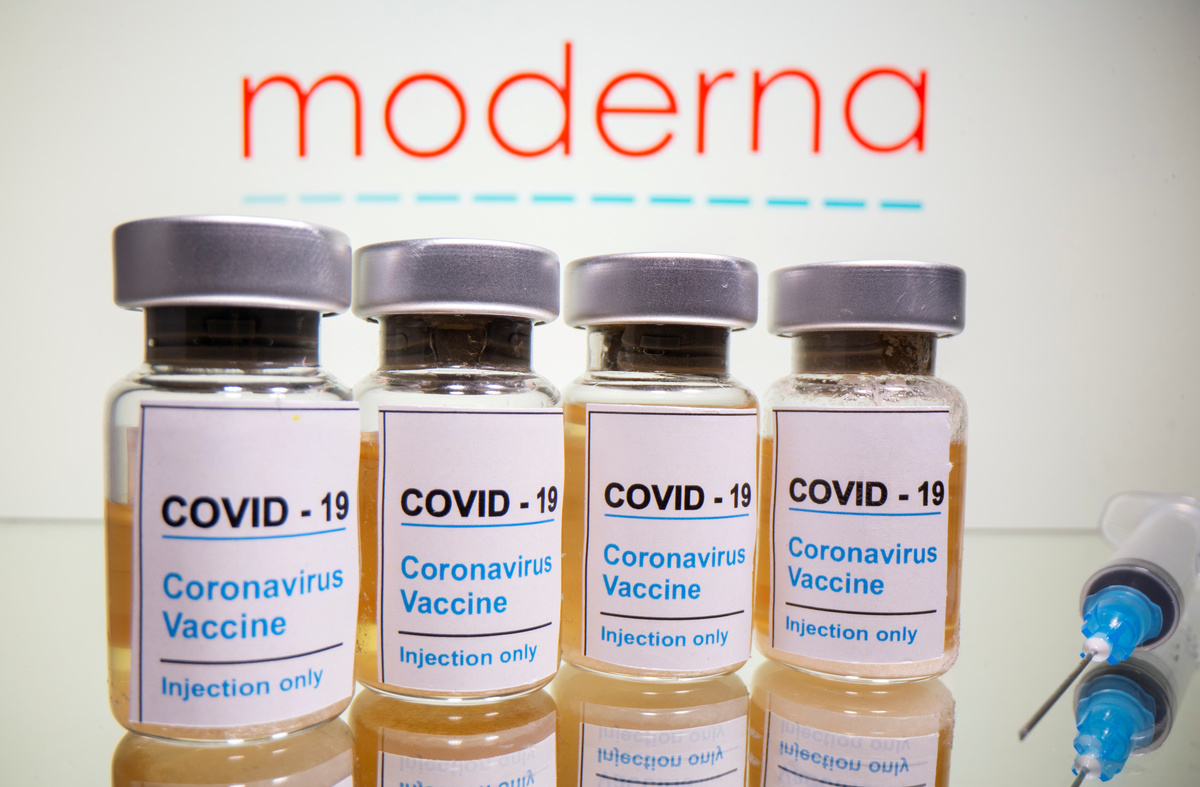
Moderna Inc's <MRNA.O> COVID-19 vaccine will be easy to distribute, particularly to rural areas, because it can be stored for one month at standard refrigerator temperatures, Matthew Hepburn, head of vaccines for the U.S. Operation Warp Speed program, said on Monday.
Hepburn's comments followed release of interim results from a late-stage clinical trial that showed the experimental vaccine to be 94.5% effective in preventing COVID-19.
Moderna's vaccine "enables a much more distributed model for us to get the vaccine out there, for example, in very rural areas and to be able to make that distribution process happen as conveniently as possible for those Americans that need vaccine," Hepburn said during a press call.
Moderna said its vaccine is expected to be stable at standard refrigerator temperatures of 2 to 8 degrees Celsius (36 to 48°F) for 30 days, up from a previous projection of seven days. That contrasts with Pfizer Inc's <PFE.N> vaccine candidate, which must be shipped and stored at ultra cold temperatures or on dry ice and can only last at standard refrigerator temperatures for up to five days.
"The stability testing for (Moderna's) vaccine is an ongoing process," Hepburn said. "Now, we could be cautiously optimistic that it may prove to be even more stable once those longer-term tests are completed."
Pfizer last Monday released initial data on its vaccine developed with German partner BioNTech SE <22UAy.F>, which also showed it to be more than 90% effective.
Both the Pfizer and Moderna vaccines use a new technology called synthetic messenger RNA to activate the immune system against the virus. Experts have raised concerns about the distribution challenges associated with Pfizer's vaccine due to its specialized storage requirements.
"Now that we know that there could potentially be two vaccines, (we are) working through lots of different scenarios in terms of who gets what vaccine when. Part of this will also be based on the distribution characteristics," Hepburn said.
(Reporting by Manojna Maddipatla in Bengaluru; Editing by Bill Berkrot)