
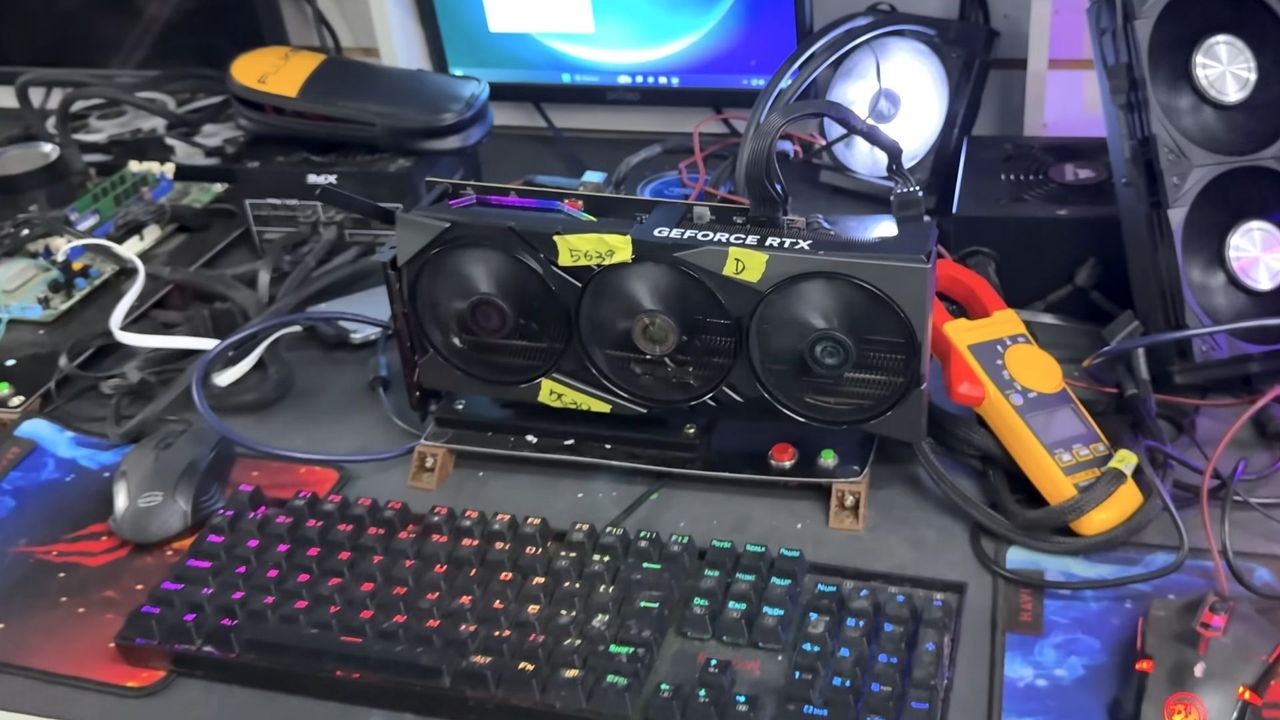
A Brazilian YouTuber with a talent for resurrecting and repurposing damaged or otherwise fatally destroyed Nvidia graphics cards has struck success with an RTX 4090. Paulo Gomes, who recently broke records with a Frankenstein RTX 5070 Ti, along with Jefferson Silva, have been able to resurrect a PCB-damaged MSI RTX 4090 by disabling one of its memory channels.
The Nvidia GeForce RTX 4090 ships with 24GB of GDDR6X VRAM as standard, but disabling one of its memory channels reduces the working capacity in this modified card to just 20GB. The card, which had seen structural damage to its PCB after being bent, is seen working in the YouTube video documenting the project (h/t Videocardz).
The cracked PCB, in this instance, is down to what Gomes and his team believe was a lack of a support bracket during use, and possibly during transport, which caused the PCB to sag and break. They speculate in the video that moving the PC without securing the card led to an impact that caused it to break. Equally, gravity and the weight of the card could cause it to warp over time.
To get the card working again, they manually rerouted 12V and 5V power rails using jumper wires. Damage to the RTX 4090’s PWM circuit meant the GPU could no longer keep the cooling fans working, so they added a 5V line to keep them working at a constant speed.
The big problem, however, was the memory. Physical traces leading to one of the memory channels were destroyed; to bypass it, they flashed a modified BIOS to the GPU to skip it. Some minor work was also taken to clean up sections of the damaged PCB. The end result is an RTX 4090 with reduced performance, with 4GB less VRAM available to it, but still operational, regardless of its physical damage.
To stress test it, the team used 3DMark to benchmark the resurrected GPU on a basic machine with a Ryzen 3600X and 8GB of RAM. The benchmark returned as high as 10,700 points, although the final run hit 10,300. The test used isn’t made clear; given the scoring, Time Spy Extreme is the most likely benchmark, although that isn’t confirmed here.
Gomes’ video also showcases a second RTX 4090 with a flashed BIOS that reports it having 48GB of VRAM. The team notes that the BIOS they’ve flashed is meant for custom PCBs that support extra memory modules soldered on to both the front and back of the PCB, which we've seen used in some Chinese AI farms, while their test used a standard RTX 4090 card. Any attempt to try and push the GPU past its legitimate 24GB would likely crash it, as they note themselves.
With GPU pricing so high, it’s good to see damaged graphics cards as powerful as the RTX 4090 resurrected from the dead. Gomes has form for this kind of work, but unless you’re an electrical engineer, we’d recommend avoiding this DIY repair yourself.