
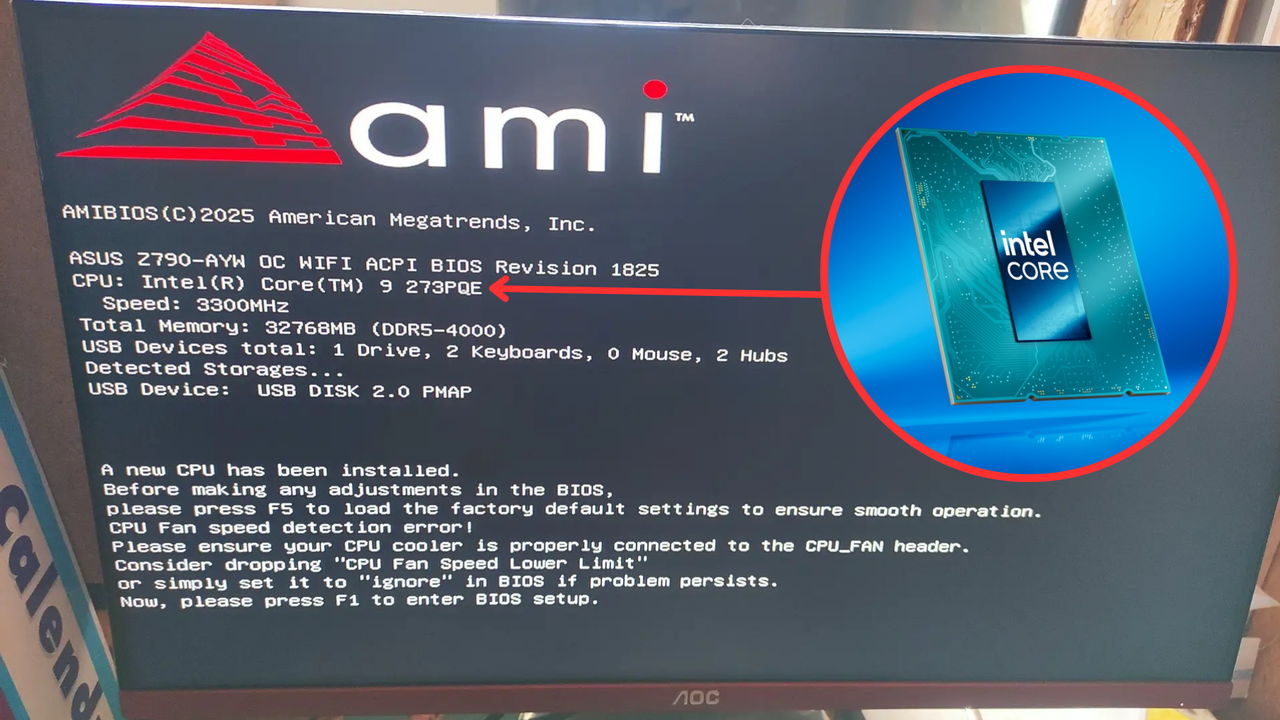
Intel launched its long-rumored "Bartlett Lake" family of CPUs earlier this month for embedded and industrial markets. These chips are based on the Raptor Lake architecture from a few years ago and only feature P-cores, but they're not intended for consumer platforms — hence, it's up to the community to formulate a workaround. As such, modding efforts to get Bartlett Lake silicon working on regular motherboards have materialized into the first Core 9 273QPE posting today.
User kryptonfly was the one who managed to achieve the feat, sharing their findings on the Overclock.net forums. They used an Asus Z790-AYW OC Wi-Fi motherboard for the experiment, which has an LGA 1700 socket that Bartlett Lake CPUs are compatible with. After some back and forth, the setup managed to boot and show the American Megatrends splash screen with the correct CPU name, but it hasn't gone any further.
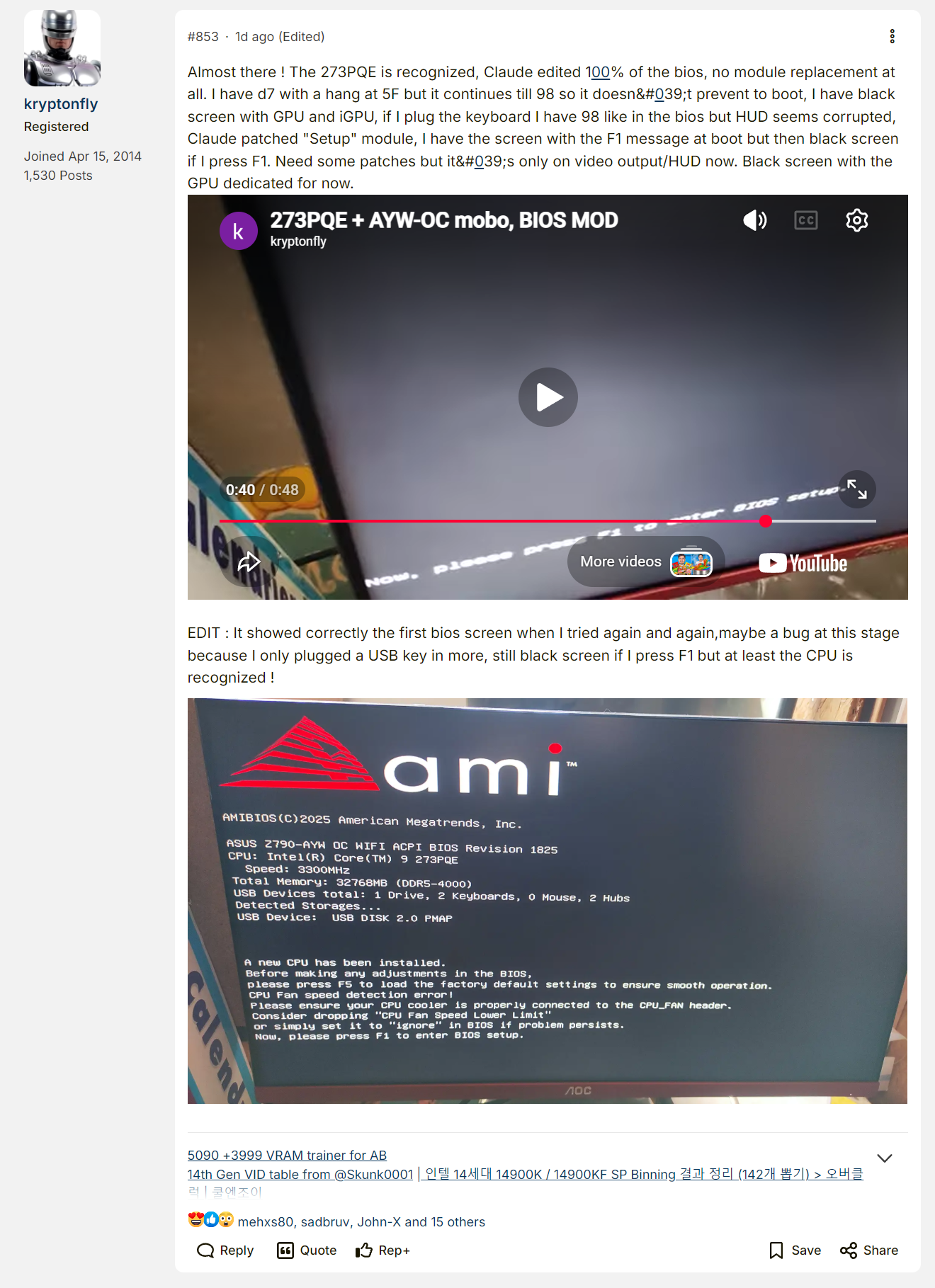
Technically speaking, since Bartlett Lake CPUs are on the LGA 1700 platform, they can be slotted into any regular Z600- or 700-series motherboard — it's just that they won't work because the BIOS is not compatible. This is where AI comes in; kryptonfly used Claude to modify the motherboard's BIOS to detect and post using the Core 9 273QPE, but an "exploit" like this can be quickly patched with a simple update from the vendor.
The processor part of this experiment, Core 9 273QPE, is the flagship offering from the Bartlett Lake family, featuring 12 cores and 24 threads that can all boost up to 5.3 GHz (or 5.9 GHz on one core). It's a 125W CPU with 36 MB of L3 cache and supports up to 5600 MT/s memory, maxing out at 192 GB. Specs-wise, this is not a bad chip for general computing, or even tasks like gaming, but there are a bunch of caveats.
The lack of E-cores might actually benefit task scheduling as the Thread Director won't have to worry about a hybrid config, which could result in superior gaming performance in edge cases. Unfortunately, the underlying silicon is just outdated at this point, and these CPUs don't have enough cache to compete with X3D CPUs from AMD, making them more reliant on system memory, so any memory latency —especially with bone stock 5,600 MT/s RAM — is only exacerbated.
Again, it’s not meant to compete in the first place, but for the sake of comparison, it’s worth clarifying that there’s no real advantage in going the DIY Bartlett Lake route over something newer, like Intel’s own Arrow Lake refresh chips. Of course, it’s still a cool project, and we hope the CPU makes it past the error codes OP shared in their original post, but its real-world effectiveness remains quite limited for now.