The winner
No surprises that Mockingjay Part 1 held in there, dropping -53% for $57m (£36.4m) this weekend in the US and -56% for $67m elsewhere. The Thanksgiving effect contributed to a firmer hold in the US. This dollop of The Hunger Games has been frontloaded more than previous ones – opening simultaneously in close to 90 territories rather than 40-something – so no surprise either that it is ahead of the last two at the second-weekend mark: $254.6m overseas against $146.1m. What is concerning is that many individual countries are tracking lower than Catching Fire at the same point. Most rich countries grossed lower this weekend, and their overall second-week take also dropped; that’s even happening in some emerging markets, like Russia (Catching Fire, second weekend: $5.4m; Mockingjay: $2.5m).
It’s in less mature markets, like Mexico (Catching Fire: $4.3m; Mockingjay: $4.4m) and Brazil ($2.7m; $3.8m), where affection seems to be building. It’s probably too early – especially with $480.3m already banked, and given the law of cleft final chapters described last week – to declare a general cooling-off. But it’s interesting for anyone given to thinking about blockbusters in geopolitical terms that, to adopt Hunger Games parlance, heat for the franchise is now burning strongest outside the Capitol.
Laddie marmalade
There’s no doubt that StudioCanal’s fondly received Paddington adaptation has got off to a very fine start. Michael Bond’s diminutive bear has nipped between the legs of The Hunger Games for an $8m No 1 in his UK home market, the second best family-film debut in 2014 after The Lego Movie. Paddington’s homeland, Peru, also got the film in its first week, where it did a tidy $405,000 – less than other kids’ fare there this year, like Mr Peabody and Sherman ($491,000), but higher than Interstellar ($369,000).
Lacking a local tie-in, Paddington didn’t make as much of a splash in the much larger Mexican market, its other inaugural territory, taking little more than $1m. Translated into 30 languages and having sold 30m books, there’s no doubt that the dude in the duffle coat has worldwide appeal – which is why StudioCanal are releasing their film in 40 countries through to next February. Judging by the UK result and the superior quality, Paddington shouldn’t flinch from believing he can match the mighty worldwide grosses chalked by his predecessors in the mixed live-action/CGI kids’ bracket: The Smurfs (2011, $563.7m), Alvin and the Chipmunks (2007, $361.3m), Stuart Little (1999, $300.1m) and Yogi Bear (2010, $201m).
Flightless birds
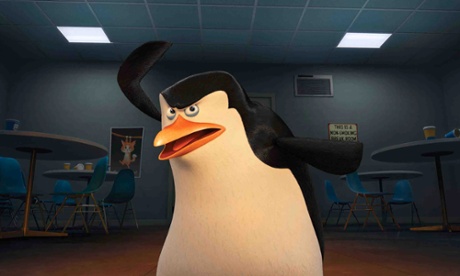
Picking up a penguin was not top priority for American audiences this weekend, with Dreamworks’ Madagascar spin-off debuting at a chilly $25.4m ($36m with Thanksgiving takings included) – despite sheltering under the franchise umbrella and being based on a popular Nickelodeon cartoon. That’s a low for the series, well below the first film’s $47.2m in 2005. Possibly it found itself squeezed between sharper-looking animation Big Hero 6, and the Hunger Games juggernaut, which swept off many of the adults who might otherwise have been attracted by the in-jokey overtures now standard for CGI cartoons (how many kids are going to get a Werner Herzog shoutout?). As emphasised in the trailers, Penguins of Madagascar also follows the global-location itinerary (Venice, Shanghai, New York) demanded of big studio films these days. But it looks unlikely that its real-world passage will leave flames behind it. The early Chinese release ($30m+ and counting) bulks out a sparse-looking initial whip-round ($36.5m overseas this week in 45 territories, compared to Madagascar 3’s $77.2m from 25 in 2012). With plenty left on its rollout – including the UK this week, where Cumberbatch fever (he voices a covert-ops wolf) should win it fans – it should make good on a $132m outlay. But the Madagascar series could be running low on juice.
Loss leaders
The Horrible Bosses franchise looks an even more conspicuous candidate for collecting its belongings and leaving the building after a shaky start for the sequel. A haul of $15.5m Stateside for director Sean Anders (also co-writer on other current top 10 denizen Dumb and Dumber To) is underwhelming, to put it mildly - nearly half of the first’s $28.3m in 2011. Taking $11.3m from 44 international locales is even more disappointing, with even the best results scraping into the medal places (Russia, $1.8m, No 3; UK, $2m, No 4; Germany, $1.1m, No 4; Mexico, $1.1m, No 3). The strange thing is that the second film is an improvement in some ways – more coherently plotted, and featuring snappy editing that shows off the souped-up budget (up $8m to $43m). So what’s gone wrong? I’d lay it at the door of Warners’ garbled marketing, which has failed to freshen up the hashtag immediacy of the original film’s premise: Kevin Spacey, Jennifer Aniston and Colin Farrell playing “psycho”, “maneater” and “tool” respectively. New bosses Christoph Waltz and Chris Pine – the venture-capitalist father-and-son duo in charge of the torment this time – don’t register as succinctly in the sequel. That has trickled down into ineffectual posters and ads that fail to pull the same trick twice: convincing the perpetually online, zero-hours generation currently in their 20s that a comedy starring three men in their late 30s and early 40s is about them.
The rest of the world
After Johnnie To’s recent Don’t Go Breaking My Heart 2, yet another metropolitan love triangle landed high in the Chinese charts (and 7th worldwide) in the shape of Women Who Flirt, directed by Pang Ho-cheung, the Hong Kong veteran responsible for 2010’s lauded Love in a Puff. As well as the $11.5m or so it took around Asia, it also enjoyed an $80,000 snifter in the US, despite reviews taking varying degrees of umbrage with its throwback frivolity. Three places below it in the global rankings, with $8m, is The Best, the Lost – another Chinese film mining another contemporary trope, the halcyon-days 1990s college drama made big business by So Young, which took $114m in 2012.
In top place in France and 14th globally, the ninth Asterix animation, Land of the Gods, opened at $5m, an upwards move for the pigtailed Gallic insurrectionist, here making his first CGI outing, after a $3.4m bow for Asterix and the Vikings in 2006. That still lacks the crucial magic-potion ingredient compared to $20m-ish French debuts for the live-action (and big-budget) Asterix films of recent years. A return of $3.4m for the Korean action comedy Big Match was good for second spot there and 15th in the worldwide list. Lee Jung-jae stars as a mixed martial-arts star forced into a series of real-time hi-tech games in order to save his brother’s life. Who said Hollywood had a monopoly on daft high concepts?
The future
Penguins of Madagascar, Horrible Bosses 2 and Paddington all continue their rollouts next week – the last hoping to prove its mettle on a global stage in the key markets of France, Brazil, Germany and Japan. Ahead of its US opening on 12 December, Ridley Scott’s Moses epic Exodus: Gods and Kings stakes out safe theological ground with early engagements in Catholic countries including Mexico, Spain, Argentina and the Philippines, and also South Korea, whose Christian population is larger than its Buddhist one; Noah followed a similar pattern. Singham star Ajay Devgan leads the line on the $15.3m Indian action comedy Action Jackson, one of Bollywood’s most expensive for 2014 (Shah Rukh Khan’s Happy New Year, at $21m, is reportedly the priciest). Adapted from the Telugu film Dookudu, having seemingly acquired some Kill Bill stylings on the way, Action Jackson is also getting the typical diaspora-oriented overseas release through Eros International. And December blockbuster season began in earnest in China on Tuesday, when the first part of John Woo’s The Crossing pushed off the jetty. Based on the sinking of a Taiwan-bound steamer in 1949, the $49m film has been dubbed the Chinese Titanic. No pressure, then.
Top 10 global box office, 28-30 November
1. The Hunger Games: Mockingjay Part 1, $124m from 87 territories. $480.3m cumulative – 53% international; 47% US
2. Penguins of Madagascar, $61.9m from 45 territories. $99.1m cum – 63.6% int; 36.4% US
3. Interstellar, $60.2m from 65 territories. $542.3m cum – 72.9% int; 27.1% US
4. (New) Horrible Bosses 2 , $26.8m from 43 territories. $34.7m cum – 34.4% int; 65.6% US
5. Big Hero 6, $23.6m from 26 territories. $224.1m cum – 25.4% int; 74.6% US
6. Dumb and Dumber To, $12.7m from 19 territories. $101.2m cum – 28.7% int; 71.3% US
7. (New) Women Who Flirt, $11.6m from five territories – 98.8% int; 1.2% US
8. Fury, $9.5m from 49 territories. $171.7m cum – 52.3% int; 47.7% US
9. (New) Paddington, $9.1m from 3 territories – 100% int
10. (New) The Best, the Lost, $8m from 1 territory – 100% int
• Thanks to Rentrak. Some of this week’s figures are based on estimates; all historical figures unadjusted, unless otherwise stated.