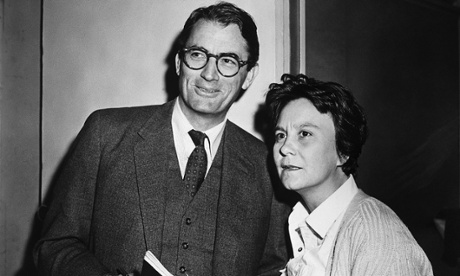
Atticus Finch a racist? What has Harper Lee done by allowing the publication of her original novel, the one from which To Kill a Mockingbird emerged? Anyway, did she really give her permission?
Given the continuing - and maybe never-to-be-resolved - mystery surrounding the circumstances of Go Set a Watchman being published, it’s no wonder that it stoked considerable controversy before anyone even got to read it.
Now that they have, it would appear that the debate is going to get hotter still. To judge from the reviews in today’s UK national newspapers, the critics are largely unimpressed, but also intrigued.
All remark on the central difference: Finch’s transformation from the impeccably liberal figure of Mockingbird to the racist of Watchman, a one-time member of the Ku Klux Klan no less.
Gaby Wood, writing in the Daily Telegraph, notes that “although we may now find him intolerable, and although readers who hold Mockingbird dear may feel betrayed, Atticus’s views are not, in themselves, alarming for their time”.
She praises Harper Lee’s original editor, Tay Hohoff, saying she “deserves a posthumous Pulitzer” because she saw the potential “for a book of Mockingbird’s quality” in the Watchman manuscript - “an act of exceptional perspicacity and optimism”. Wood writes:
“Go Set a Watchman is barely a novel at all. It contains several passages of undigested shouting, of the kind a student might write in a political pamphlet.
The climactic scene, in particular, involves a detailed discussion of states’ rights that will be virtually unintelligible to non-American readers. And it’s bookended, rather half-heartedly, with sentimental scenes designed to obscure this and sell it instead as a love story”.
She thinks the book too “weighed down with literary references” and that the author’s “point of view doesn’t have enough distance for irony.
Compared to Mockingbird, Watchman is “a more anxious book” and its heroine “is more hysterical, and its register less confident”.
Mark Lawson, writing in the Guardian, is also amazed that Lee’s talent was discovered in the pages of Watchman. “It is hard,” he writes, “not to feel some awe at the literary midwives who spotted, in the original conception, the greater literary sibling that existed in embryo.
“If the text now published had been the one released in 1960, it would almost certainly not have achieved the same greatness”.
Lawson thinks the shift in Finch’s attitudes over race is “rooted in the deep political complexities of the south – which New York editors may reasonably have thought too obscure for a broader audience – but their excision significantly altered the story”.
But he argues that Watchman, is “a pleasure, revelation and genuine literary event, akin to the discovery of extra sections from T S Eliot’s The Waste Land or a missing act from Hamlet hinting that the prince may have killed his father”.
Robbie Millen, in the Times, argues that Watchman “is not as polished nor as sharply written” as Mockingbird. “Nor,” he adds, “is it as uplifting, moving or funny”.
But he finds it “more edgy and thought provoking. For all its flaws as a novel, it has a power to it beyond being a mere historical curio or more lit crit material for Harper Lee studies”.
Millen writes: “Despite the occasionally heavy-handed dialogue and a couple of dramatic encounters that fall flat, there is still much to recommend it. Eccentric characters are brightly drawn. There is Lee’s trademark warmth, some droll lines...and the sense of place and time is strong”.
Arifa Akbar, the Independent’s literary editor, says it “is not a finely written story”, reading instead like “a ‘good’ first draft”. However, despite the shifts in narration “and leaden lectures on the southern states’ racial history... it is the more radical, ambitious and politicised of the two novels”.
She believes it to be a “necessary” reassessment of the Mockingbird story and “that we will never be able to read Mockingbird in the same way again” becvaue, of course, we will “never see Atticus in the same light again. It is the end of innocence for that novel, and its simple idealism”.
Finch “personified the intrinsic Christian goodness of the southern white male” and in Watchman that “southern male has turned mean, racist and small-minded”.
Despite the boldness and bravery of its politics, Akbar views Watchman as “a very rough diamond in literary terms... it is a book of enormous literary interest, and questionable literary merit”.
Yet, even with its weaknesses, Watchman’s voice is “beguiling and distinctive, and reminiscent of Mockingbird” and “whatever its failings, Go Set a Watchman can’t be dismissed as literary scraps from Lee’s’ imagination. It has too much integrity for that”.
*Go Set a Watchman will be published tomorrow by William Heinemann (£18.99). To order a copy for the special price of £9.99, click here or call 0330 333 6846. Price valid until 31 July 2015.