KYOTO -- People who could seldom see Kyoto's traditional culture and crafts close-up were able to do so recently through mock job experiences provided by information and telecommunication companies and a local bank.
The operators of the project were eager to convey the charms of traditional industries in the city and bring in new ideas from the outside. Some company heads even took on the role of explaining their business to the visitors.
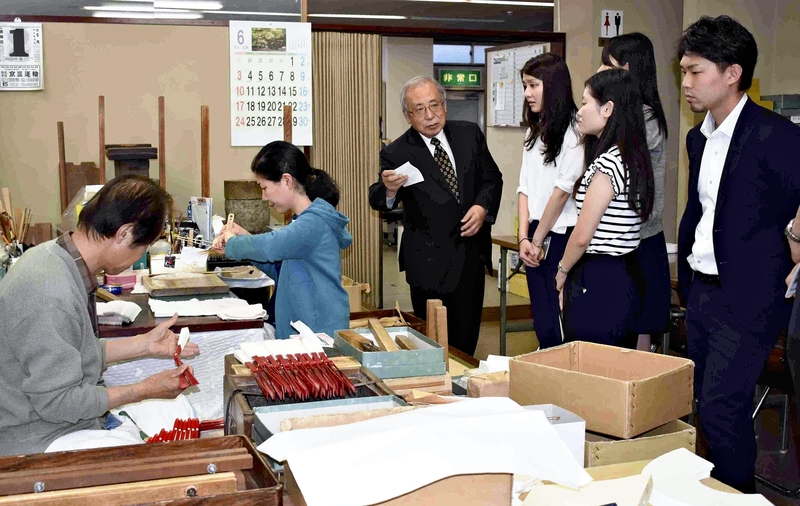
Earlier this month, a group of seven company employees from Tokyo visited Kyosendo, a Kyo-sensu fan manufacturer in Kyoto founded 186 years ago. They were taking part in a mock job experience at the long-established shop.
"Sensu are said to have their origin in the mid-Heian era [794-late 12th century] when people would bind mokkan thin wooden plates together with thread," said Kyosendo President Shunsaku Saiki, 81.
After showing them part of the process of manufacturing fans at a workshop inside the shop, Saiki asked the visitors to propose ideas on how to expand the need for sensu. "How about using them as a cheering tool at a sporting event?" one person said, while another suggested, "Why don't you try to sell them to foreign tourists by becoming affiliated with a hotel?"
Saiki welcomed their ideas.
"It's been a great opportunity to tell them good things about sensu, as the number of people using sensu is decreasing. Some of the ideas they suggested to us were ground-breaking. I'll keep them in mind for future reference."
The project took place from May 21 to June 10, and was jointly conducted by NTT Data Corp. and an information technology company, with cooperation by the Bank of Kyoto. Nine establishments that have business with the bank participated, including some manufacturing and selling Buddhist altar fittings, nenju prayer beads, traditional Japanese candles and sweets, and dashi soup stock. A shopping mall in the city's Nanajo area also took part.
The process of visitors first observing a shop or company and then giving it their views and ideas was a win-win situation for both sides. The companies could promote themselves to the visitors and also benefit from their ideas and proposals for the development of new products and services. The visitors enjoyed the benefit of seeing traditional industries in Kyoto up close.
"Even if you go to Kyoto for sightseeing, you rarely get an opportunity for a firsthand look at a traditional industry there. This kind of project lets you learn more deeply about Kyoto," said a 28-year-old man who took part in the mock job experience at Kyosendo.
Read more from The Japan News at https://japannews.yomiuri.co.jp/