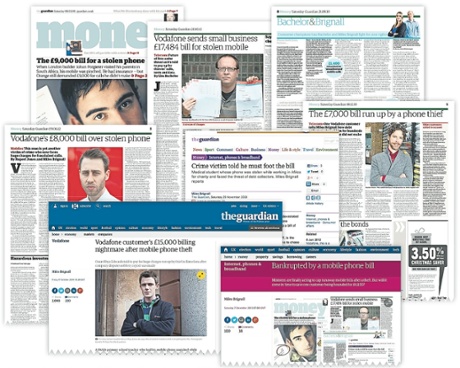
It has been one of the longest Guardian Money campaigns, but finally the government has forced the mobile phone operators to introduce £100 “liability caps” for customers who have their phones stolen by thieves who then run up huge bills.
For at least a decade Money has highlighted how the mobile operators have repeatedly chased their customers for bills – often in excess of £5,000 – following an unreported theft of a handset. While bank customers have a £50 limit on losses following a card theft, mobile operators have held customers liable for all calls made, a stance Money has long felt was unreasonable. Now mobile users are set to enjoy bank card-style limits, at least in part.
Following months of discussions with the Department for Culture, Media & Sport, phone giants EE, O2, Vodafone and Virgin have agreed to introduce a £100 cap for their customers. The measure will come into force between now and September. Rival suppliers Three and Tesco Mobile have already set up similar caps.
The “voluntary” agreement’s introduction ends the operators’ opposition to the scheme that dates back years. In March 2012 the regulator Ofcom gave the companies until that summer to come up with plans to introduce caps on their customers’ monthly bills. At the time Ofcom threatened enforcement action, but the deadline passed with no decision. Consumers are currently liable for all calls made on stolen mobiles until they report the loss to their network provider – irrespective of the circumstances or size of bill – although this has never been tested in court. Thousands have fallen victim to the rule.
In the most recent case in Guardian Money – and a story that sparked worldwide interest – Welsh teacher Osian Rhys Edwards was chased for a £15,000 bill run up by organised criminals. His phone had been taken by a pickpocket in Barcelona last summer and used round the clock to call premium rate numbers. His network, Vodafone, insisted he was liable for all the calls made, and only backed down when a barrister took up his case.
Ministers say the new £100 cap will apply to the 27 million customers on pay-monthly contracts. However, users will have to report the loss to both the network and police within 24 hours for it to apply.
About 300,000 mobiles are stolen every year in the UK, according to the National Mobile Phone Crime Unit. However, critics have already said the move doesn’t go far enough as plenty of victims are often unaware their phone or sim card has been taken – and are therefore unable to report it – but will still be liable.
Five providers have signed up to a new code of practice which also obliges them to provide clear pricing information and alerts when consumers reach data bundle limits and information on how to avoid roaming charges.
Three introduced the cap for its customers in January and the other four main operators have confirmed:
• EE will introduce a cap within weeks;
• O2 is taking the longest time and will only introduce the cap “by September”;
• Virgin will introduce the cap on 1 July;
• Vodafone will introduce the cap this summer.
Ed Vaizey, minister of culture and digital economy, says the agreement will “provide consumers with real benefits as well as offer peace of mind”.
But Richard Lloyd, director of consumer group Which?, says: “This long overdue cap proposed by mobile operators falls short of expectations and won’t do enough to protect consumers facing unfair bills run up by criminals when their phone is lost or stolen.”
Gillian Guy, chief executive of Citizens Advice, says victims of phone crime should not be paying excessive bills run up by thieves. “Citizens Advice has been calling for a cap to be put in place after helping consumers landed with bills as high as £23,000. We will be keeping a close eye on the phone providers’ caps to see if they do really protect phone crime victims from the worst bills.”
Victims who will miss out
The new caps will come too late for the numerous consumers who were threatened with bankruptcy by mobile providers after they failed to report the theft of their phone.
Back in 2003 we reported on the case of Ben Jemison who was landed with a £1,000 bill when his mobile was stolen in Barcelona.
Since then cases have come in thick and fast, and we could have run a similar story every month. In 2008 Orange customer Johan Potgieter set a record of sorts when he was presented with a £9,000 bill after his phone was stolen while in South Africa. Orange later climbed down. It did, however, pursue Asgar Ali from Leicester who was landed with a £5,000 bill after thieves stole his phone in India.
Also in 2008, Three threatened trainee doctor Michael Barker with debt collectors after thieves ran up a £1,500 bill. He had been working as a volunteer at a hospital in an Aids-devastated area of Africa when his sim card was taken from his rucksack. The thieves racked up the charge despite a £75 credit limit on his account. Another victim was Vodafone customer Kaveh Lajmir who was hit with an £8,000 bill in 2012 after thieves struck while he was on holiday in Barcelona.
Last week Money was contacted by Chris Newlove Horton, a low-paid NHS worker. In 2013 we reported how EE/Orange was pursuing him for £4,107. His phone was taken in the UK and used to call Algeria round the clock before he reported it. The debt has been sold on to a firm of debt collectors called Lowell Group, who have offered to halve the bill but are still threatening court action if he doesn’t pay up – money he says he simply doesn’t have.