Motorola Mobility's Fourth Annual Media Engagement Barometer reveals that consumers are watching an enormous amount of video, in some surprising ways, in unexpected places.
The Media Engagement Barometer is an independent global study of video consumption habits among 9,500 consumers in 17 countries. The study looks closely at new and emerging content trends, such as multi-screen habits and recording behaviors, which are dramatically shifting the way audiences are consuming video.
Notably, these trends reveal consumer frustration with the delivery of video content – a prime opportunity for service providers to deliver content experiences in the new multi-screen environment that are free of traditional boundaries and complexity; the experiences that consumers crave.
The study revealed some compelling statistics: • Consumers around the world are watching an average of 25 hours of TV programming and film content a week. That's one day a week watching content!
• Film viewing has risen from 5 to 6 hours. TV viewing is up from 10 hours in 2011 to 19 hours this year
• The living room remains the epicenter of the home content experience, but the multi-screen home is now a reality; the study shows the impact of laptops, tablets and smartphones – on viewing throughout the home.
• Consumers want to be able to move content between devices more easily; 76% would be interested in a service that automatically loaded content a user liked to their mobile phone or tablet, to enjoy when on the move.
One day a week spent watching video content – rise in hours spent viewing content
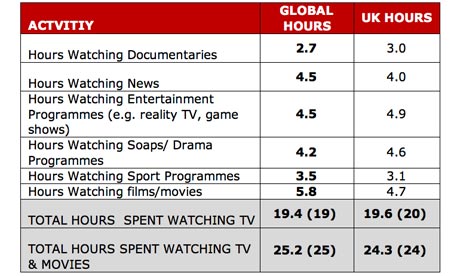
It's not uncommon for people to underestimate how much time they spend watching TV, but this year's study reveals what type of programming people watch in an average week – building an accurate picture of home viewing habits. As you can see from the chart below there are some interesting shifts from the global average to UK behaviours; the UK watches slightly less sport but more entertainment and soaps and dramas:
Multi-screen romance – tablets eclipse broadcast for content in the bedroom
As with other studies, this findings show how laptops, mobiles and tablets are reshaping viewing habits. The living room is the center of home entertainment consumption, but consumers are taking advantage of the ability to watch the content they like in multiple rooms throughout the home, even in unexpected places.
•50% watch broadcast TV in the living room
• Highest in Sweden (81%), the UK (75%) and Australia (68%)
• 36% of consumers globally are watching broadcast TV in the master bedroom, and countries with above-average consumption in the bedroom include Argentina (62%), the U.S. (54%) and Russia (49%).
Smartphones and tablets are driving most multi-room content behaviors – they are watched more than broadcast TV in the bedroom (46% and 41% versus 36%). These portable devices are also used in less-conventional rooms; 10% of tablets are used in the kitchen.
Tablet owners – the hungriest for content
In general, tablet users could be described as 'super users': watching more content on their own terms than non-tablet users.
• On average, tablet owners watch 6.7 hours of movies a week versus the average of 5.5 of non-tablet owners • Tablet users are more likely than non-tablet owners to use a service provider's TV catch-up service (47% versus 31%). 80% of a tablet user's content is recorded, versus 65%.
Content on the move – three quarters would like content loaded onto mobile devices
Consumers across the globe are storing content on devices to watch when away from home – but the study shows this experience could be made easier. Seventy-six percent would be interested in a service that automatically loaded content a user liked to his/her mobile phone or tablet, to enjoy when on the move.
• Currently, 55% have downloaded or stored a TV program or film to at least one device
• 73% of global respondents have a laptop, versus 60% and 26% who own smartphones or tablets
• Majority of U.S. (71%), UAE (79%) and Turkish (85%) respondents would be interested in this service
• Consumers in France, UK and Germany are less favorable to this opportunity, with only 50%, 47% and 41% saying they would be interested in this sort of service.
Younger audiences – more likely to engage with programming via social media
Fifty percent of global consumers do not follow social media conversations about a TV program on a companion device while watching a programme, but younger audiences are more inclined to interact – 60% of 16-24-year-olds do follow social conversations during programming. Some countries revealed year-on-year declines in those following social media conversation online:
• The UK falls from 39% in 2010 to 24% in 2012; the U.S. falls from 32% to 23%
• Increases were seen in Turkey, 44% in 2010 to 55% in 2012; and in the UAE, rising from 60% to 64%
Though it appears the majority do not avidly follow online chatter, people are more likely to use social media channels to recommend content than they are to make oral recommendations (38% versus 34%). The study also shows potential to use social media to further deepen audience interaction and sharing. Seventy-eight percent would be interested in linking their social network profile to a TV service to share what they are watching and increase online, real-time discussion.
The content is provided and controlled by Motorola Mobility. For more information on the study visit here.