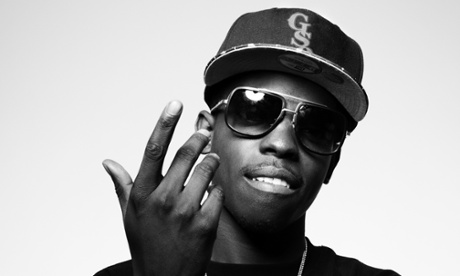
Bobby Shmurda doesn’t want you to judge him at face value. “A lot of people see me and they assume. You should never assume,” he says, moments after strolling into the Guardian US office with a six-strong entourage, dark shades and a gold chain that looks heavier than he does.
“They see me smile and dance, and they think I ain’t been through nothing. I don’t know.”
You can understand why people might think he’s laid-back. Shmurda – real name Ackquille Jean Pollard – is one of this year’s breakout hip-hop stars. He’s just been signed to Epic Records, a division of Sony Music Entertainment, and his track, Hot Nigga, has more than 40m views on YouTube.
Halfway through the video, Shmurda breaks out into a juttering dance – a mix of drunken auntie dancing and street swagger. He says he made it up on the spot, a throwaway moment not meant to make the cut. Only it it did. Within a few days of the video going up, Hot Nigga had been christened “the Shmoney dance”, prompting thousands of imitators on Vine. Everyone from Beyonce and Jay Z to Rihanna and Miami Dolphins wide receiver Brandon Gibson got in on the action. It even got the Jimmy Fallon seal of approval, who invited Shmurda to perform the dance on The Tonight Show.
But Shmurda says it’s not all celebrity shoutouts and six-second viral loops. The contrast between what you see on screen and real life is evident when I ask him what was he doing this time last year. “I don’t know,” he says. “Probably selling crack.” There’s a line in Hot Nigga where Shmurda talks about selling drugs since he was in the fifth grade. I ask him if this is true. He answers by recalling the first time he was arrested. “I was selling on Wilmohr and 98th, but I got locked up … right over by the chicken store.”
There’s a gallows humour to his matter-of-fact depiction of a childhood most of us have only read about in books like Clockers, or seen on television shows like The Wire. When I ask Shmurda to describe his neighbourhood growing up, his go-to reference is New Jack City, Mario Van Peebles’s 1991 film about a sociopathic crack dealer. When we talk about the case of Akai Gurley, who was fatally shot by a police officer in a housing block not far from where Shmurda grew up, he expresses a cynical, seen-it-all-before attitude at the fact the police officer involved got off with a mere suspension.
“Suspended for killing someone. Liteesha!” he says, using his own slang word meaning something is amazing. “Stuff like that influences a lot of people, man. When I see someone getting away with that I think, ‘Why can’t I do that?’”
Shmurda was born in Florida and moved to Brooklyn. He was disruptive at school and lost interest in it before eventually moving into music. He’d come up with his own words for hip-hop tracks, like Young Buck’s Stomp, rapping into cups and play-acting, but he only began taking it seriously a year ago. The first time he knew his music was starting to cut through was when his usually frosty neighbourhood started warming to him.
“My block is a nasty block and when I saw people coming through and screaming ‘That’s him!’ I was thinking ‘What the hell?’” he says. “Then we started getting fans, like actual fans. It was crazy.”
On his latest EP, the gloriously named Shmurda She Wrote – though he claims to have no idea who Jessica Fletcher is – there are boasts about being asked to perform all over the world: London, Paris, Dubai. The problem is he can’t. Shmurda is dealing with a felony gun charge, which means he can’t leave the country. And, although he has another song called Wipe The Case Away, in which he talks about a seemingly magical solicitor who can make his legal woes disappear, it doesn’t look like that will happen anytime soon.
The disconnect between the real world and the rap world is a key tenet of hip-hop’s theatrical appeal, but a fast-moving industry means not being able to build on early success could stymie a career that’s barely even started.
Cautionary tales are everywhere in hip-hop’s recent past. Two years ago, Trinidad James had a huge hit with All Gold Everything. Everyone wanted to do a remix of it, and he eventually signed a record deal with Def Jam rumoured to be worth $2m. Fast forward to 2014, and Trinidad James has been dropped without an album ever being released. In the same year, Chicago drill bellwether Chief Keef released I Don’t Like. It quickly spawned an official Kanye West remix, and Keef eventually signed a deal with Interscope rumoured to be worth $6m. A year later, after releasing one album, he’s also been left high and dry. The similarities between the three artists are obvious: one huge hit that goes viral, pursuit by several labels/artists and then – for James and Keef at least – a tumultuous 18 months topped off by an unceremonious divorce.
But Shmurda is defiant. He’s different, he says. Special.
“I feel like everything I’ve been doing has been the best,” he says. “When you have that type of confidence you don’t worry about anything. I never worried about anything since I was a little kid.”
But it’s not just a similar career trajectory that pairs Shmurda with Chief Keef. It’s his sound. Traditionally, New York rappers embraced boom bap. In the genre’s golden era, between 1988-1993, groups from the east coast laid out a blueprint of slower, sample driven hip-hop that valued flow and lyrics over the faster call-and-response fare of southern styles like trap and the bellicose drill of Chicago. In the 2000s, New York artists such as Nas criticised the southern style, saying the music reinforced negative stereotypes of black people. But Shmurda’s sound has a southern tinge. Hot Nigga was produced by Jahlil Beats, whose most well-known work was for trap godfather TI and Meek Mill. Yet Shmurda isn’t buying the comparison.
“I wouldn’t say that. People say that because we’re both young, we’re both black and we’re both rapping about similar things. We’re too different. We’re two different things,” he says.
We’ll have to wait another year to see whether he’s right.