
BENGALURU: Global capability centres (GCC) now contribute a fifth of India's tech sector revenue. They contributed 19.5% of the $174.3 billion IT revenue in 2019-20, up from 15.9% of the $118.6 billion revenue in 2014-15. Tech sector revenue excludes hardware revenue.
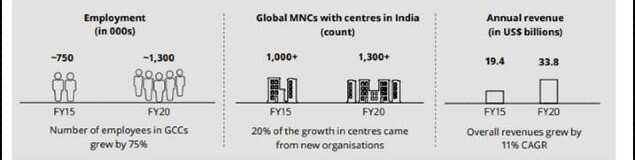
GCCs are the tech and shared services centres of MNCs in India. India has 1,300 GCCs employing 1.3 million. GCC revenue was $19.4 billion in 2015, indicating a revenue CAGR of 11% between then and the 2020 fiscal.
GCC revenue can potentially scale up to $60-$85 billion by 2025, from $33.8 billion in 2019-20, according to a recent report by Deloitte and Nasscom. The $33.8 billion revenue is about 1% of India's GDP.
The India GCC story started with Texas Instruments (TI) setting up an R&D centre in Bengaluru in 1985.
Today, many of the world's biggest companies have centres in India, including Walmart, whose India team has been instrumental in developing Optima, a solution that uses algorithms to generate optimised in-store pick walks for grocery orders.
A number of GCCs today have strategic capabilities in digital and own functional areas to drive business outcomes.
KS Viswanathan, VP of industry initiatives at Nasscom, says there is increased trust in GCC management capabilities today.
“It’s not just a seat at the table but a voice too. The voice of the Indian leadership in GCCs is heard because of the growing trust factor and management capabilities. Many traditional industries are looking at GCCs to redefine their tech blueprint," he says.
What’s worked in India’s favour is the availability of contextually skilled talent working on frontier technologies and a mature operating model.
“Till 2015-16, most of the centres were shared services centres. From then, companies started looking at India as a technology and capability centre – hubs that were augmenting their capabilities in digital technologies. The shared services narrative changed to centres of excellence,” Viswanathan says.
For instance, in the finance function, GCCs have moved from running transactions to housing controllers with increased global ownership.
Lalit Ahuja, founder and CEO of ANSR, a company that has helped many MNCs establish GCCs in India, says Indian GCCs have emerged as efficiently-run global distributed teams complementing their digital strategies.
“GCCs have morphed from having outsourcing footprints to having increased tech intensity, focused on driving innovation and building new business capabilities. GCCs are becoming a national agenda now, and are a priority for all the major states. The pandemic has led to greater focus on digital and technology adoption, and India provides both skill and scale,” he says.
The Deloitte-Nasscom report says India also provides the unique advantage of homogeneity of skilled talent across locations, enabling GCCs to expand operations for risk mitigation and business continuity.
The report estimates an incremental $10-20 billion market through new GCCs that could set up a centre in India. It says the country should brand itself as a global GCC hub, and position itself as a ‘volume + value’ creator. That, combined with Incentives, tax benefits, and clarity on transfer pricing, will help to draw in many more GCCs, the report says.