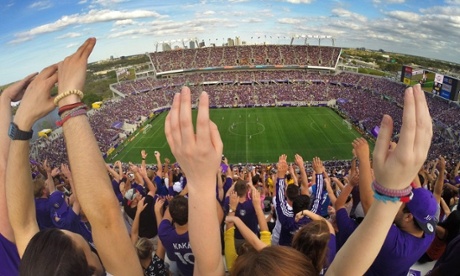
Television is all that separates MLS from becoming the truly major league its name bills it as, or so the commonly repeated rhetoric goes. For all that Stateside soccer has drawn a steep growth curve over the past decade – building state-of-the art venues, expanding to 20 franchises, having the third-highest average attendance of a sports league in the US and generally finding credibility – television is the one barrier the league has left to clear.
Perhaps the new eight-year agreement with ESPN, Fox and Univision – signed last May and reported to be worth a combined $90m – will change that. MLS wants more than just a bolstered revenue stream from its new domestic broadcast deal. Ratings and engagement, rather than attendance figures, are now the yardstick by which the league’s progress is gauged.
The same could now be said for such development outside North America too. On the face of it, MLS’s new four-year deal with Sky Sports – which sees the Rupert Murdoch-owned British broadcaster show at least two regular-season games a week, as well as the All-Star game, every play-off fixture and the MLS Cup final – is little more than just another television deal with just another broadcaster.
But with this new partnership, soccer in North America has gained a degree of legitimacy in the UK, something it has often struggled for. BT Sport – the previous holder of MLS rights in the UK – has made quite the impression since its launch in August 2013, splurging £897m on three years of exclusive Champions League rights from next season, but Sky Sports can be worn as a badge of authenticity by MLS. Imagine a television drama switching from Lifetime to HBO. In sporting terms, that’s what MLS has done in Britain.
Apart from anything else MLS will now be showcased to a bigger audience in the UK, with Sky Sports boasting over 10 million subscribers compared to BT Sport’s 2.5 million. This year’s season-opener between Orlando City and New York City FC drew 36,000 viewers and many more through the broadcaster’s on-demand service. The production value isn’t quite of Super Bowl standard – with nothing more than an announcer and a colour commentator speaking over a centralised feed – but nonetheless, MLS has heightened its visibility in soccer’s hottest hotbed.
“This is another important moment that shows the continued growth of MLS,” said David Beckham - Sky Sports ambassador and MLS cheerleader - in a statement released upon news of the deal’s completion. “I have seen first-hand how popular soccer has become in America. Having fantastic partners such as Sky Sports on board will not only add to the coverage of the game, it will also broaden its appeal outside of the US.”
Disregard Beckham’s glossy, PR-talk and the former LA Galaxy man prompts a pertinent point of discussion. For so long MLS has focused its efforts on growing and developing within its own borders, and understandably so. Globalisation doesn’t work without a key demographic to begin with. But has the time come for MLS to consciously evolve its appeal and image abroad? If so, has such an effort started with its new British broadcast deal?
MLS doesn’t just have increased TV prominence in the UK this season, it also seems to have found its own time slot in Britain’s crowded television sports schedule. On BT Sport, MLS struggled for a regular and consistent time slot. There was no routine behind what Stateside soccer was broadcast on the channel, with only the LA Galaxy and the New York Red Bulls receiving any live coverage during the regular season. On weeks when no live games were shown, MLS fans would have to make do with highlights – sometimes broadcast in the early hours.
Sky Sports too has been somewhat guilty of focusing on the league’s marquee teams – having broadcast all three of New York City FC’s opening games this season, capitalising on any interest sprung from the franchise’s close links with Manchester City – but the same could be said of essentially every division the world over. The exact scheduling might not give a full picture of MLS, but that there is a picture given at all – at a set time, every week – represents progress.
After ‘Super Sunday’ and the Premier League’s weekly dose of afternoon hyperbole, as well as whatever offerings La Liga, Serie A and Ligue 1 has for cultured europhiles, but before the BBC’s Match of the Day 2, is where MLS has positioned itself - at 10pm GMT on Sundays. And it’s not a bad position to be in. British sports fans will watch live soccer, regardless of where it is played, especially when nothing else is on.
So what’s in this new agreement for Sky Sports? Why has MLS been added to a stable which already holds rights for English Premier League, La Liga, Scottish Premiership and Dutch Eredivisie games?
The belief that Brits are unwilling to embrace the ‘Americanisation’ of sport is something of a misconception. Tickets for NFL games at Wembley Stadium sell out within minutes, with the same going for NBA games played at London’s O2 Arena. Even at local level, attendances are burgeoning across the country’s ice hockey and basketball leagues as fans look for the family-friendly, confetti-sprinkled sporting spectacle soccer generally can’t offer.
Sky Sports has translated such an appeal into success with its NFL coverage – which attracted close to 14 million British viewers over the course of last season – and is now counting on the same allure to make a success of MLS in the UK.
At odds with pretty much the rest of the soccer world, scheduling barbs have been angled at MLS ever since the day of its inception as a predominantly summertime pursuit. It is often claimed that implementing a more orthodox calendar – in keeping with Europe and Fifa’s mandatory international dates – would aid the league’s global appeal, and yet the very opposite seems to be true in the case of Sky Sports’ interest in MLS.
Wimbledon and cricket can only fill so much airtime over the British summer – when Europe’s soccer leagues take their off-season break. A cynic would claim MLS has been bought as summertime fodder by Sky Sports, but whether or not that is true should be of little concern to the league. Either way, the league has found more than just a wider audience and a niche market in the UK, but a stamp of approval too.
• This article was amended on 30 November 2015. A reference to Fida has been corrected to Fifa.